
The Wunderkind Who Sailed to the South Seas with Captain Cook
Andrea Wulf explains how the linguist and naturalist George Forster came to join the remarkable voyage of HMS Resolution


Captain James Cook’s circumnavigation of the globe in HMS Resolution is widely regarded as one of the great voyages in modern history. During the voyage the Resolution probed into the high latitudes of the South Pacific and visited islands across the ‘South Seas’.
Today the voyage can be interpreted variously from different perspectives. And one of the most intriguing points of view is that of the young George Forster. A teenager when Cook weighed anchor in 1772, as Andrea Wulf explains, he was a traveller of extraordinary insight and sensitivity.
This piece accompanies the Travels Through Time episode with Andrea Wulf.

An unexpected visit
On the evening of a late spring day in 1772 a Royal Navy surgeon named Charles Irving called at the home of the Prussian naturalist Reinhold Forster in Somerset Stable Yard, central London. There was something ‘mysterious’ in Irving’s behaviour, Forster noticed as the two fell into conversation. It turned out that Irving had been sent to sound the naturalist out. Might he be interested in joining Captain James Cook’s new voyage to the South Seas?
For Reinhold Forster – clever, acerbic, ambitious – this was the very kind of opportunity that he had been awaiting. Perhaps he sensed immediately that this was the chance of a lifetime. But for his son, George, Irving’s offer would turn out to be equally transformative. Still just 17 years old, George Forster had a convivial personality that was quite different to his father’s. He was clever and capable, curious-minded and well-read. Very soon he would become one of the most popular of all the crew on HMS Resolution as Cook embarked on one of the most famous voyages of all.

George Forster
Born, one of seven, near Gdansk in Royal Prussia in 1754, George Forster was just a boy of ten when his father took him on an expedition to Russia. This boyhood experience opened Forster’s eyes to a world that was still at that point largely unknown. Across all the branches of the humanities and sciences there was much to do – from geographical maps to botanical, animal and ethnographic studies.
At this young age Forster displayed real aptitude. He learned languages, in particular, with speed and fluency. Alert to the advantages of having a clever son, his father Reinhold was soon making professional use of him as an assistant.
By the time they moved to London in the mid-1760s it was the boy who had become the family’s main breadwinner. Despite the fact that it was Reinhold’s name that appeared on the title page, his son was the one responsible for translations of books like Louis-Antoine de Bougainville’s A Voyage Around the World.

📚 Previews
The Traveller by Andrea Wulf features in our June 2026 previews. Find out more about the book and explore the full list
While few in Enlightenment London had heard anything of George, by the early 1770s many did know of Reinhold Forster. He was an intense man, a Lutheran pastor who also had a reputation as a travelling surveyor of some learning.
Reinhold, however, was more than this. He had a hot temper, a pomposity and a tendency to think the worst of people. Nevertheless when at the very last minute a vacancy arose for a voyaging naturalist on HMS Resolution in 1772, Reinhold was in the right place at the right time. Irving came to call and he took the opportunity as it presented itself to him. Reinhold was to travel with Captain Cook and George was to come along too.

The Traveller
Andrea Wulf is one of Europe’s pre-eminent biographers. In particular she is known for her 2015 book The Invention of Nature: The Adventures of Alexander von Humboldt the Lost Hero of Science. This year she has returned with her eighth book which is entitled The Traveller: The Revolutionary Life of George Forster and His Search for Humanity. This latest biography has been shortlisted for the UK’s leading non-fiction award, the Baillie Gifford Prize.
Charles Irving’s knock at the door of Somerset Stable Yard in May 1772 happens halfway through this episode of Travels Through Time, in which we explore this ‘hugely catalytic’ year in George Forster’s life. That year begun with Forster hard at work in the study which he shared with his father a short distance from the Strand. Outside there was the incessant hum of London.
Born: 27 November 1754, Nassenhuben
Died: 10 January 1794, Paris, French Republic
Famous work: A Voyage Round the World in His Britannic Majesty's Sloop Resolution (1777)
'Man is neither good nor evil by nature; but the circumstances into which fate places him, from his very earliest beginnings, can make anything of him' – George Forster, quoted as the epigraph to The Traveller by Andrea Wulf
‘It is the centre of one of the world’s largest economies’, Wulf explains. ‘You have to imagine the Thames being completely clogged with the ships that bring tea from China and cotton and tobacco from America and spices from the East Indies’. Every time that George opens the door, she continues, ‘he’s faced with streets that are equally clogged with carriages and carts and people. It is a boisterous, noisy, dirty and frenzied city. I would love to see London in 1772.’
But from this place at the heart of imperial London, Forster was soon transferred to his cabin on HMS Resolution. At just six feet by six this was a tiny space and so much needed to be crammed into it – his bed, his folding chair, his books, his scientific equipment, his mahogany desk which can still be seen in the Captain Cook Memorial Museum in Whitby today.
This might have been cramped, as Wulf points out, but ‘I think it’s probably for the first time his own space’. At the age of 17 he was able to carve out a little independence from his father.
The Resolution Voyage
The voyage that the Forsters were about to participate in was Cook’s second to the Pacific. In the years 1768–71 he had completed his first circumnavigation in the Endeavour, a successful voyage that saw Cook study the Transit of Venus in Tahiti, chart the two islands of New Zealand and then skirt up the eastern coast of what was then called New Holland – today we call it Australia.
This second voyage was intended to build on the accomplishments of the first. In particular Cook had been instructed to search the high latitudes of the Pacific for any sign of a Southern Continent – a mythical landmass about which there had been much speculation. His intention, too, was to investigate the geography of the mid-Pacific, the islands and people of which were only superficially understood in Europe.
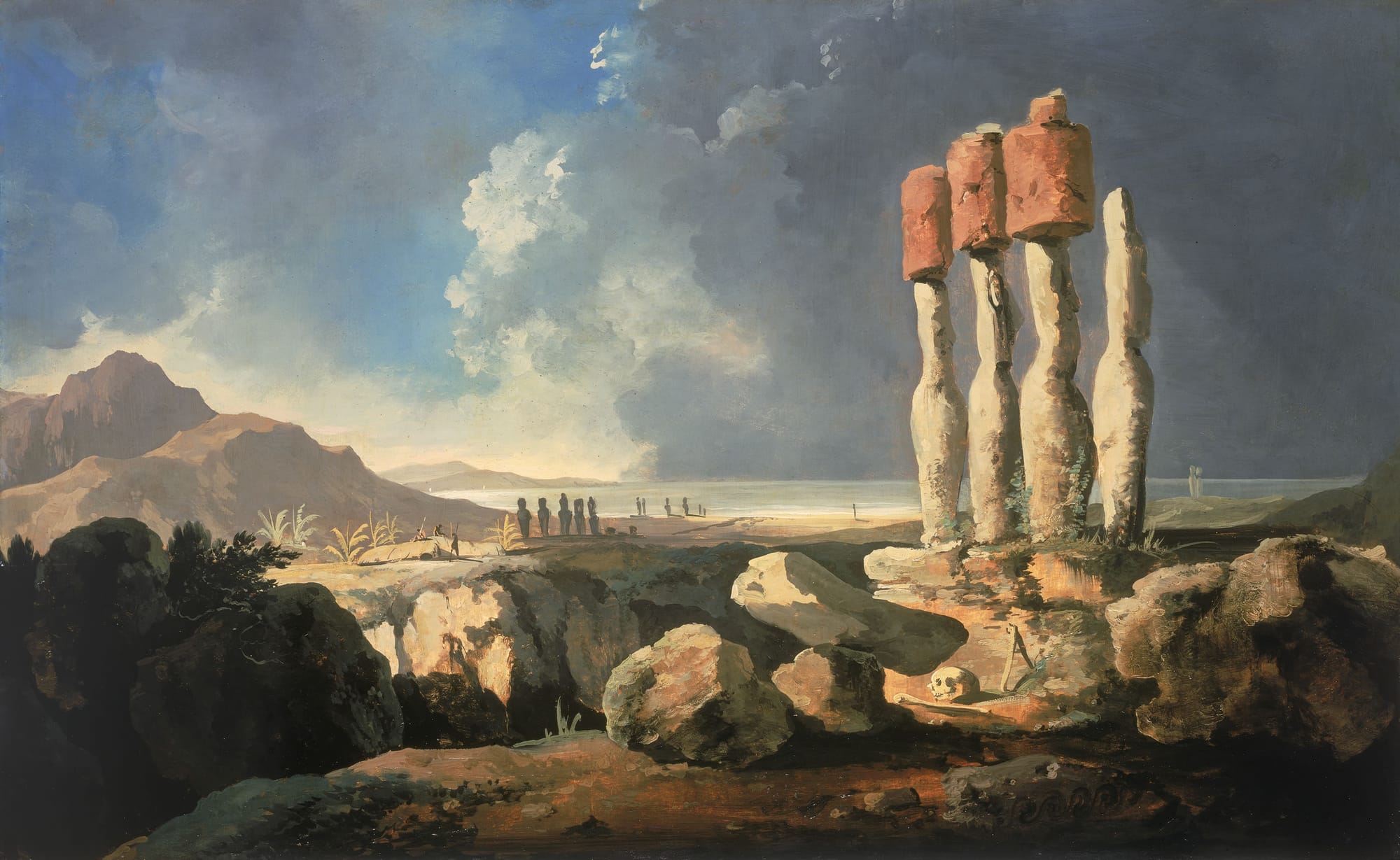
So began what Cook’s great biographer, J.C. Beaglehole, reckoned the greatest of all of Cook’s voyages. It took place between 1772 and 1775 and included great sweeps of the mid-Pacific and deep dives down towards the Antarctic. These were places that hardly any European had seen and, still not yet twenty, George Forster observed them all.
As Wulf describes in this episode of Travels Through Time, Forster emerged from this experience a changed person. He felt a strange and intense empathy for the people that he met on the various islands – from the Polynesians of Tahiti to the Māori of New Zealand. He drew and collected, watched and reasoned, and quite unlike his cantankerous father became a great favourite of the Resolution’s crew.
During this time Forster confronted some of the great questions of the age. How had the people of the Pacific managed to disperse themselves over such a great geographical area? Were they a connected people or entirely separate? How should they be regarded by Europeans? How should their behaviour be judged?
Here Wulf takes us back to the Pacific and to the catalytic encounters that stood at the beginning of one of the great Enlightenment lives. Later Forster would break free from his father’s tyranny and he would become a respected thinker and, after this, a daring revolutionary. But would all this have happened had Charles Irving not come to call on his father in May 1772? Quite possibly not •
The Traveller: The Revolutionary Life of George Forster and His Search for Humanity
Allen Lane, 2 June 2026
RRP: £30 | 512 pages | ISBN: 978-0241711217

George Forster was a man out of time: he journeyed to the far reaches of the known world and challenged the worldviews of eighteenth-century Europe with radical ideas about equality and freedom. Celebrated during his lifetime, he knew Goethe, Benjamin Franklin, Mary Wollstonecraft and Alexander von Humboldt but has since been largely forgotten by history.
The Traveller seeks to restore Forster as one of the great visionaries of his era. At the age of seventeen he joined Captain Cook’s second voyage – an exploration of vast contrasts from the icy world of Antarctica to the tropical islands of the South Pacific. A brilliant mind driven by boundless curiosity, he studied the diverse nature, people and cultures he encountered and came back imbued with a deep belief in the equality of races. On his return he was feted in England, France, Germany and Poland, using his fame to advocate freedom and human rights and argue against empire, racism and slavery. He admired strong and educated women and was proud to have daughters. The book traces how – inspired by the French Revolution – he became a leader of the short-lived Republic of Mainz and was eventually forced into exile in Paris during the Reign of Terror.
Following in Forster’s footsteps from Europe to Tahiti, and drawing on a wealth of correspondence mostly unpublished in English, Andrea Wulf paints a portrait of a remarkable, passionate figure unbound by place, people or establishment. She vividly conveys his extraordinary quest to find what connects us rather than what sets us apart.
Travels Through Time – Andrea Wulf: George Forster on HMS Resolution (1772)
Show Notes
Scene One: January 1772, 2 Somerset Stable Yard, Strand, London.
We catch up with George Forster in London. He is busy with the publication of his translation of Bougainville’s A Voyage Around the World.
Scene Two: 11 July 1772, Plymouth Harbour.
George Forster’s first night on HMS Resolution.
Scene Three: 10 December 1772.
Forster enters the wild ocean. Latitude: 51° 37’ S, Longitude: 25° 28’ E.
📸 Dive into our Features
🎤 Read Interviews
🎧 Listen to Podcasts
🖼️ Buy fine art prints & more at our Store



