
Welcome Aboard the Empire State Express – the ‘Fastest Train on Earth’ (c. 1905)
By the early years of the twentieth century American trains were rivalling those of Britain and France. And, of them all, the Empire State Express was perhaps the greatest.


As the twentieth century dawned, rail companies on both sides of the Atlantic competed to offer the best in speed and style.
Here we look back at the Empire State Express – the pride of the New York Central and Hudson River Railroad.
Words by Peter Moore
Photograph Remastered & Colourised by Jordan Acosta

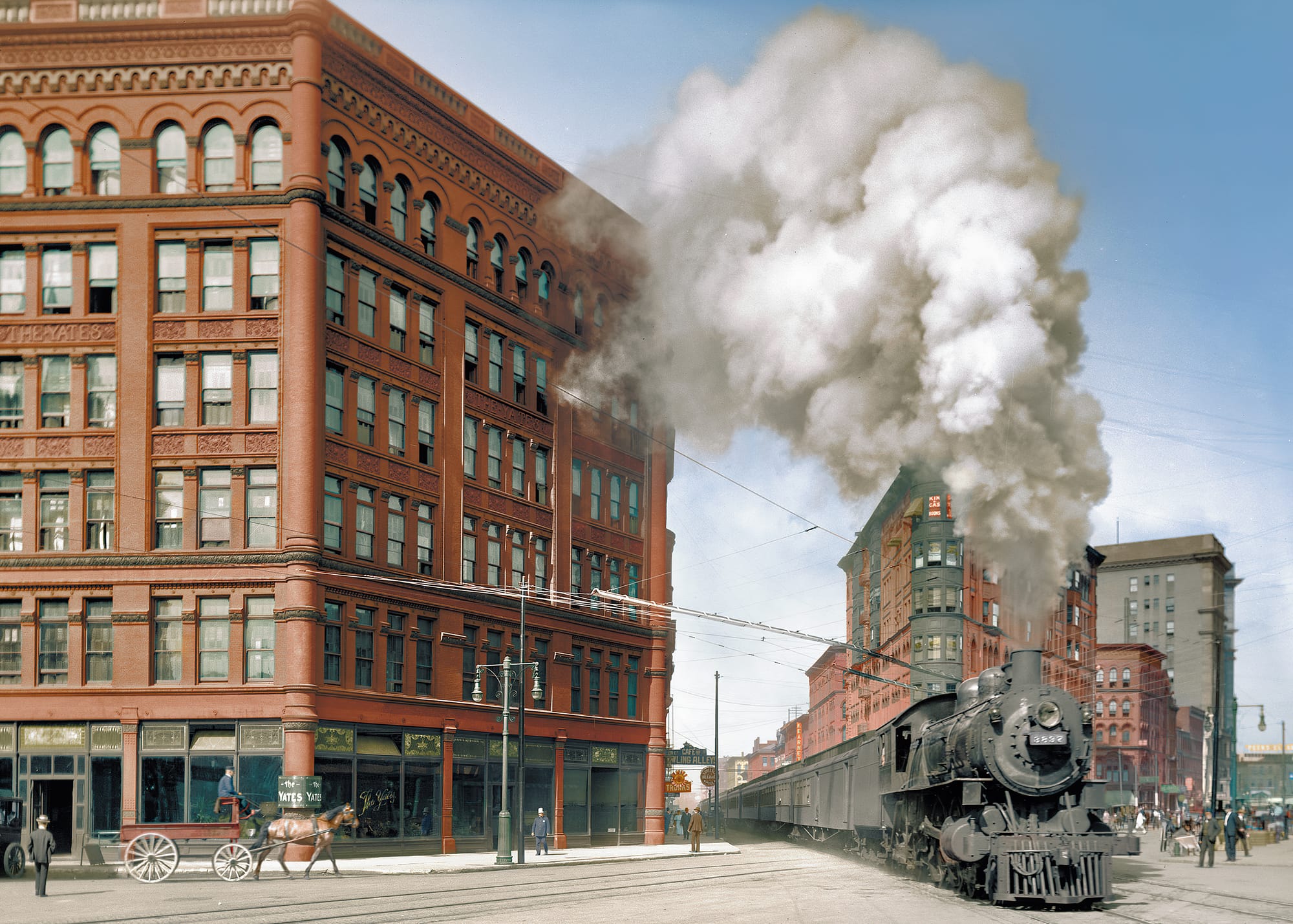
To the modern eye the above photograph of a locomotive steaming through the centre of downtown Syracuse seems completely incongruous. Today railway tracks are fenced off from the public or hidden away in cuttings. Yet here is a huge locomotive – it alone weighed more than 56 tonnes – running like a tram down Washington Street in Syracuse, NY.
No one in the frame seems at all concerned about this. One person has their back turned. Another shoots the train a glance. The only ones to be really taking any interest in the moving train are standing beyond the tracks – and it is possible that they are only waiting for it to pass so they can cross the street.
But one person does have their attention fixed on the scene. The photographer, we can deduce, has been waiting patiently for this moment. They have selected a fine vantage point, looking down Washington Street. It is a bright day, a crucial factor as it allows them to make an exposure fast enough to capture the train in motion. Half a century before, using the cumbersome wet-plate method, this would have been impossible. But in 1905, with the highly sensitised gelatin dry plates, it was something that could be done.
While it was a technical challenge to capture this image of the locomotive, it was a worthwhile one. In these years the railroads were associated with glamour, energy and dynamism. For the Detroit Publishing Company, which distributed this image, the commercial appeal of such a photograph – one that combined a busy American street with a paragon of the latest engineering – was obvious enough.
Looking at it today, the picture is charged with a different kind of narrative power. Here is a world that is being remade by science and technology. And the train in the photograph is no ordinary one. Pictured here is the celebrated 'American Flier', the 'fastest long-distance train in the world': the Empire State Express.
We can now look back at the Empire State Express as a symbol of a nation rising at the beginning of the 'American Century'. But in 1905 fewer people were thinking about that. Far more interesting to them, as she rolled through downtown Syracuse, was how fast she went.

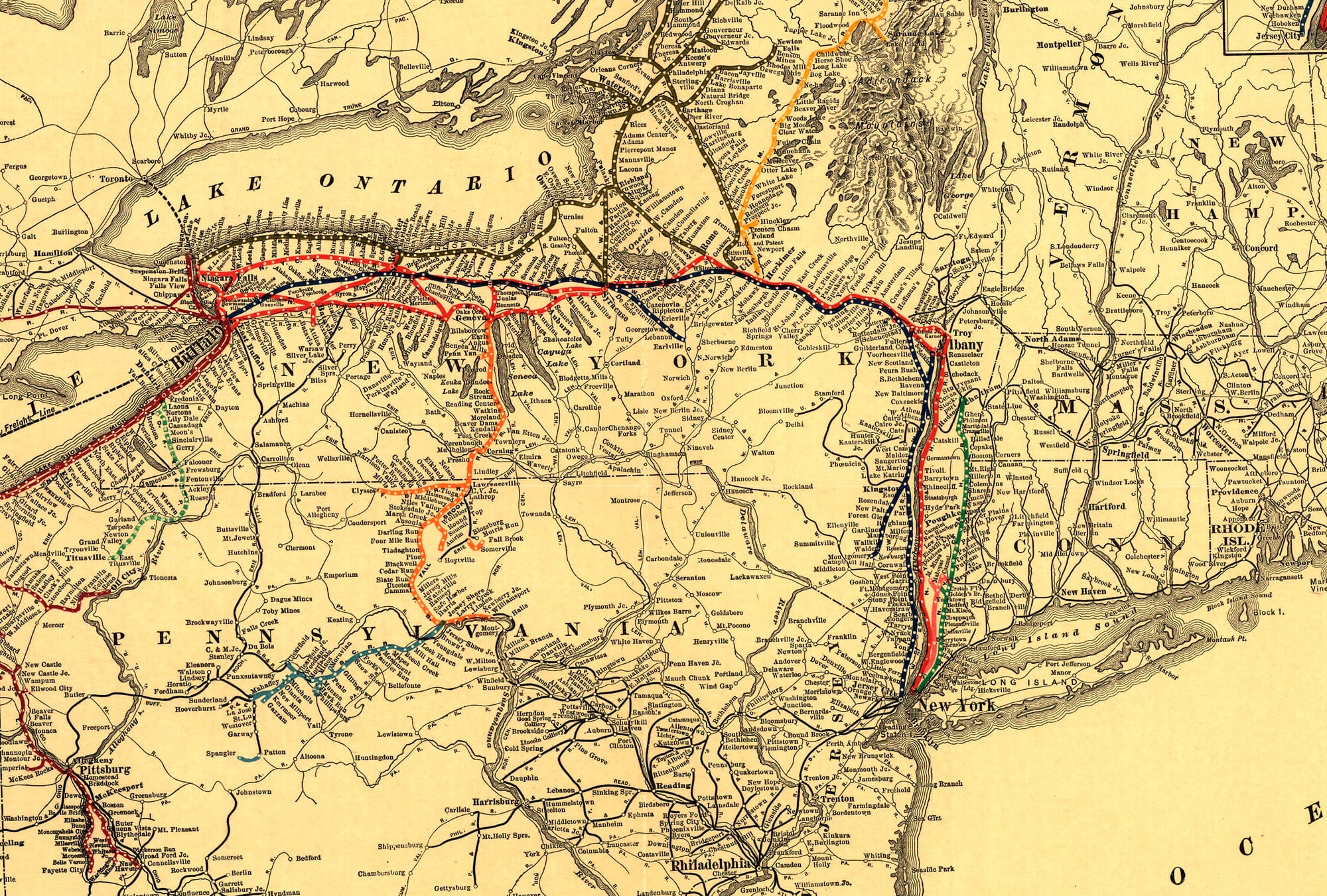
New York Central and Hudson River Railroad
In a nation so vast and one that was growing so quickly, railways were always going to have a special allure. In the second half of the nineteenth century many of the pioneering lines and companies began to merge. It was as part of this process that, in 1869, Cornelius Vanderbilt took control of the Albany–Buffalo line and joined it to his own to create the New York Central and Hudson River Railroad.
Syracuse lay roughly midway along the Albany–Buffalo line and in the years after 1869 the track that ran right through Washington Street brought increasingly large trains and greater numbers of passengers who were shuttling between the Great Lakes and the eastern coast. The journey between New York and Buffalo was 440 miles in all, but it was no longer the daunting prospect it once had been.
But merely covering the distance was no longer the concern of the railway companies. Increasingly they wanted the journey to be comfortable, stylish and fast. To achieve this, in the early 1890s, the Empire State Express was launched. The locomotives that pulled the service were mighty '4-4-0s' with a satin finish of black. Behind them, the finest passenger carriages were likened to a box at an upmarket theatre. They had deep, upholstered armchairs with tasselled bottoms and heavy curtains that could be drawn across to separate one compartment from the next. There was a smoothness to the ride too.
There was no unusual swaying or jolting, and only persons who were looking out for manifestations of extraordinary speed would have noticed that the clickerty-click of the rails sounded like the roar of musketry, and the telegraph poles along the track seemed like pickets in a fence.
New York Times, 12 May 1893
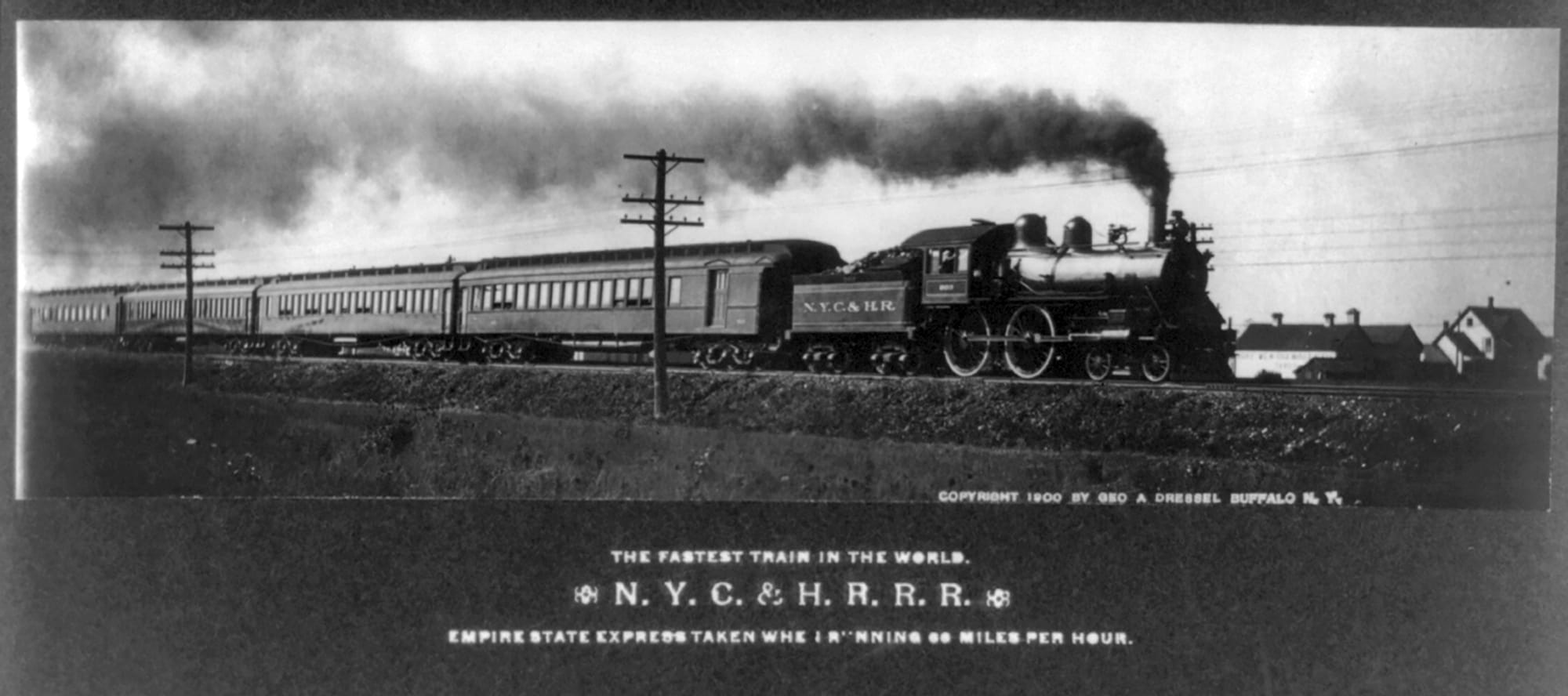
The race for speed
The Empire State Express needed to be impressive because, from 1896, it had competition. From Exchange Place on the Jersey shore passengers could board the ‘Black Diamond Express’, ‘a very heavy and magnificently appointed train’ that ran up the Lehigh Valley Railroad to Buffalo in nine hours.
But, as the directors of the New York Central and Hudson River Railroad may well have reflected, the Empire State Express made the journey half an hour faster than this. And in the opening years of the twentieth century, speed was the quality that people treasured above all.
From the beginning the Empire State Express had a reputation for raw speed. In a pre-launch run in 1891, it flew from Grand Central to Buffalo in a staggering 7 hours 6 minutes – or ‘Over a Mile a Minute’, as the newspapers reported it. Two years later, in May 1893, a thrilling ‘instantaneous photograph’ claimed to show the Empire State Express travelling at a speed of 112.5 mph near Batavia, west of Rochester.
Such reports said something about the improvement in photography as well as rail travel (was it really possible to capture something travelling so fast?) and the news left readers perplexed across the Atlantic. For years the British had considered themselves pre-eminent when it came to railways. But it was undeniable that the Empire State Express was performing impressively.
‘In everything that makes railway travel safe, rapid, and convenient’, reflected a journalist for The Times in 1898, ‘America is the only country which can seriously dispute our English primacy … But to-day, while the quantity of our fast and very fast trains is still quite unmatched in the States, it must be confessed that the quality of the very fastest American trains is such as we cannot pretend to equal.’
This was the kind of sentiment to raise a smile in the executive offices of the New York Central and Hudson River Railroad. Indeed, by the turn of the twentieth century their greatest rival for speed was not a British train at all. Faster than anything the British could manage was France's ‘Sud Express’ that ran on a north/south route between Paris and Madrid.
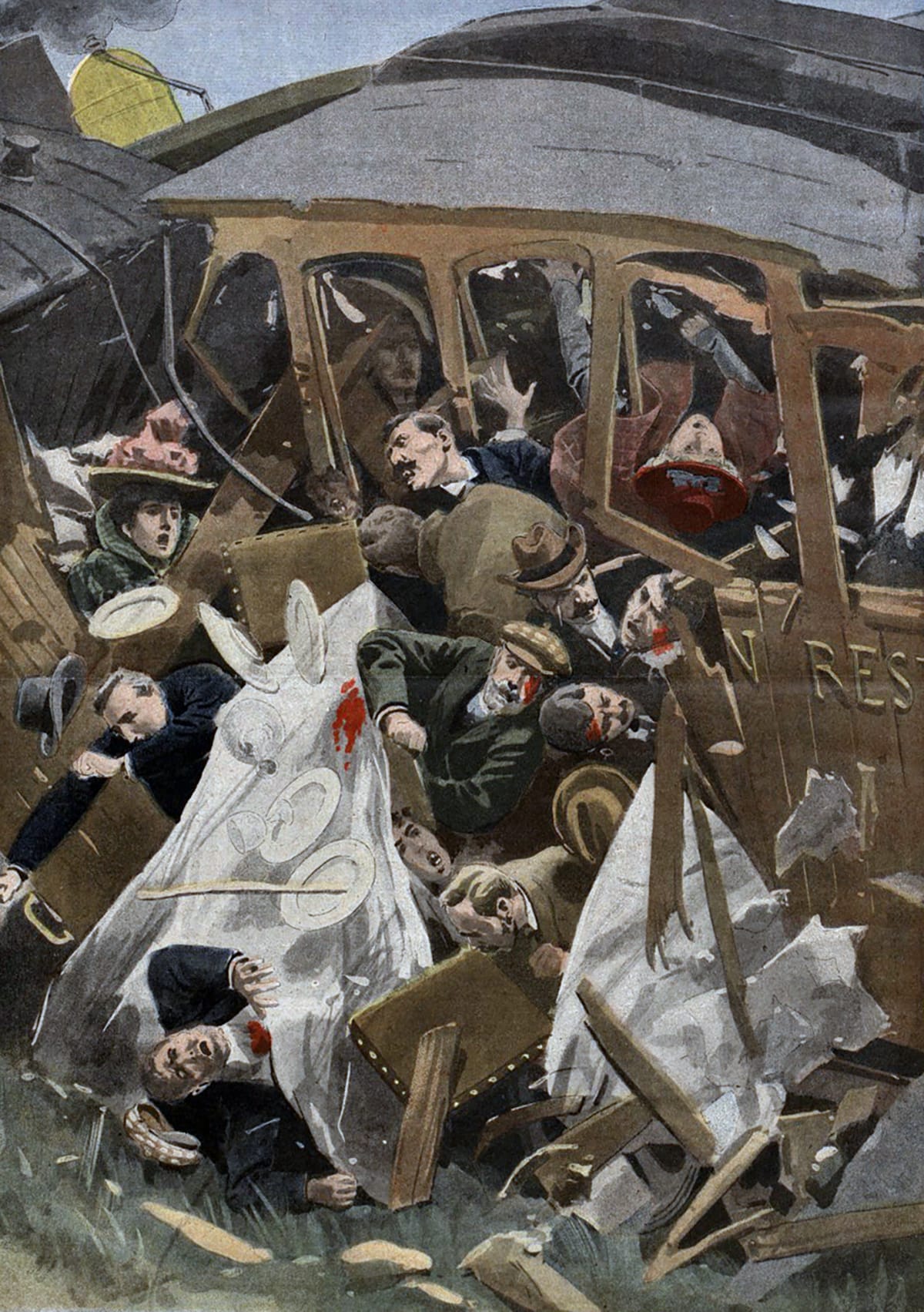
On 15 November 1900 the Sud Express was involved in a terrible derailing, near Bayonne, in which two dozen passengers died. The accident shocked the French authorities and damaged the railway's reputation. It was in the wake of this that journalists began to wonder whether the Empire State Express really was the greatest service on the planet. The management of the New York Central and Hudson River Railroad played on this sentiment, describing it as the ‘fastest regular train on earth’ in their promotional materials.
Whether this was marketing or reality is the subject of debate. According to one newspaper that collected data on all the leading services, in 1906 France's Sud Express retained its position as the 'fastest long-distance train', but the Empire State Express was only a mile an hour or so slower.
In a time of fierce nationalism, this was a matter of great pride. By the time that the photograph was taken in about 1905, everything was being done by those who worked on the Empire State Express to bridge the gap with the French. The change of engines at key stations along the route – Syracuse and Albany – was done in as little as two and a half minutes. To ensure that the trains were not too heavy, passengers were not allowed to carry portmanteaux or heavy trunks; personal luggage, ‘handbags’, were the only items that were permitted.
1st. France's 'Sud Express' on the Paris to Madrid line – average speed 54.2 mph / fastest section 62 mph between Bayonne and Dax
2nd. USA's 'Empire State Express' on the New York Central and Hudson River Railroad to Buffalo – average speed 53.3 mph / fastest section 57.1 mph between Syracuse and Rochester
3rd. UK's 'Night Express' on the East Coast Main Line from King's Cross to Edinburgh – average speed 50.7 mph
4th. USA's 'Black Diamond Express' on the Lehigh Valley Railroad to Buffalo – average speed 49.7 mph
Source: Reading Standard, 28 April 1906
The smooth running of the line was often scuppered by outside factors. Parts could overheat. Sometimes they would break completely. Bad weather posed yet more troubles. The video below, from the Library of Congress, shows how the engineers confronted the challenge of standing water on the tracks.
As well as all this there was the additional threat of criminality in a space that was still lightly policed. In 1892 an infamous episode had taken place when a masked man was discovered by the conductor rifling through the contents of the express car. The incident happened between Syracuse and Rochester and, after the robber drew out a pistol, it developed in dramatic style.
On the train arriving [at the next station] the valuable contents of the safes in the express-car were found strewn all over the van, and the messenger in charge was lying on the floor in a semi-unconscious condition and bleeding from several wounds.
The robber appeared to have escaped, but the train officials soon observed among the crowd on the platform a man whom they suspected, and they at once attempted to seize him. The latter thereupon drawing two revolvers jumped upon the footboard of a goods engine and started on it down the line. The officials quickly went off in pursuit on another locomotive, on the second line of rails and soon overtook the robber, who kept up a popping fire with his revolvers.
Ultimately the man jumped down and tried to escape across country in a horse and cart. A sheriff’s posse, however, was at once organized, and, after an exciting chase, the robber surrendered. He gave his name as William Cross; but is believed to be a noted train robber named Oliver Perry.
St James's Gazette, 22 February 1892
All of this – the steam, the might, the energy, the danger – can be glimpsed in the colourised photograph of the Empire State Express below. With the horse and cart pictured alongside this massive, brutish locomotive, the photograph has something of Turner’s The Fighting Temeraire – a work of art in which the old and new worlds are displayed side by side.
For years after 1905 those who grew up in Syracuse would recall seeing the Empire State and the other expresses rolling along Washington Street. Fred B. Videtto was one. He worked shifts at the Syracuse depot in the late 1920s and remembered that the highlight was always the changing of the engines.
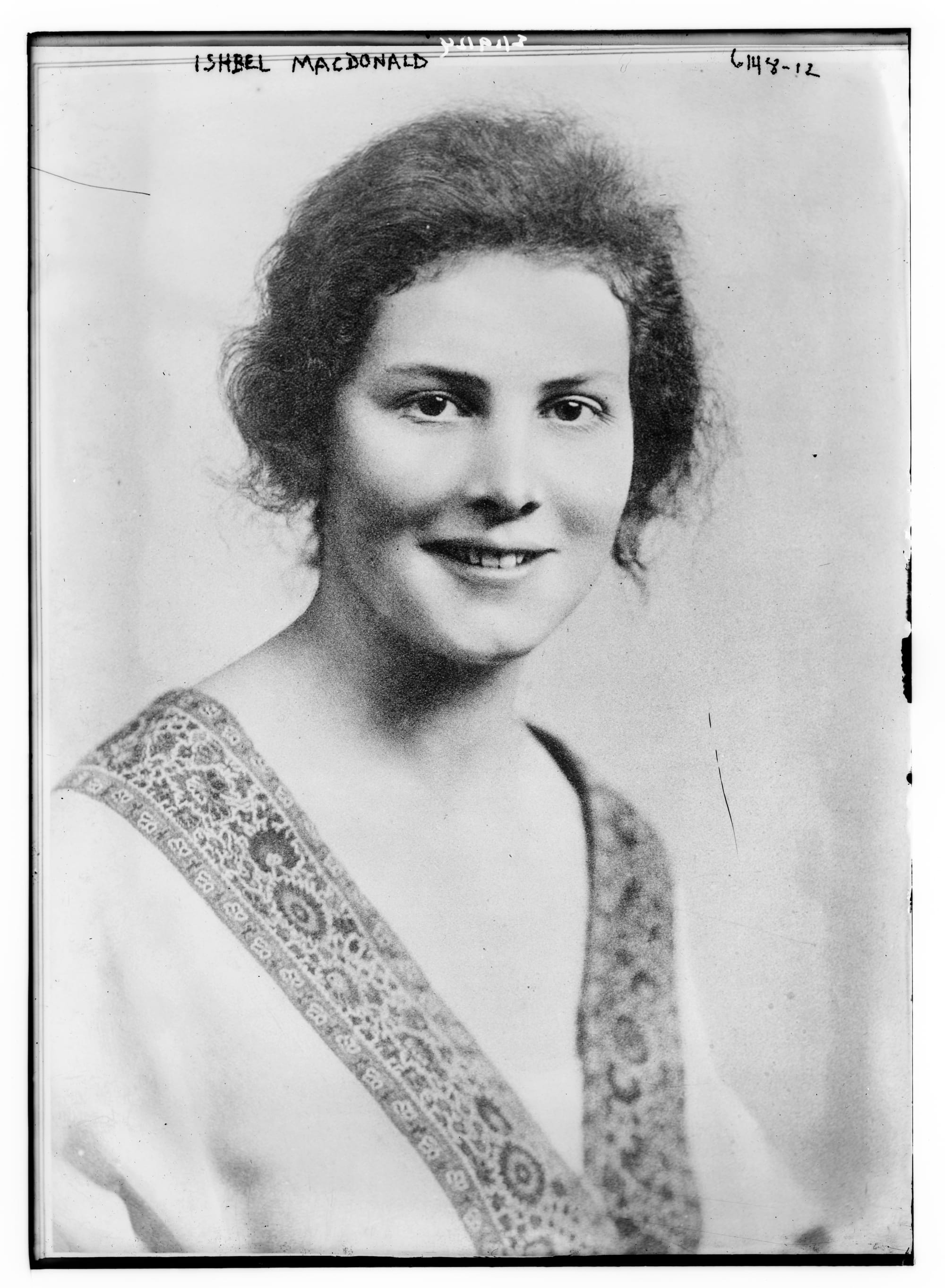
And it was not just Americans who would admire this wonder of engineering. In October 1929 the British prime minister, Ramsay MacDonald, passed through Syracuse on his way to a viewing of Niagara Falls. At the station in Syracuse MacDonald’s daughter Ishbel was invited to come up to the footplate of the engine to enjoy the fastest leg of the journey from the very front.
Ishbel stayed in the cab, the reports explained, for the full 80 miles to Rochester, ‘thoroughly enjoying her novel experience’ •
📸 Dive into our Features
🎤 Read Interviews
🎧 Listen to Podcasts
🖼️ Buy fine art prints & more at our Store


