
‘A Gem of Art’ – The earliest surviving photograph of the US Capitol (c. 1846)
The earliest surviving photographic image of the US Capitol was captured with skill and grace by John Plumbe in the mid-1840s.


As voters in the USA prepare to cast their ballots in next week’s midterm elections, we thought it was the ideal time to look at John Plumbe’s superb daguerreotype of the United States Capitol – that supreme symbol of American democracy.
Words by Peter Moore
Photograph Remastered & Colourised by Jordan Acosta

One day in the mid-1840s a man named John Plumbe hauled his photographic equipment to a carefully chosen location that faced the east front elevation of the US Capitol Building. It was a bluebird day. The sky was fresh and clear. A bright sun illuminated the Aquia Creek sandstone of the Capitol’s walls.
Plumbe had doubtless been waiting for the right day. He had started making daguerreotypes in about the year 1840, having seen another photographer attempting the process that had been pioneered in France. Like the method itself, Plumbe had come to the United States from Europe. He was born in Powys, Wales, in 1809 – the same year as Darwin and Tennyson – and he had migrated with his family as a boy of about 12.


It is easy to admire the composition of Plumbe’s image of the Capitol today. It is all symmetry and proportion with the avenue of trees leading towards the circular pool and then the spreading building with its dome behind. If such a photograph were taken today it would be admired as a harmonious work of art.
But the complexity of the process Plumbe had to work through that day should be recalled. It began with the not insubstantial task of lugging all of his equipment up to this elevated point on Capitol Hill. Surely he had some help to do this given the fact that he needed a tripod, a camera, a covering curtain and all of his plates and chemicals.
Once he was set up and satisfied with the weather conditions, Plumbe could get to work. This began with the buffing of a silver-coated copper plate. Once this was worked out to a high shine it would be placed, facing downwards, into a wooden box that was filled with the chemicals iodine and bromine. These would sensitise the plate, making it ready for the exposure.
From this first chemical box the silver plate would now be transferred to another tray that was slotted into the back of the large-format camera, behind its lens. The exposure could then be made by removing the lens cap for a calculated length of time. As usual with daguerreotypes, this particular exposure was long enough to remove all traces of human life. Only those who stood stock-still, like on Daguerre’s ‘shoe shine shot’, would have a chance of being captured.
Once the cap was replaced the latent plate could be removed from the camera to be developed and then fixed. The first of these involved mercury fumes and the fixing was done with the chemical sodium thiosulfate – although the precise recipe that Plumbe used that day is not known.
What is almost certain, however, is that Plumbe must have been delighted with the exposure when he first held it in his hands. It was precise, detailed, well-lit and enchanting. Surely there were others who had attempted such an obvious photographic subject before, but Plumbe’s plate survives today as the earliest extant view of this magnificent building.
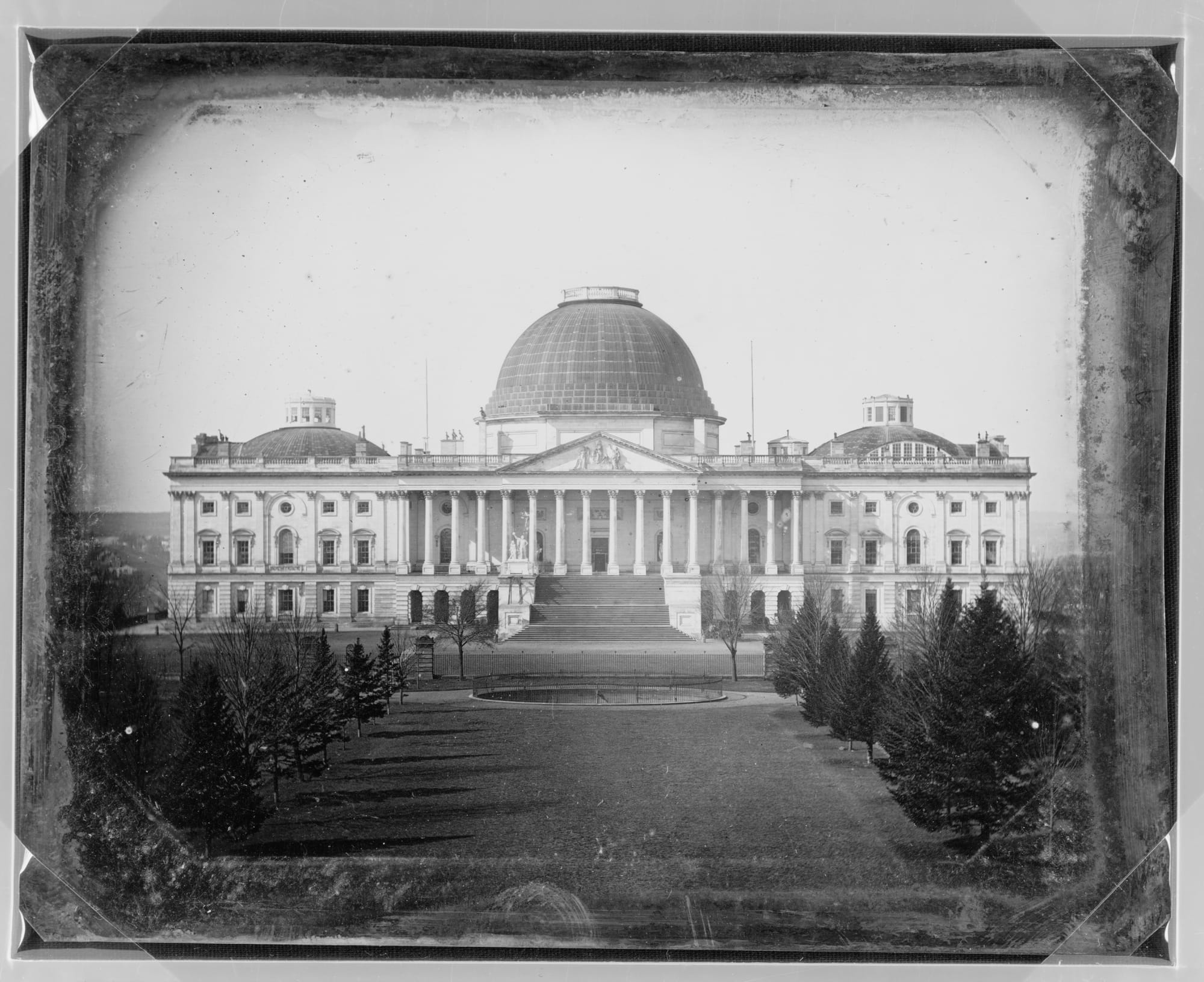
The US Capitol Building
The structure that Plumbe captured in his 1840s daguerreotype is different to the one that we know today. The great dome that today dominates the Washington skyline was only added after the Civil War in the 1860s and, as well as this, the building has undergone all sorts of renovations – from successive rounds of painting (as many as 30 coats) to the recent addition of a Capitol Visitor Center.
But Plumbe’s Capitol of the 1840s was already a storied building. Like many of Washington’s public buildings, it was the product of a design competition in the 1790s. This was won by an amateur called William Thornton who was inspired by the noble but simple architecture that was to be found in Paris. By 1800 the Capitol – a name seemingly bestowed by Thomas Jefferson – was in operation on its location on old ‘Jenkins Hill’ right at the centre of the new city.
Like the President’s House, the Capitol was burned by the British during the War of 1812. It was not fully repaired until 1825 and, distressingly for those involved in this, it was nearly lost for a second time that year in December when a new fire was caused by a neglected candle in the library.

The Capitol was soon after the scene of political drama. On 30 January 1835 President Andrew Jackson was subject to an assassination attempt. This was reported in newspapers across the Atlantic:
On the 30th of January last the funeral of the late Warren R. Davis, of South Carolina, took place at the Capitol, in Washington, according to previous arrangement. An occurrence took place at the end of the ceremony at the Capitol, which can be heard by no one without shuddering.
As the President of the United States, who was present at the ceremony, came into the portico of the Capitol from the Rotunda, a person stepped forward from the crowd into the space in front of the President, and snapped a pistol at him, the percussion cap of which exploded, without igniting the charge!
This person was struck down by a blow from Lieut. Gedney, of the Navy, who happened to be near; he also received a blow promptly aimed at him by Mr. Secretary Woodbury; but, before receiving either blow, he snapped a second pistol at the President. The cap of that lock also exploded without igniting the charge!
The perpetrator of this daring outrage was, of course, immediately seized and taken into custody by the marshal of the district, by whom he was carried to the City-hall, where he underwent an examination before Chief Justice Cranch.
The attacker turned out to be a painter called Richard Lawrence who was found to be insane. He spent the rest of his life in an asylum.
Different types of people could be found at the Capitol by this point. As well as the politicians of the day, and all of their entourage, it was common for inventors to arrive at the building with their various contraptions in hand. A free Black man named Henry Blair was reported to have visited in 1836, with his new ‘corn-planting machine’.
Around the same time a British tourist called Eliza Hulman Butler included a description of the Capitol in an account of her travels to France and America. She reckoned the architecture of the building to be, at once, ‘bold and delicate’. ‘The city is visited by numbers of strangers’, she wrote, ‘for the purpose of contemplating this “gem of art”. It commands a magnificent view of the surrounding country, and from the display and design does much honour to the knowledge and skill of the American architect’.
But Butler did find flaws. The steps and entry doors, she decided, were ‘not sufficiently broad’ – a flaw, she reasoned, that removed it from the very highest league of public buildings. There was beauty at the Capitol, she argued, but it could still not compare with the taste and grandeur of the Cathedral of Notre Dame in Paris with its 116 windows.

As at Notre Dame, there were delights to be discovered inside the Capitol. One that really caught her imagination was the painter John Trumbull’s epic depiction of General George Washington resigning his commission as commander-in-chief at the end of the War of Independence.
Trumbull’s painting depicted something intensely curious. People generally clung to power once they had it. But here was a painting of Washington, inside the rotunda of the Capitol, willingly giving it away. ‘He was a man take him for all in all, they will not look upon his like again’, wrote Butler, paraphrasing Hamlet.
Most Americans, however, then as now, did not pry inside the Capitol. They were instead used to seeing it in all its glory on great occasions like inauguration day. On 4 March 1845, shortly before the time Plumbe’s daguerreotype is thought to have been made, the Capitol was the setting for the installation of James K. Polk as the 11th president. It was a rainy day and one newspaper left a memorable description of the scene behind:
The crowds about the Capitol were enormous: the city was thronged with visitors from all parts of the Union. The rain fell heavily during the day of inauguration. A spectator some distance up the avenue, looking towards the Capitol, could see only a long line of moving umbrellas, terminating at the Capitol, the dome of which towered up like a gigantic umbrella held up by some invisible hand •

Peter Moore is a British historian and writer. He is the author of the Sunday Times bestsellers The Weather Experiment and Endeavour. His latest book is A Dangerous Game, a biography of the naval captain Thomas Cochrane (2026). He teaches creative writing at the University of Oxford and edits the website Unseen Histories.
📸 Dive into our Features
🎤 Read Interviews
🎧 Listen to Podcasts
🖼️ Buy fine art prints & more at our Store


