
On Ocean Beach Beside the Cliff House Hotel in San Francisco (1902)
The Cliff House Hotel in San Francisco overlooked Ocean Beach – a place that drew crowds in hot weather. This colourised photograph shows people taking a 'sun bath'.


As we swelter through the latest summer heat wave, many of us are dreaming of that timeless escape: a refreshing dash to the beach.
But beach culture has developed sharply over the past century. To look at the above photograph is to see a very different scene from one that we might find at Bondi or Venice Beach today.
Here, in front of the Cliff House Hotel in San Francisco in 1902, the beach-goers wear hats and suits. It is unlikely that any of them would ever have heard the word 'sunbathing'.
Words by Peter Moore
Photographs Remastered and Colourised by Jordan Acosta

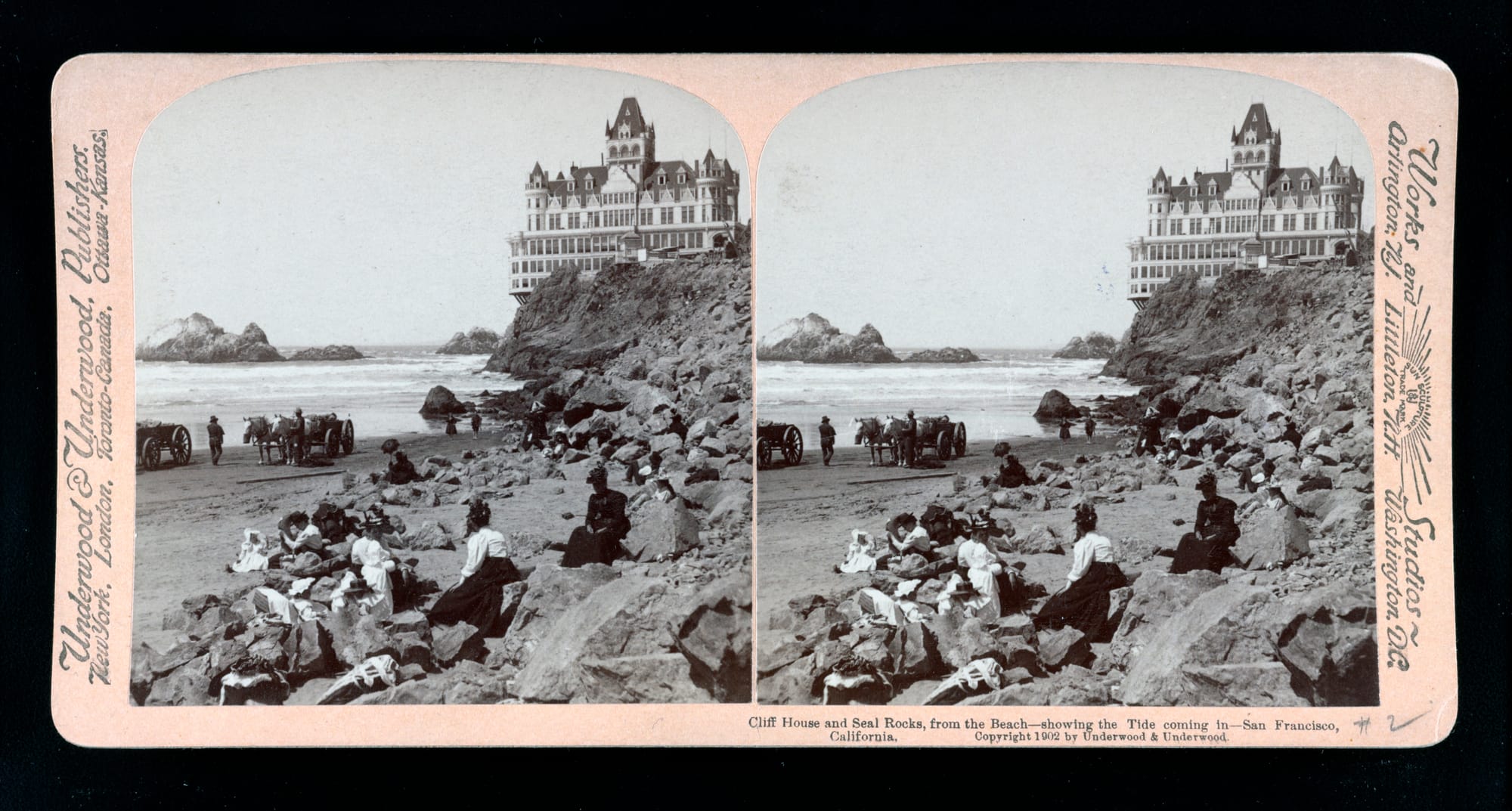
‘I do not know anything more delightful than to lie on the beach in the sun, and watch the rising waves, while a thousand vague ideas pass over the mind, like the summer clouds over the water’, wrote Robert Southey to a friend in 1796.
This was the kind of sentiment that would have appealed to the American poet Walt Whitman. Half a century or so later, shortly after the publication of his collection Leaves of Grass (1855), Whitman was discovered on the sands of Long Island by an admirer, ‘stretched on his back on the shore, gazing up at the burning luminary’.
The heat being fierce, this admirer asked Whitman whether ‘he did not find it rather hot?’ – ‘Not at all hot’, came the response. He liked, Whitman explained, to ‘drink the sun-rays in at every pore’.
What Whitman was partaking in, as nineteenth century readers would have understood it, was a ‘sun bath’. For us today this phrase seems off-kilter. But ‘sunbathing’ – the ‘exposure of the naked body to the direct rays of the sun’ only took off as a verb in the 1930s.
The 'sun bath' can be recalled as a little different to 'sunbathing'. Like the vapour baths of the Regency Age. it had much more of a medical essence. As Pearson’s Weekly in 1892 explained it:
One of the greatest cures is the simple sun bath, which very few people appreciate. The solar heat gives to the whole system a strength and vigour which no nourishing food can impart. It is so essential to our health and happiness that when it is taken away from us we become weak, puny and pale.
This period video shows the other activities people got up to on the early twentieth century beach. As well as the predominance of clothing another striking fact is the almost total absence of any beach furniture. There is the odd wooden chair but nothing else. Most people simply sit on the sand.
I have joined their ranks, and find bathing from the beach most enjoyable. From my neighbors I have learned the luxury of a sun-bath before entering the water, and a sand bath afterwards. The entire operation takes time, but it furnishes a pleasant occupation each morning. – Morning Leader, 24 July 1902
The below colourised image of the Cliff House Hotel in San Francisco was taken on the same stretch of shoreline as the video. It also powerfully captures a time before twentieth century culture colonised the beach. Interestingly the well-known Cliff House Hotel stands in the background as a symbol of leisure time – a suggestion of a time to come.
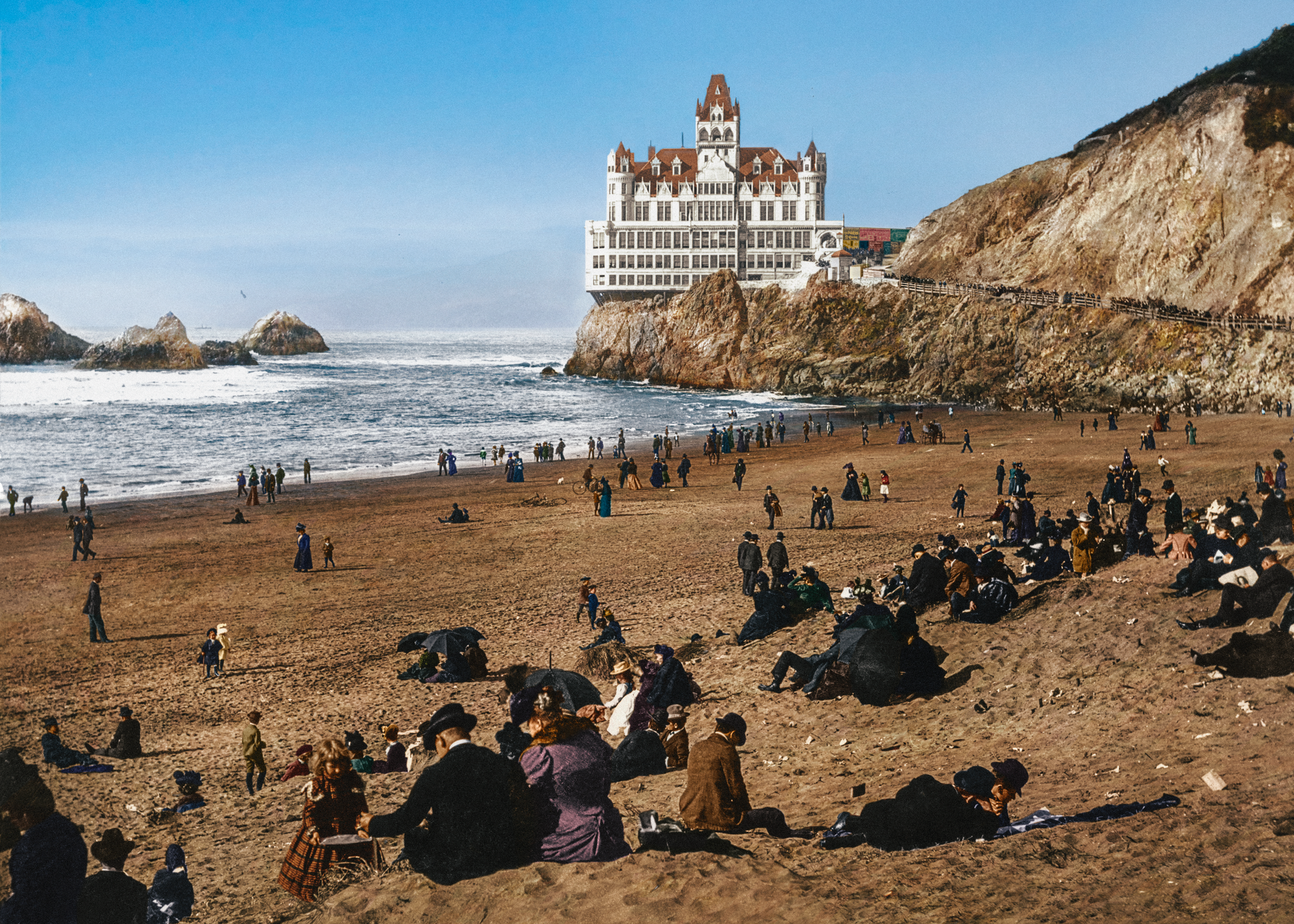
The Cliff House Hotel with its fresh white paintwork and rows of floor-to-ceiling windows that you can see in the photograph is the third incarnation of the hotel that stood over Ocean Beach in San Francisco. Commanding views over what was previously a perilous bay, infamous for shipwrecks, it was built by the engineer Adolph Sutro and it would survive the 1906 Earthquake that destroyed so much of the city.
Cliff House was at this moment regarded as a magnificent building with handsomely proportioned and richly furnished rooms. It had bedrooms, parlours, dining and billiard rooms and observatories that all overlooked the sea. Sadly it would be lost to fire the year after the earthquake.
But for the social historian it is the characters in the foreground that hold the most fascination. The day cannot be as sweltering as that in which Walt Whitman was disturbed, for there they sit in dark-coloured coats and hats. There’s scarcely an inch of skin on display.
Everyone seems to be lost in thought, just like Whitman in Long Island five decades before. No one seems to have noticed, or to have been troubled, by the photographer who has set a tripod up on the rim of the beach, framing the Cliff House Hotel and Seal Rocks and making an exposure •
More
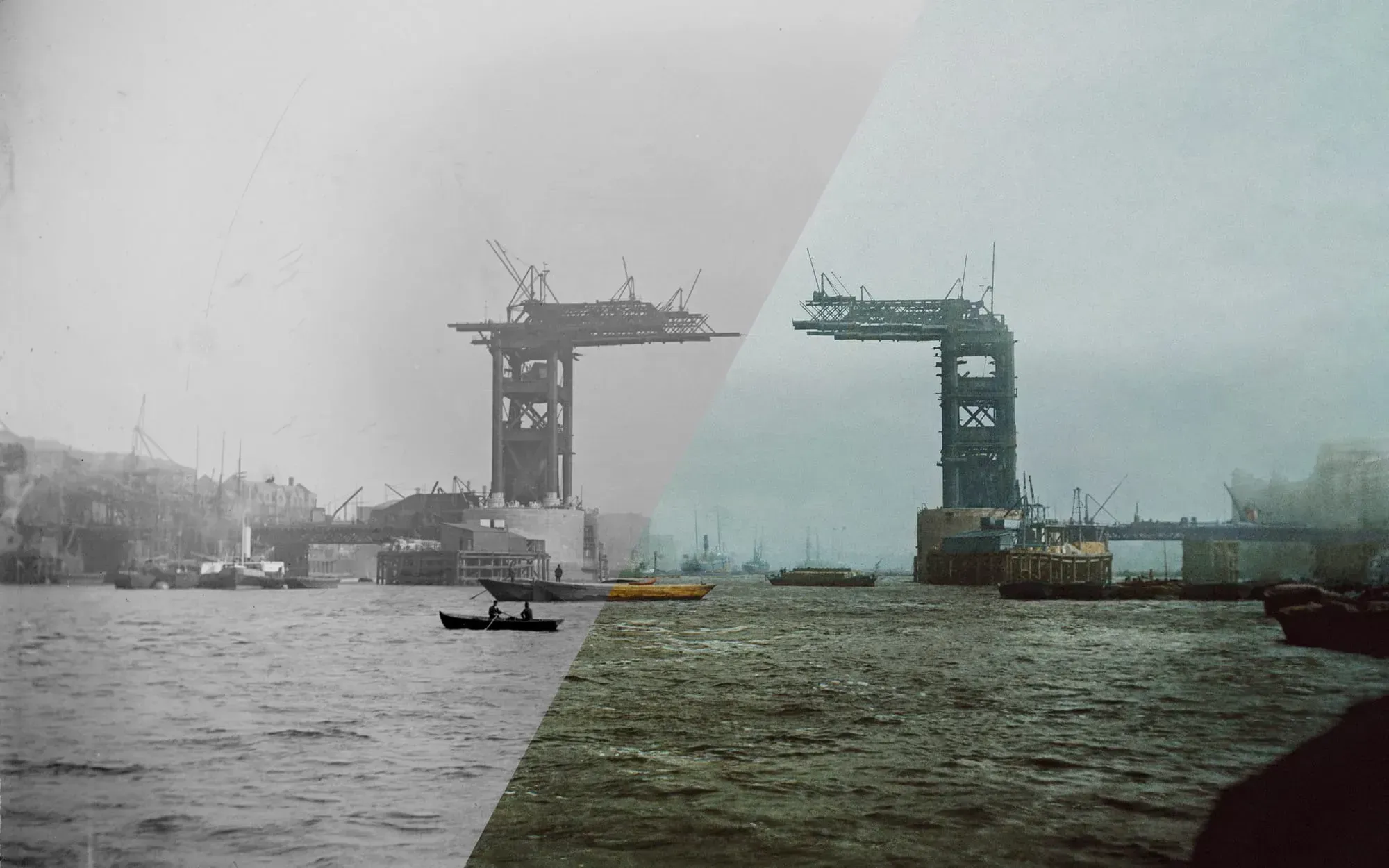
Building Tower Bridge in London (1892)
At the end of the nineteenth century the gaunt arms of an engineering wonder stretched across the River Thames
📸 Dive into our Features
🎤 Read Interviews
🎧 Listen to Podcasts
🖼️ Buy fine art prints & more at our Store


