
The Wold Newton Meteorite (1795)
With a boom like the sound of a cannon, a meteorite flew through the Yorkshire sky on a December day in 1795.


In December 1795 an extraordinary stone was seen travelling between the clouds on the Yorkshire coast. When it fell to earth it narrowly missed an agricultural labourer and it left behind a series of perplexing questions.

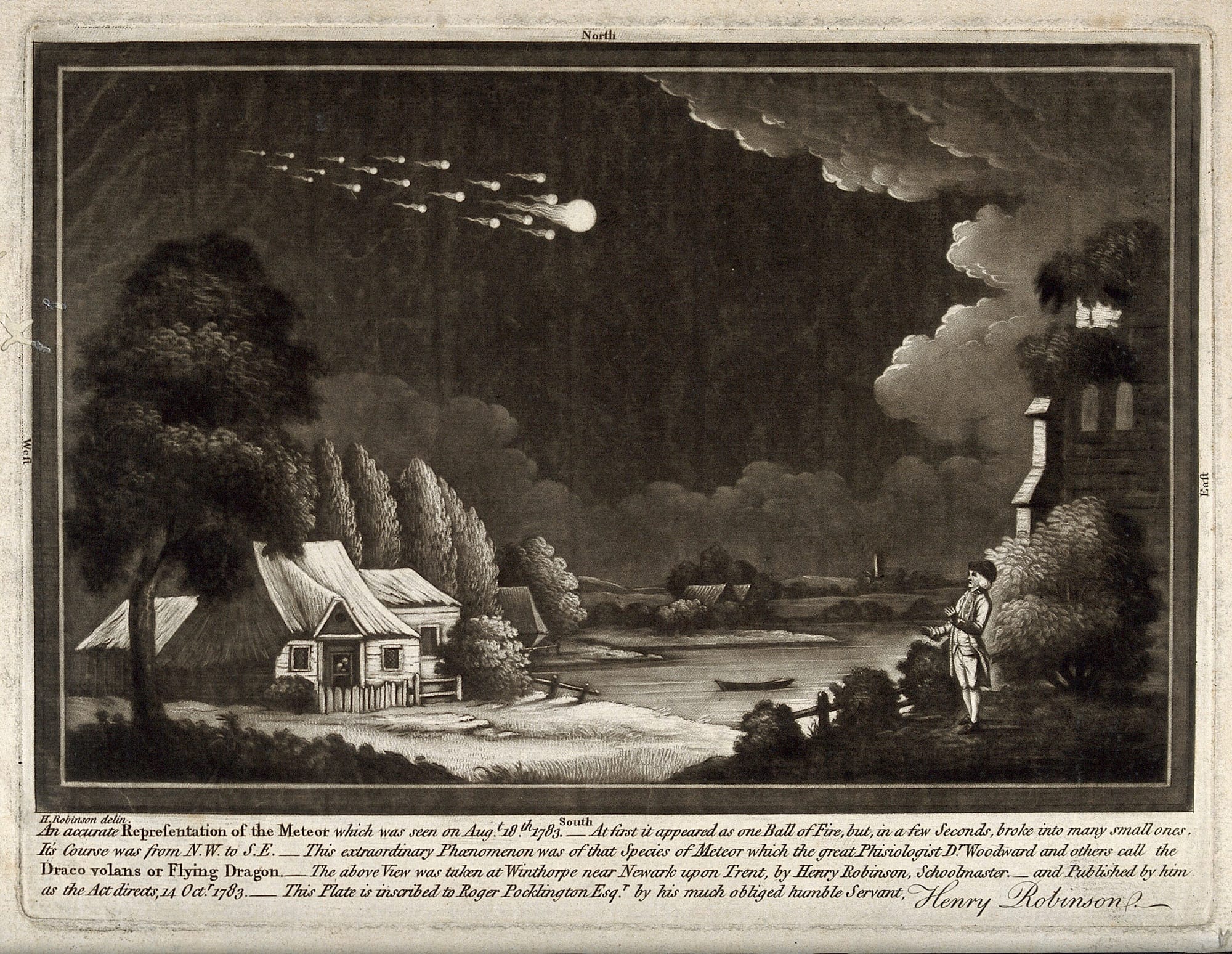
At about 3 p.m., on Sunday 13 December 1795, a strange object was seen hurtling through the air near Bridlington on the Yorkshire coast. It was travelling fast towards the north-west and those who did catch sight of it as it flew through the clouds could not ‘ascertain what it was’.
Those who caught sight of this ‘strange Phenomenon’ were said to be ‘very much terrified’. There were others, though, who did not see it but distinctly heard two noises – with about 30 seconds between each – that were said to resemble the discharge of a cannon. Others spoke of a rumbling in the sky, which they heard ‘accurately and distinctly’ as the object raced through the clouds in the direction of Wold Newton.
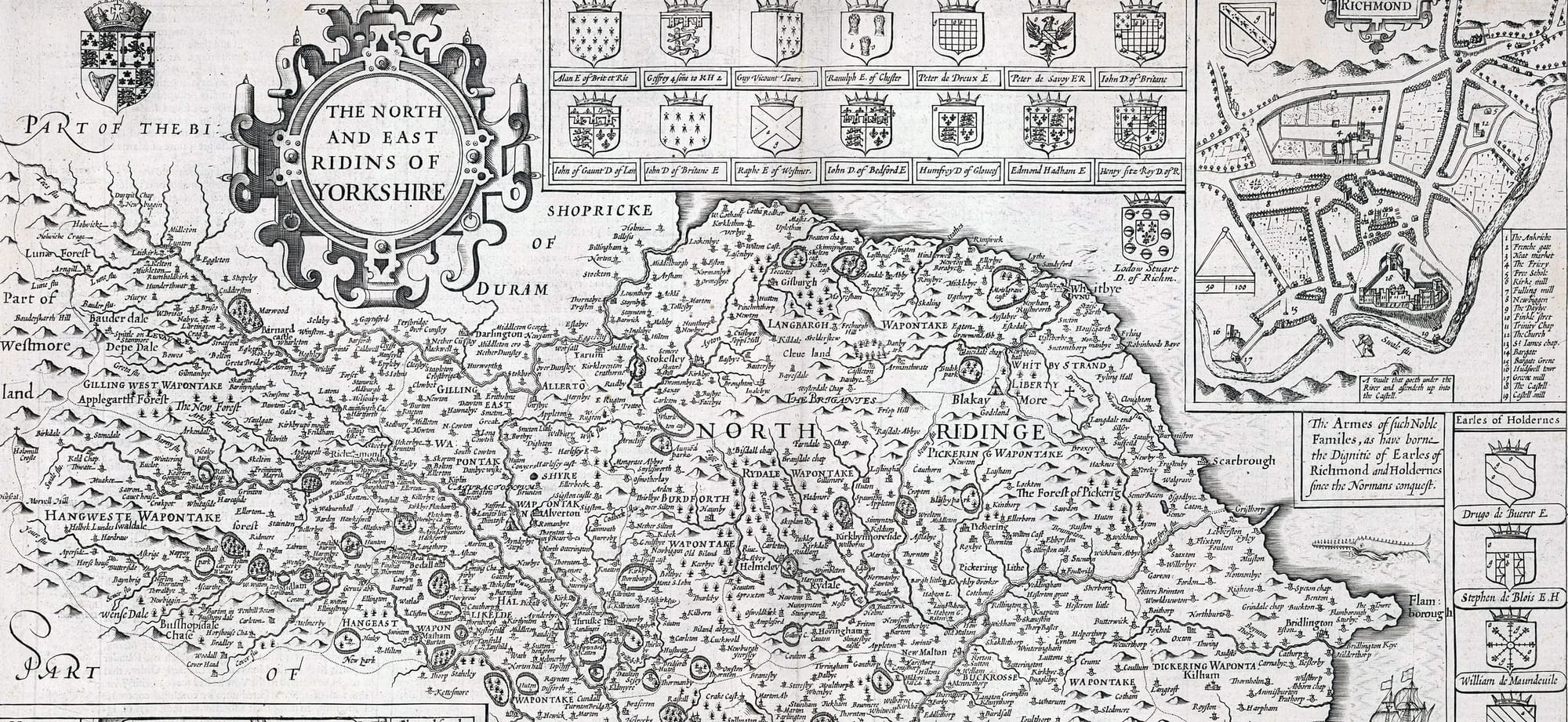
There, about 10 miles inland, on the chalky hills that rose over the sea coast, the stone was seen by the two sons of the parish clergyman. They watched as it lost altitude and collided with the earth in a field belonging to Captain Edward Topham, a local magistrate and member of the gentry. They set off immediately to see ‘if anything extraordinary had happened’.
It was a mild and hazy December afternoon, ‘a sort of weather very frequent on the Wold Hills, when there are no winds or storms’. As such it had been a typical December day for three men who happened to be working in a field a short distance away from Captain Topham’s villa. All three were alarmed by the sound of the crash, which was shortly afterwards described as being like ‘an explosion’.
The closest to the impact site was a labourer called John Shipley. He was just yards away from the place where the stone slammed into the ground – so near that he was splattered with mud and earth. ‘In burying itself in the earth’, one report declared, ‘it threw up a greater quantity of soil by far than a shell would have flung up, and to a much greater extent’.
‘When the labourer had recovered from the extreme alarm into which the descent of such a stone had thrown him’, the report went on, ‘his first description was, “That the clouds opened as it fell, and he thought heaven and earth were coming together!”’
One of Topham’s carpenters, George Sawden, was only 60 yards away and the third who saw the crash was his shepherd. This shepherd's account would be published in newspapers across Britain over the weeks that followed. He asserted that his eye was caught by a ‘sudden and unexpected flash’ that was ‘accompanied by instant thunder’. He ‘looked up at the dark part of the cloud, from whence he actually saw a large stone fall, which pitched very near him’.
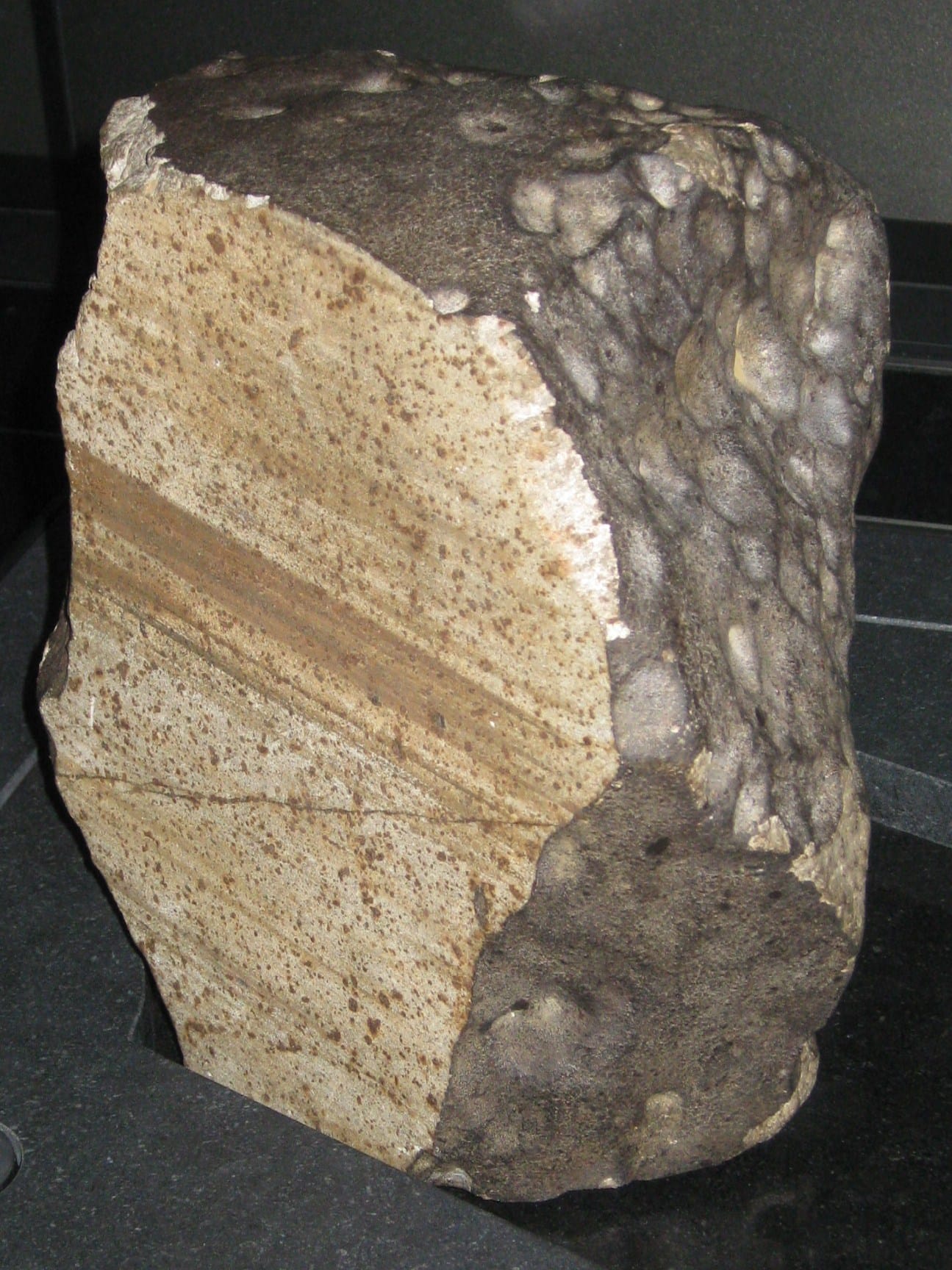
Recovering from their shock, these three men were the first to inspect the stone. It was warm to the touch, the outside was very black and it smelt strongly of sulphur. It was jagged and irregular and it took a great deal of effort to dislodge it from the chalky landscape. It was taken up to the house, Wold Cottage, and all the neighbouring gentry came to view it over the days that followed.
Captain Topham himself, the proprietor of Wold Cottage, was away in London at the time of the strike. As such he read the extraordinary reports in the provincial newspapers like everyone else. ‘On my return here’, he explained, in a letter that was printed in the papers, ‘I found that for a space of nearly three weeks thirty or forty persons on each day had come to see the stone that had fallen; & I found likewise a number of letters from different parts of the kingdom requesting me to give them an account of the circumstance’.
Topham was a magistrate, an educated man with a precise, tidy mind. He took measurements of the impact site, which was about a yard or so in diameter. The stone, he ascertained, had penetrated the earth for a full 19 inches – through 12 inches of soil and seven of chalk rock.
Inside Wold Cottage more investigations continued. When it was struck with a hammer it rang like limestone. The particles inside shone. It was entirely different to the types of stones that were known across Yorkshire – with the appearance of lava and the scent of brimstone. When Topham placed the stone on one of John Joseph Merlin’s weighing machines, it registered three stone 13 pounds – 55 pounds in all. (Although he would later add on another pound – perhaps accounting for all the bits that had been chipped off.)
‘I felt so desirous of giving this matter every degree of authenticity,’ he later wrote, that, in his capacity as a local magistrate, he took witness statements from all three men ‘immediately’ and ‘on oath’. As he did so, Topham was clearly pondering the obvious question. What was this and where did it come from?
These were perplexing questions. Topham himself worked through the possibilities:
We have no such stone in the country. There has not been any where in these parts any eruption from the earth. From its jagged and irregular form, it cannot have come from any building; and as the day was not tempestuous, it does not seem probable that it can have been forced from any works, the nearest of which are those of Flamborough Head a distance of twelve miles.
‘Some people suppose it has been done by art’, explained an article in the local newspaper, the Hull Advertiser, ‘but most thinks it to be a Phenomenon’.
At the end of January 1796 a poem was published in the Staffordshire Advertiser, addressed to the ‘three Worthies, who lately saw a stone 55 pounds in weight, fall from the Clouds, near Wold Cottage in Yorkshire':
January 1796
No doubt, my good friends, the stone came from the moon,
Philosophers think there are stones in that orb,
Sure no man will say it was strange you should swoon;
’Twas enough, I confess, all your brains to absorb.
What a privilege ’twas you so near should have been,
More happy than we who were warm in our beds;
But however glad such a sight to have seen,
’Twas a lucky escape, you’ll allow, for your heads.
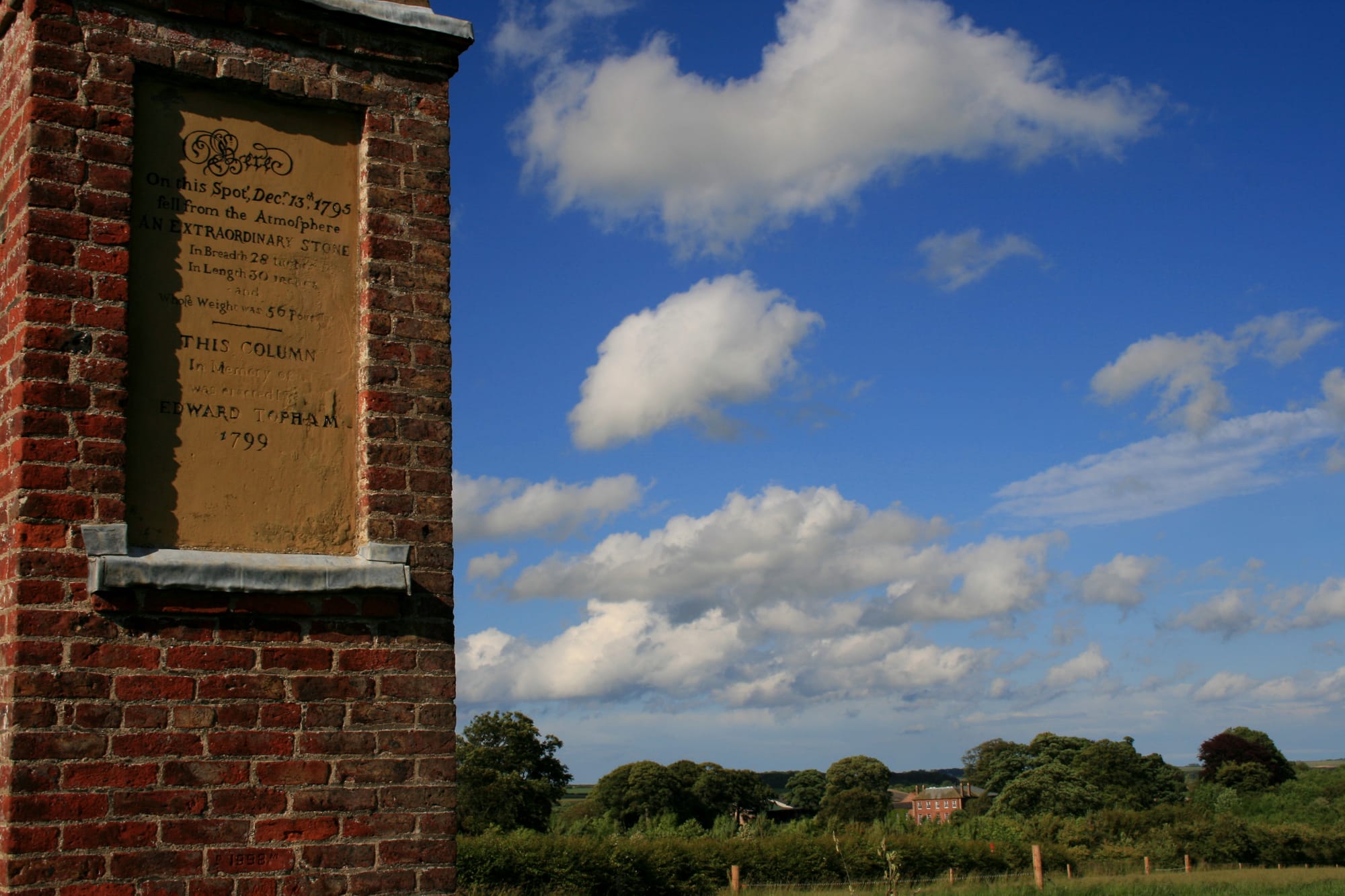
Three years later, in 1799, Topham decided to commemorate the episode with a stone of his own – a column that was erected on the spot of the impact with the following inscription:
1799
Here On this spot, on the 13th of December, 1795, Fell from the Atmosphere, An extraordinary Stone; In breadth 28 inches, In length 30 inches, And whose weight was 56 pounds! THIS COLUMN In memory of it Was erected by Edward Topham A. D. 1799
Topham did not keep the stone for long. He sold it in the early years of the 1800s to James Sowerby who in turn sold it to the British Museum in 1837 for £250. It is now in the Natural History Museum’s meteorite collection and, thanks to the well-documented account of its arrival on earth, it is considered the object that ‘proved’ that meteorites had extra-terrestrial origins •
📸 Dive into our Features
🎤 Read Interviews
🎧 Listen to Podcasts
🖼️ Buy fine art prints & more at our Store


