
The Thrilling Finish to the 1908 Olympic Marathon
The marathon at the 1908 Olympic Games in London provided one of the most dramatic moments in the history of athletics


Sabastian Sawe ran the first sub-two-hour marathon in London at the weekend. His astonishing time, 1h.59m.30s., was nearly an hour faster than the record first established by Johnny Haynes at the London Olympic Games of 1908.
But despite Sawe’s blistering speed, when it comes to drama and heartbreak the 1908 race remains unmatched. Here we look back at ‘one of the most memorable contests in the history of athletics’.

By two o’clock in the afternoon of 24 July 1908, the day of the marathon race, there was not a vacant seat in the 80,000 capacity White City Stadium in west London.
Spectators with the cheaper tickets were wedged together ‘like sardines’, three and four deep in the boiling sunshine as they strained to get a view of the track. Those in the prime seats, meanwhile, had paid as much as a sovereign for places that had originally been advertised for half a crown. They were all there to witness the most testing event of the games.
‘It was a wonderful picture viewed from the arena’, explained one journalist. ‘The women were in light summer costumes, and the general effect of black and white was brightened here and there by a red or blue silk parasol.’
Among the masses a section of Swedish naval officers could be picked out in their bright blue uniforms, as well as a party of boarding school girls. ‘The men were for the most part in their shirt sleeves’, another eyewitness recorded, ‘for flag waving and ‘ra-ra-ra-ing’ are hard work on a hot summer’s day.’
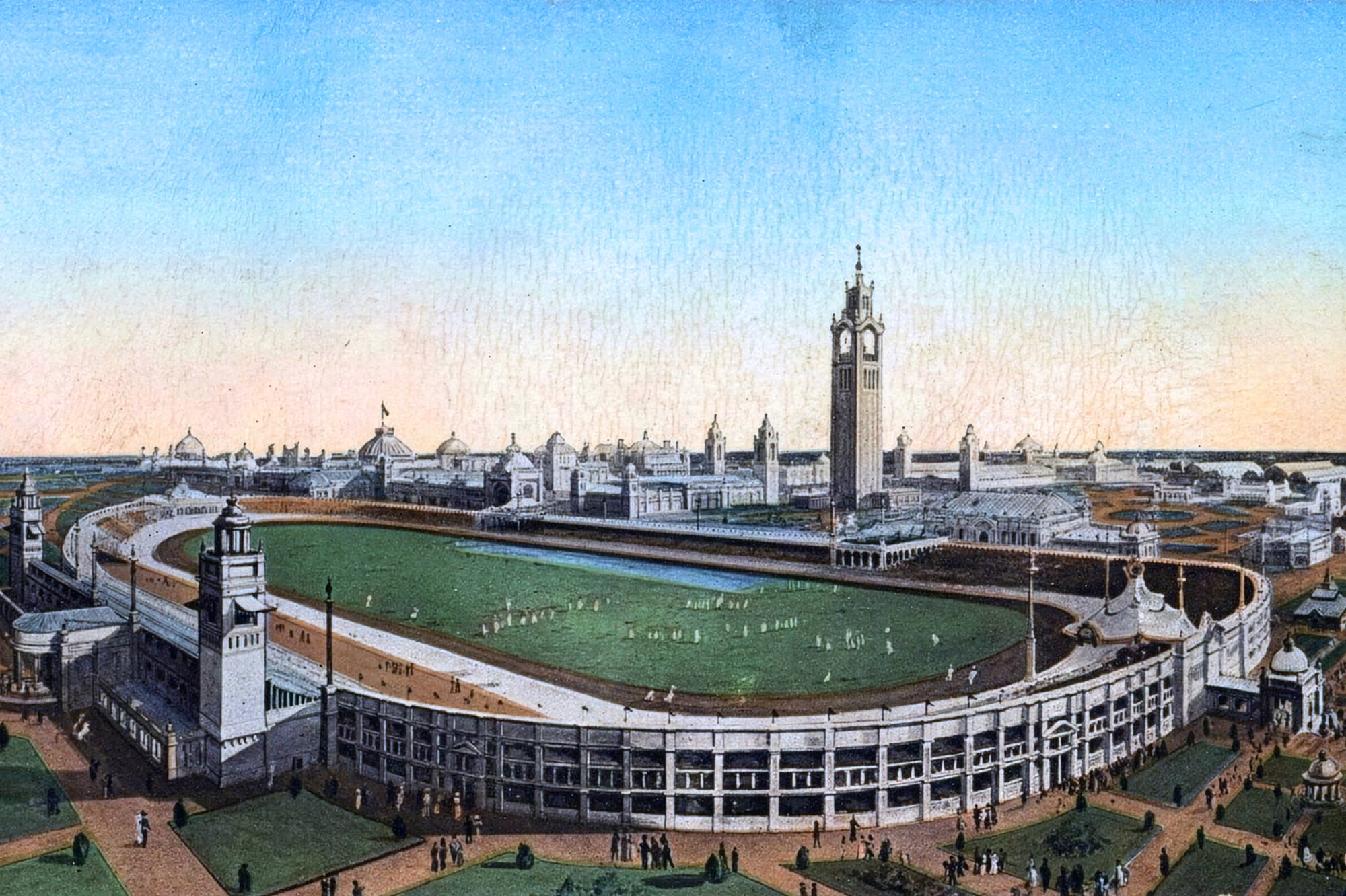
The racers had set off from Windsor Castle at about half past two and they were expected to reach the stadium in the early evening. From about half past three onwards bulletins started to arrive. These told that the runners were four miles out and the rumour was that three of the leaders were British. Next came news from the nine mile mark. 'Hefferon', a runner from South Africa held the lead, but it was only a slender one for two Britons were close behind.
As anticipation mounted, the dignitaries entered the stadium. Queen Alexandra was helped into the royal box along with her second daughter, Princess Victoria, and Crown Prince Constantine of Greece. While the swimmers splashed up and down a tank in the centre of the arena, the crowd kept an expectant eye on the man with the megaphone. At 5.25 p.m., having previously ordered for the stadium to be cleared, this official announced excitedly, ‘The runners are in sight. South Africa and Italy are still leading.’
A strange hush fell over the stadium. ‘The sea of humanity suddenly became very still', it was said. 'Men were gripping their field-glasses nervously; women stood up in their seats.’
What happened next was extraordinary. The drama of the finish would be seared into the memories of the thousands who saw it.
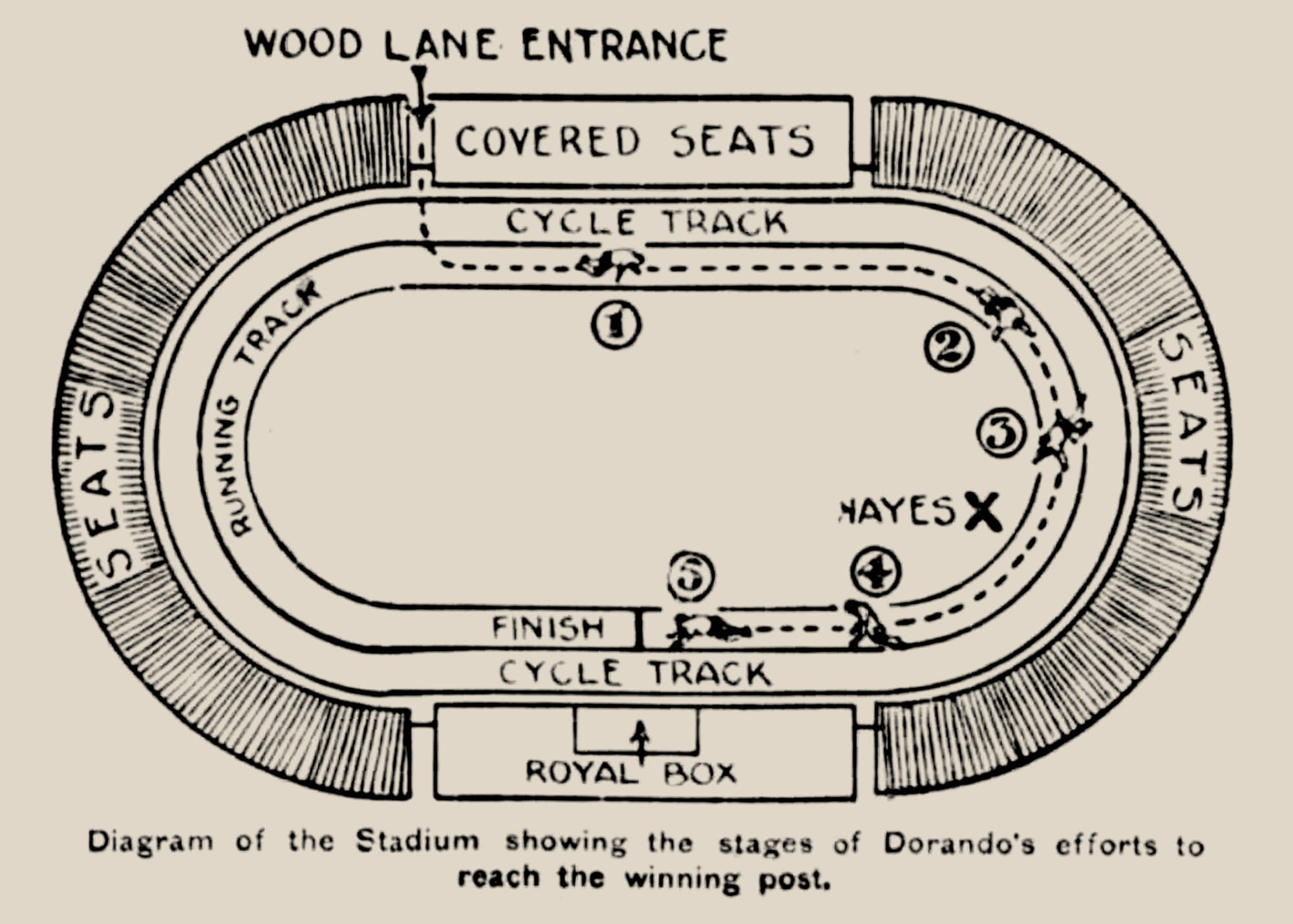
The drama began when, shortly after a great shout from the spectators on the stand overlooking the road, a tiny figure staggered through the gateway on Wood Lane. He was variously described as, ‘A gaunt little man with burning eyes and livid features streaked with dust and perspiration;’, or a ‘strange little figure in deep red pants and a white jersey’. Although many in the crowd did not know it yet, this was Dorando Pietri, an Italian competitor.
What was screamingly obvious to everyone, however, was that this runner was in great distress. Alone on the track, with 80,000 people gazing at him, he was going at little more than walking pace. To finish the race all he had to do was to turn to his left and complete half a lap of the stadium before he finished in front of the royal box.
The runner's first mistake was to turn the wrong way. An official intervened and turned him about. Then, staggering but seemingly energised by the crowd, he started to move along the straight towards the final bend.
‘Dorando’ as he would be called by the London press over the days to come, reeled forwards for about 80 yards. But then, horrifyingly, he fell down. There was a gasp from the stands as they saw the consequence of three hours of running in the heat of summer.
Officials gathered around Pietri. Two minutes passed before they could lift him to his feet. Again he staggered forward. He shook off the supporting hands of several friends, and then, once more, ‘started into a trot’.
What the crowd were witnessing here was completely different to their expectations. A group of runners had been anticipated and a frantic race to the line between them. But instead they were left with the picture of this lone runner, seemingly on the point of collapse.
Pietri looked ‘more like a corpse than a living man’, wrote one spectator, ‘stumbling blindly – almost unconsciously – along the path between two guides, trying bravely to respond to the pitying cheers from the tiers of humanity above him, and lash his tired body into one last effort.’
After a hundred yards, Pietri collapsed again. He lay in a confused heap while anxious friends bent over him, frantically trying to stir him into life. Queen Alexandra was seen at this point, standing in the box, ‘watching breathlessly’.
The reporter for the Daily Express took the story forward:
25 July 1908
Dorando slowly rose upright and tried to continue his journey. The men around him were cheering him, imploring him. Two constables, following behind, pushed away other men who tried to approach.
In a moment he was down again. The same entreaty and persuasion. Again he rose and this time he staggered blindly half way round the end of the oval. Again he collapsed, and this time he lay outstretched on the track. One man rubbed his head. Another elevated his heels and chafed his limbs. All the while the crowd cheered spasmodically, a little hysterically. I saw more than one woman who averted her face and would not look at the spectacle.
At this moment another cheer went up. A second runner had entered the stadium. The Stars and Stripes on his vest shone out in the sunshine, declaring his nationality to everyone. ‘Hayes!’ the cry went up from the American team’s section. ‘It’s Hayes!’ ‘Go it Hayes, if you love, Oh, go it!’
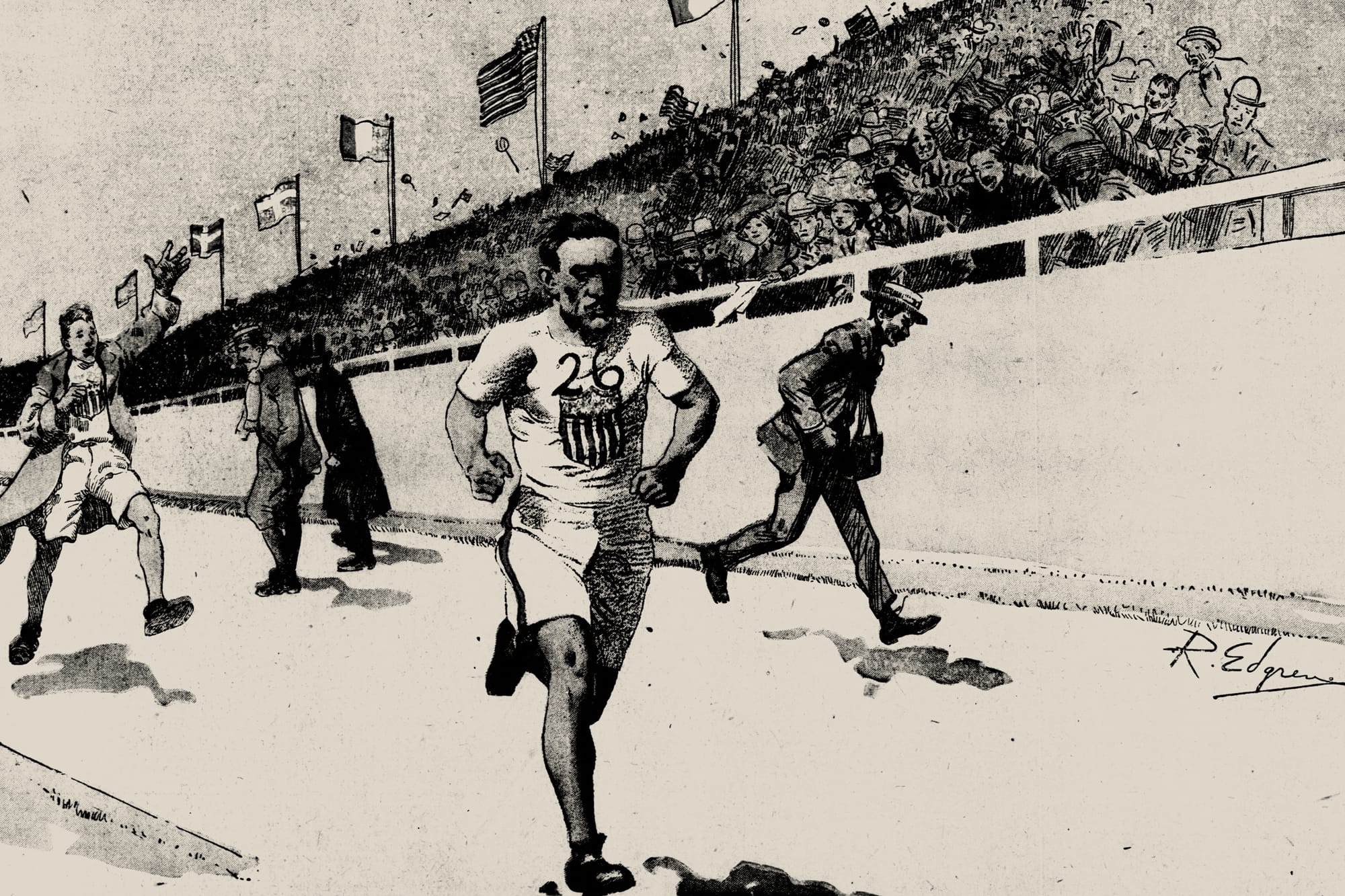
Enter Johnny Hayes
This was, indeed, Johnny Hayes, a short and stocky 22 year-old who was obviously in a far better physical condition than his rival who was sprawled on the track ahead of him. In contrast, Hayes came ‘steadily down the track past the frenzied face of his countrymen’. A forest of flags waved as he went.
The tide of noise announcing Hayes's entry had a catalytic effect on Pietri. Having been flat on his back for almost a minute, something deep awoke inside him. He pulled himself up and gathered all his effort for a last push to the finishing line.
‘But it was still merely a feeble nerveless walk’, one spectator wrote. ‘The ghost of a sprint – so slow that the short steady pace of the man on the other side of the arena seemed rapid by comparison. The feelings of the spectators [were] beyond description. They saw the Italian, now on the home stretch and only a short distance from the goal, going slower and slower, like a mechanical doll, suddenly run down, and his rival gaining steadily every second.’
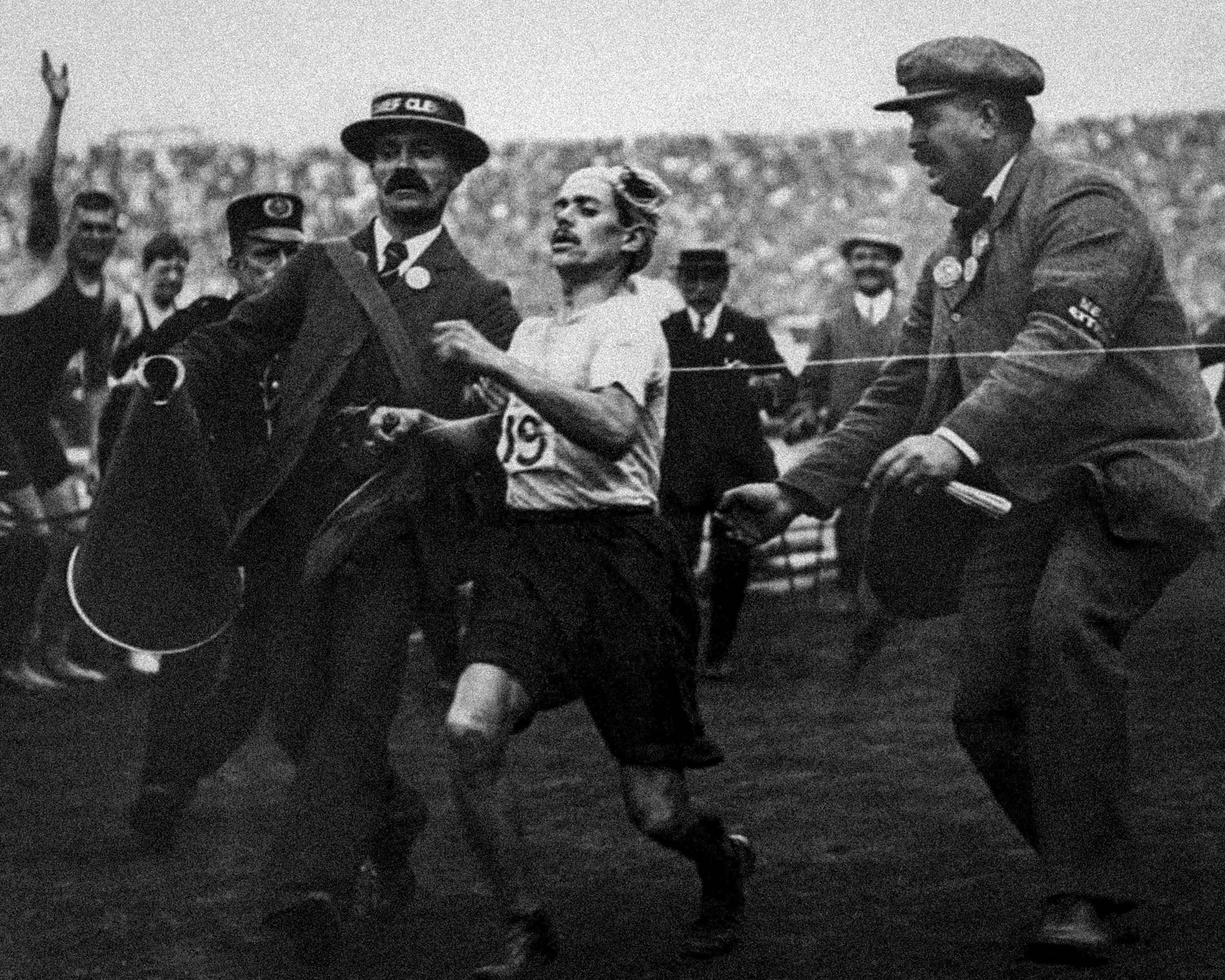
The stadium was now in a state of utter emotional bewilderment. ‘Hayes!’ ‘Hayes!’ ‘Hayes!’ shouted the Americans, while others screamed for the Italian. ‘He’s up again’, came a cry through the megaphone.
Pietri was now within a few feet of the line, borne along by the arms of officials as well as the noise of the crowd. Then there was a mighty cheer as he crossed it, with a medical officer on one side and the announcer on the other. Pietri then collapsed onto a stretcher that awaited him. ‘It seemed’ as one journalist put it, ‘that he must be dead’.
While Pietri was being carried away, a second burst of cheers erupted as Hayes came home in a time of 2h.55m.18.s.. In the following minutes the early leader, Hefferon of South Africa, entered the stadium and crossed the line – he had lost his lead after fainting near Wormwood Scrubs and had rallied to the finish.
But it was dribs and drabs rather than hard racing. It was only a Canadian called Goldsboro and a Brit named Beale, who provided the expected dash towards the line. ‘These two sprinted round the track at marvellous speed’, in a contest for seventeenth position, ‘and Goldsboro who had given the Britisher a fifteen yards’ start beat him in the end.’
Elsewhere other battles were already taking place. Having been helped around the final bend, Pietri had left himself open to accusations of misconduct. There was a rumour that Hayes, too, had received help in the stadium. In consequence, Hayes filed a complaint about Pietri while, in turn, Hefferon issued his own complaint about both of them.
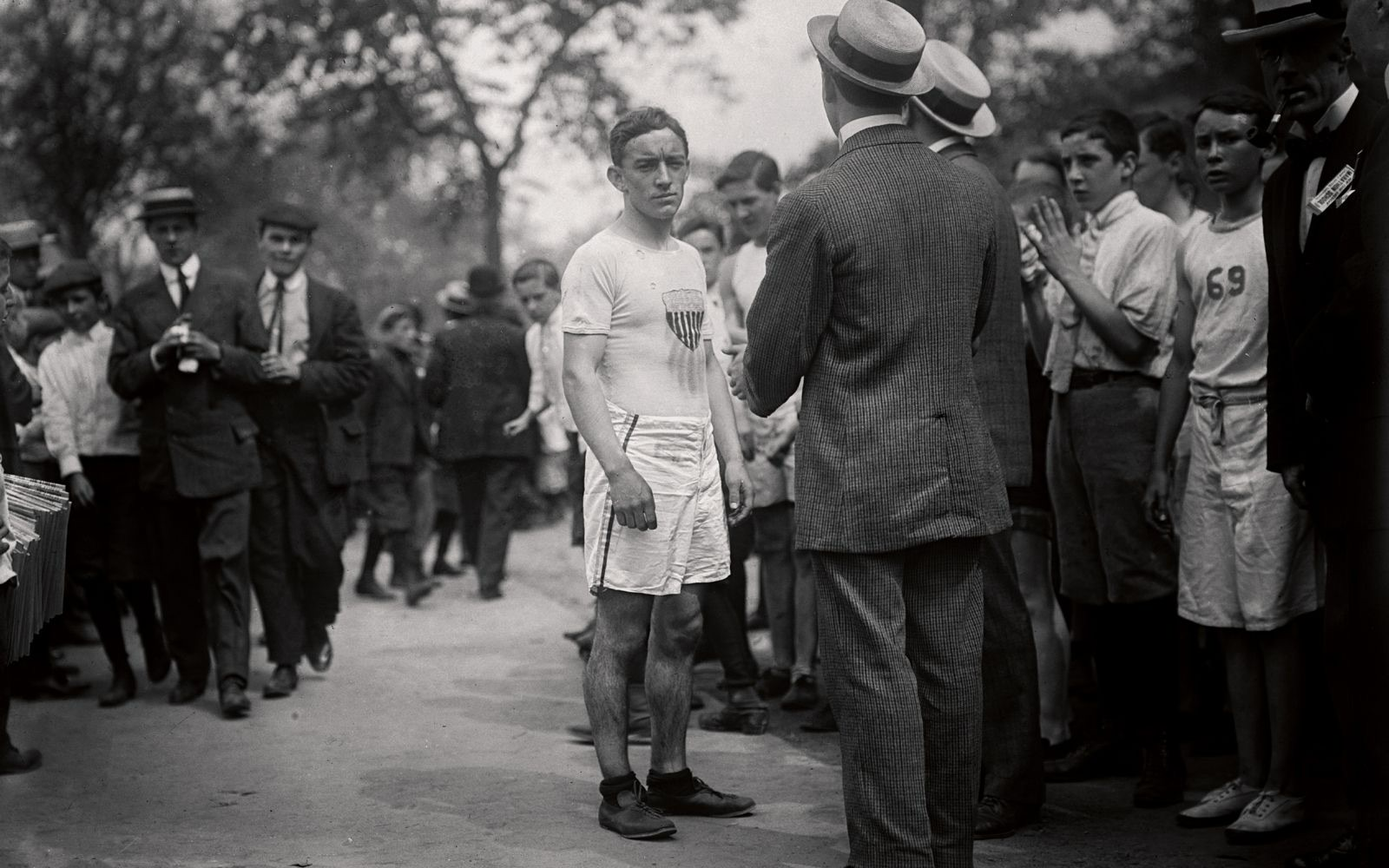
That evening the judges issued their verdict. Pietri was disqualified. Hayes was to be the Olympic champion. This decision was reached having consulted medical opinion. This asserted that Pietri could not possibly have finished in his exhausted state without the interference of others.
By the time this outcome had been reached, a rumour was in circulation that Pietri had died from the terrible strain he had put upon his body. This, happily, turned out to be untrue and more cheering news for the Italian came at a gala dinner that night. At this, Queen Alexandra, who had been impressed by Pietri's ‘pluck’, declared that she had decided to present him with a personal trophy of her own. He was to be ‘the practical though not de facto champion’.
'Johnny Hayes’, meanwhile, was the name on everybody’s lips. ‘A pleasant-featured, bright-eyed little fellow, hard as nails’, the press spent the next few days bothering him for photographs and commentary.
'All the hammer-throwers, shot-putters, jumpers, hurdlers and sprinters whom America has sent us seemed for the moment to be forgotten’, it was said, ‘and Hayes basked in the sunshine of admiration.’
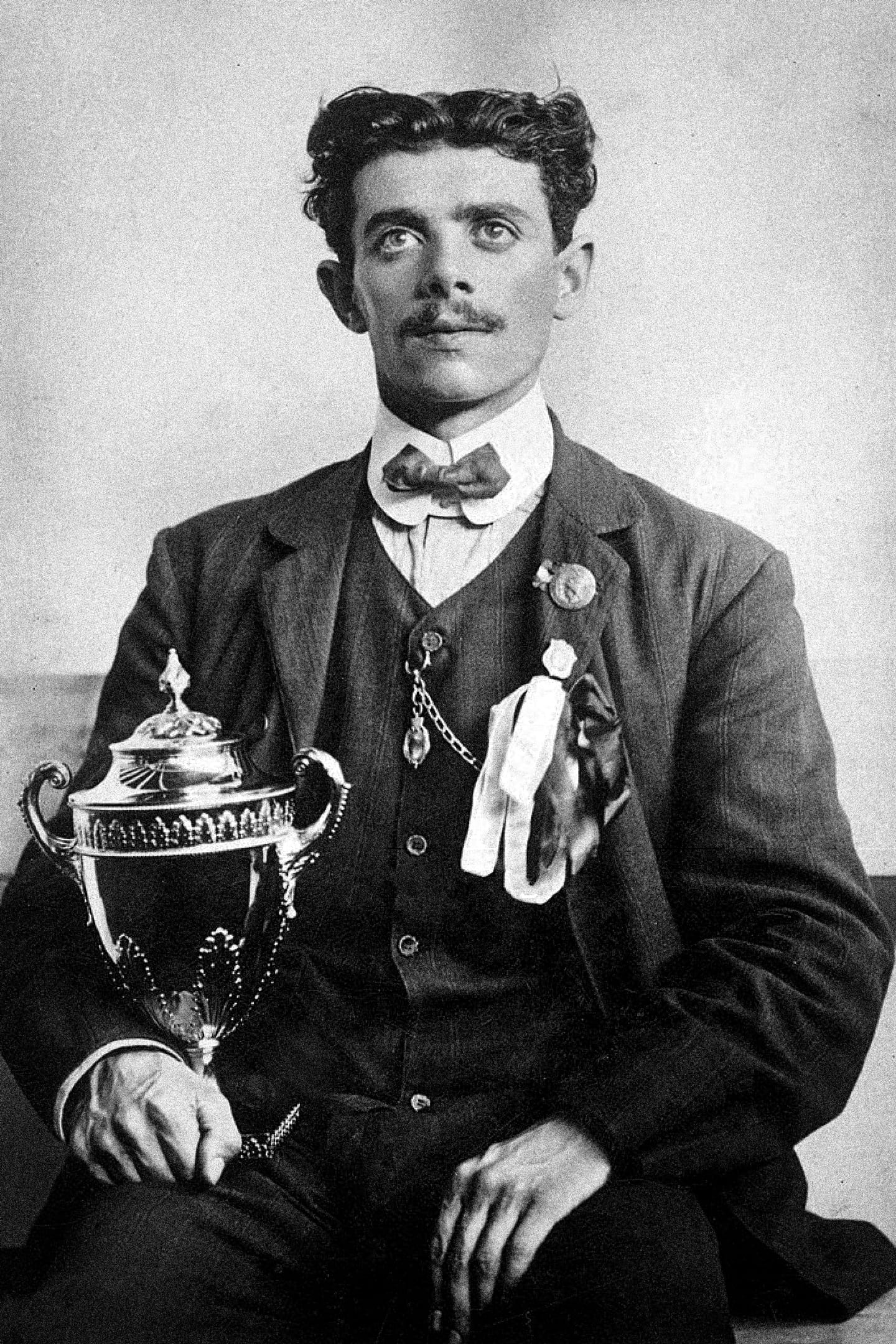
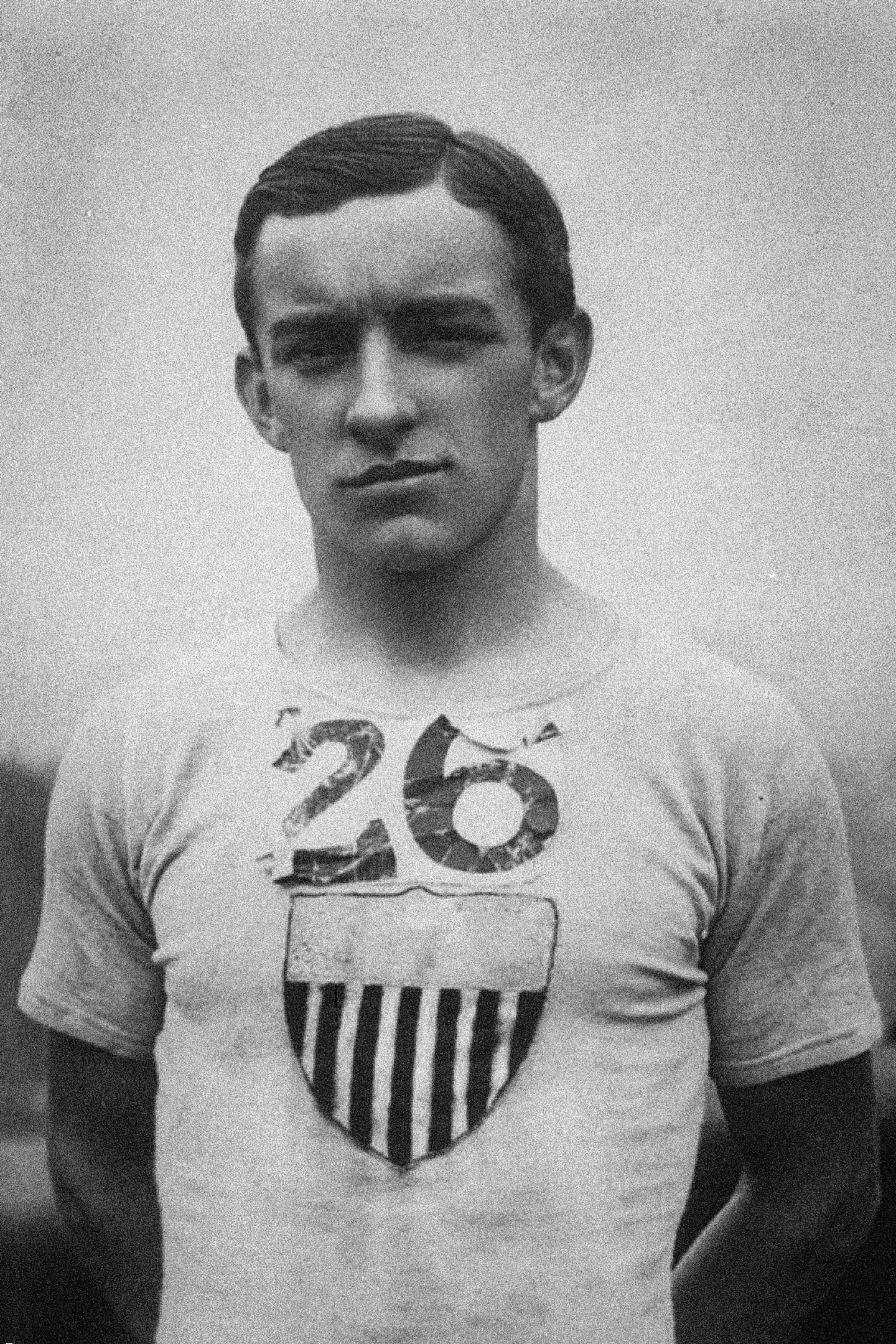
Dorando Pietri with a cup, possibly the trophy awarded to him after his collapse. (⇲ Wiki Commons) Photograph Unknown, 1908; John Hayes of the USA during the 1908 Olympic Games in London. (⇲ Wiki Commons) Photograph Unknown, 1908
Hayes's every move was watched. His training schedule was explained to readers and his background investigated. 'I am a New Yorker of Irish heritage', he revealed. His success was all down to his trainer, he added, 'Mr Murphy'.
Traces of Hayes' background – he was an office clerk – were said to be visible in his signature, which he was asked to produce hundreds of times. Eventually a journalist for the Morning Leader caught up with him.
‘I feel real good, now’, remarked the Marathon hero, ‘just bully’. ‘I can’t say though that I should care to run it all over again, just yet awhile’.
‘Where did the Italian pass me?’ he replied to a query. ‘He never passed me, for he was in front of me all the way.’
‘Well, so long, ole man. I’m feeling really spry again now’, Hayes bid the journalist farewell. He was off to his blankets 'for a quiet snooze' •
📸 Dive into our Features
🎤 Read Interviews
🎧 Listen to Podcasts
🖼️ Buy fine art prints & more at our Store


_LCCN2014682116.jpg?ref=unseenhistories.com)

