
Life at the Loneliest Farmhouse in the World
The author Tim Ecott is a regular visitor to the remote Faroe Islands. Here he takes us to one of the most sparsely populated of them all, Stóra Dímun, and its single, lonely farmhouse.


The isolated Faroes island of Stóra Dímun is home to just one married couple who farm sheep and grown turnips. The author and journalist Tim Ecott visits regularly to learn the history of this family and the long tradition of the island which has been occupied for a thousand years.

The Faroes Saga survives in fragments, much of it it retold in the Icelandic tales recorded by Snorri Sturluson in his Heimskringla in the twelfth century. The Færeyinga Saga tells the story of two young Faroese boys, Sigmundur Brestisson and his cousin Thórir whose fathers are killed by their pagan nemesis Trondur of Gøta. Sold into slavery they escape into the wilds of Norway and after many years fighting as Vikings for the king, they return to Faroes tasked with spreading Christianity.
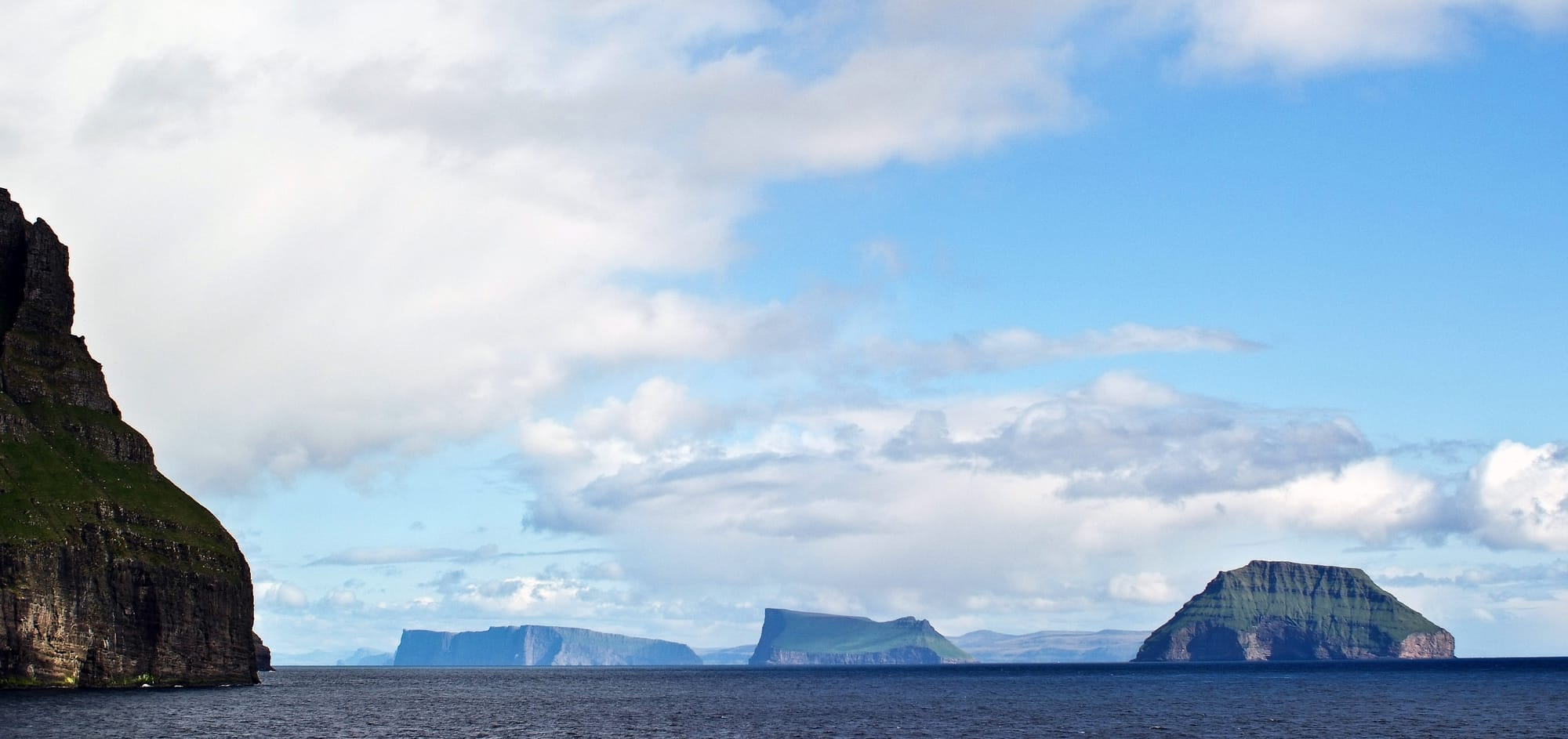
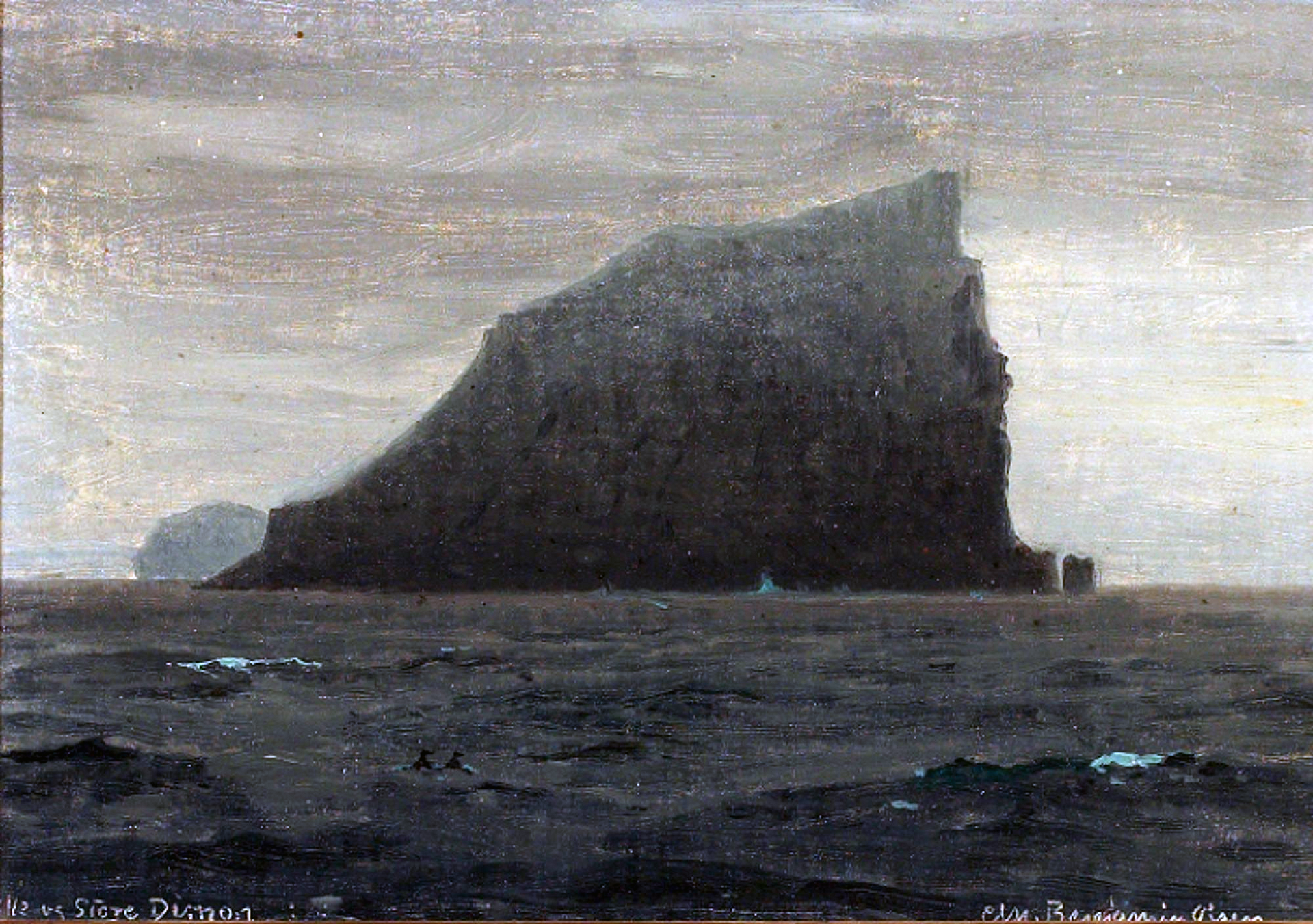
The landscape and the geography of the islands is so accurately described that the saga becomes much more than a fable, and I prefer to see it as ‘oral history’. The swordfight in which the heroes’ fathers die takes place on the remote island of Stóra Dímun, currently the smallest inhabited island in the archipelago. The rocks where the men fell, and the dangerous path from where the two young cousins watched them die are easily recognisable today. It is this island and the stories associated with it that form the subject of my latest book ‘Eva and the Island: Life at the Loneliest Farmhouse in the World’.

History is alive here. The ruins of an old nineteenth century chapel sit snugly in the pasture west of the island’s single farmhouse. It has no roof, and the west wall is missing. The floor is made entirely of grass in which, each spring, several fulmars lay claim to nesting sites in which to lay a single egg. 5o days later, each pair become parents to a pure white, very fluffy chick.
The chapel ruins are encircled by a dry stone wall which keeps the sheep out, as long as the small wooden gate is kept closed. There are starlings nesting in the wall and snipe rise from the long grass whenever I step through the gate.
When the chapel was in use it was the smallest church in all of the eighteen islands, serving just the farming family and a handful of farmhands and milkmaids. Its official description lists it as ‘six and a half cubits in length and five cubits wide’ (a little more than four metres by three and a half metres) with a height of just three metres to the roof-line. It had neither a tower, nor a bell and there were five simple rows of ‘boards’ (pews) which could each seat three worshipers.
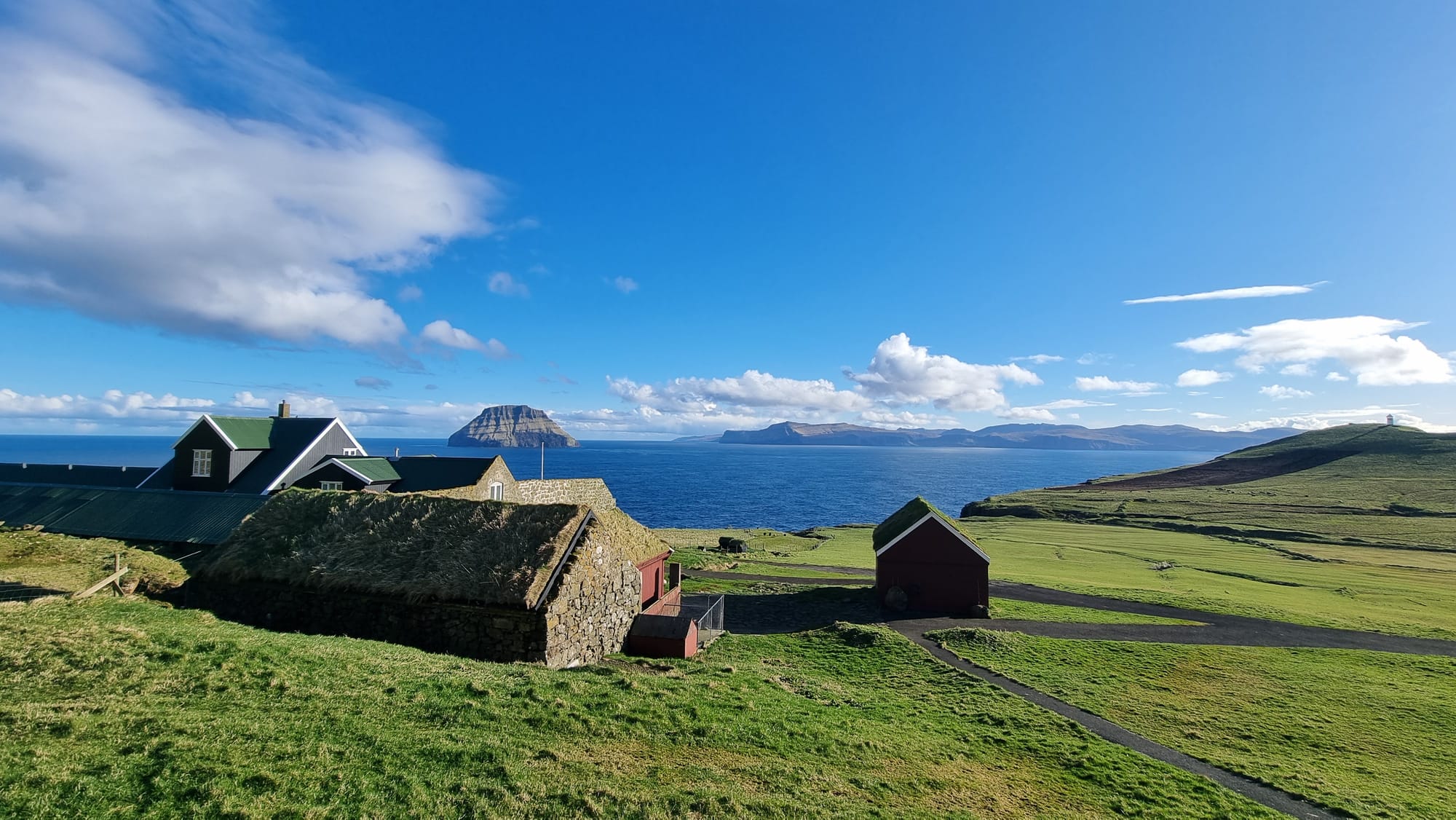
The same family still farm here, tracing their family tenancy of the farm back through eight generations, beginning in 1807. The current farmer, Eva, and her husband Jógvan Jón are the only two official residents on the island now that their young adult children have moved to the capital.
Eva manages a flock of around 500 ewes, half a dozen bullocks that are fattened for slaughter, a milk cow and a few dozen chickens, geese and ducks. Five sheepdogs live here too, essential tools for rounding up the sheep for shearing and slaughter.
There is an old photograph of the chapel from 1916, with the occupants of the island lined up beside the visiting priest from the neighbouring island of Sandoy. One tall man with dark glasses stands out in the group, Janus, known as the ‘Blind Farmer’. He is Eva’s Great Great Grandfather, fifty-four years old when the photo was taken. In spite of his disability, Blind Janus was still able to run the farm and would place his hand upon the shoulder of a guide, usually one of his children, so as to navigate his way around.
In 1918, just two years after the photograph outside the chapel was taken, Janus went down onto a narrow ledge on the Western cliffs with Óla Jákup, a sixteen-year-old farmhand, who had abseiled down to destroy fulmar nests. Unluckily, the farmhand was also blind – albeit in just one eye – meaning they only had one good eye between them. Great Great Grandfather Janus was the one bracing the rope around his shoulders to support the boy below.
Fulmars were considered a nuisance because the islanders believed they were displacing the local guillemots on which people relied for food and eggs. The place where Janus sat, a spot on the cliff path known as Innan Barm, on the route to the grazing ledge known as Grønaskor, was narrow.
On this day, as the Blind Farmer sat with the rope around his shoulders, while a young man attached to the other end was suspended over the cliff face, swinging to and fro to gain purchase on the basalt wall while he dislodged the fulmar nests.
Without warning, the young man slipped and fell, jolting the slack rope with all of his weight as he plummeted downwards. His impetus dragged Janus towards the edge. Janus was being watched by his son Óla Jákup and by his twelve-year-old daughter, Jana, who had been sitting on the grass nearby while he worked.
Slipping and sliding slowly on the rocky scree, Janus fought against gravity for as long as he could, refusing to let go of the rope as the dangling weight of the young man pulled him inexorably towards the cliff edge. Knowing that his fate was sealed, and with seconds left to live, he urged the girl and her brother to leave him.
Silently, hand in hand, they walked back to the farm to tell their mother what had happened. Jana said that the last thing she saw was her father’s feet as he went over the edge. They later found Janus’ cap caught on the cliff edge, but on the rocks below there was no remnant of his body, nor anything of the boy Óla Jákup.
The story of this island is populated with the names of those who have perished on the cliffs, or in accidents at sea. There is no reliable harbour here, just a small inlet in the rocks where a small boat can take temporary refuge. For most of the thousand year history of this island, the residents had to haul a rowing boat up and down the cliff face in order to come and go.
Bad weather left the occupants marooned for weeks, sometimes months at a time. It is no different today, there is no boat on the island, but the farmers are served by a government helicopter service run by the national airline, Atlantic Airways.
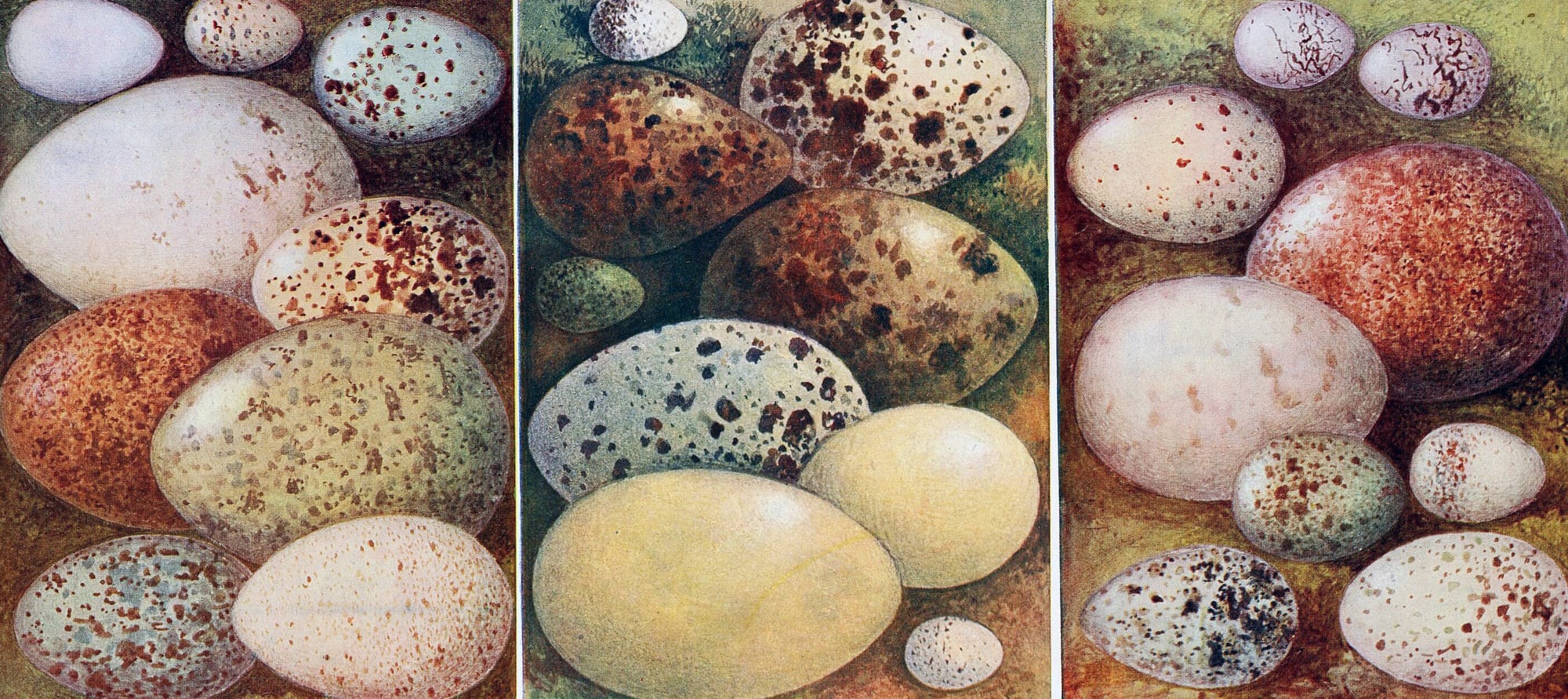
A few years after the Blind Farmer died, his son was collecting bird’s eggs on the southern cliffs of the island. He was lowered safely onto the beach where some visiting Danes had arrived to see this mysterious island.
They asked him to show him the colourful guillemot eggs he had collected and as he did so, the rope above him dislodged a small stone, ‘no bigger than a man’s hand’ and it fell hundreds of feet onto his head.
He dropped dead in front of the assembled visitors. His gravestone, marked with his Christian name, Óla Jákup, is the only visible headstone in the abandoned graveyard around the chapel.
The island is home to many spirits, and dozens of stories about previous generations who eked out a harsh existence here, surviving tempestuous North Atlantic weather, and stormy seas.
Eva sees herself as a temporary guardian of the island, and a keeper of the family history. Through her eyes I have come to see this place as a vibrant example of a disappearing way of life, with an intricate past. It is not simply a small island, but a gathering place of living history •
Eva and the Island: Life at the Loneliest Farmhouse in the World
Icon, 13 August, 2026
RRP: £15.99 | ISBN:978-1837733767
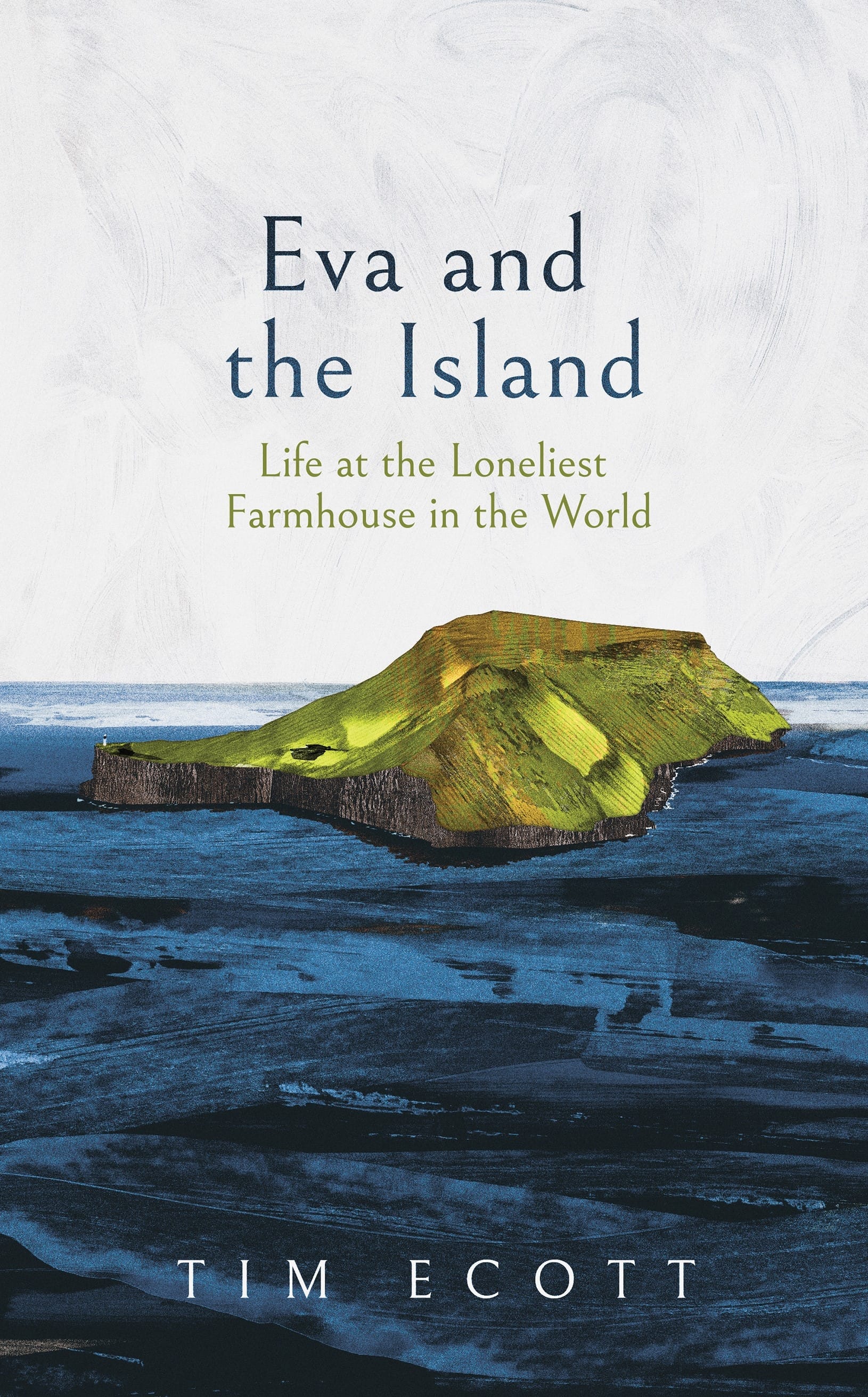
An island without a harbour, encircled by perilous cliffs and rising high above the wild Atlantic Ocean, farmed by the same family for eight generations. What is it like to live at the edge of the world?
In this marvel of quiet reflection and keen observation, Tim Ecott takes the reader to Stóra Dímun - an isolated island farm in the Faroe Islands with only two permanent residents. He finds a remarkable way of living; one where you're isolated but never truly alone, surrounded by wildlife and an ever-changing landscape. On the island, every day is spent breathing fresh air, managing your livestock and continuing the work begun by your forebears hundreds of years ago. Here, time blurs - technology may encroach, but traditions are ingrained.
Tracking the rhythm of the year and the challenges of life on this island, this book is a celebration of both the human spirit and our relationship with the natural environment. It is about sustainability, resilience and how to survive and adapt when the world is rushing headfirst into a digital future of artificial intelligence and anonymous food chains. Eva and the Island is a call to anyone who has ever dreamt of an island of one's own.
With thanks to Elle-Jay Christodoulou.
📸 Dive into our Features
🎤 Read Interviews
🎧 Listen to Podcasts
🖼️ Buy fine art prints & more at our Store



_(14753011724).jpg?ref=unseenhistories.com)