
The Beauty and the Terror in Renoir’s ‘Pink and Blue’
This 1881 portrait of Alice and Elisabeth Cahen d'Anvers would inspire Catherine Ostler's The Renoir Girls


Pierre-Auguste Renoir is a favourite artist for millions. His dreamscape visions of Paris during La Belle Époque are filled with the elegance of a vibrant moment in the past.
But as Catherine Ostler explains in her new book, The Renoir Girls, one of the artist's best known portraits is haunted by a history of a very different type.
Words by Peter Moore

Listen
Watch on YouTube instead
Renoir's Pink and Blue
On a midwinter’s day in Paris in early 1881 the painter, Pierre-Auguste Renoir, began a painting that would come to symbolise much more than he ever intended. From the start it was a somewhat unusual commission: a portrait of not one, but of two young girls – Alice and Elisabeth Cahen d’Anvers – daughters of a wealthy Jewish banker. When these children arrived and stood before his easel at no.66, Avenue Montaigne, Paris, Renoir started work on the piece that would become known to history as Pink and Blue.
Renoir was just shy of forty. He was one of Paris’s most fashionable young painters, belonging to a movement that had emerged over the past decade called ‘Impressionism’.
Along with artists like Claude Monet and Camille Pissarro, Renoir had pioneered a style that valued the overall effect of a piece rather than its careful rendering of fine details. It involved bold brush strokes and clever dabs of paint to capture the play of light on objects and scenes.

The Cahen d'Anvers
To reach the Cahen d’Anvers ‘golden’ townhouse that winter’s day, Renoir had passed through the noble avenues that surrounded the Champs-Élysées.
He had captured these in his famous 1875 composition, The Grands Boulevards, a work full of ‘pigment daubs and bright colours’ that depicted a horse drawn carriage rolling through the city, between clusters of prettily dressed Parisians – families, flâneurs, newspaper readers. After the ruinous Franco-Prussian War of 1870–1, there was colour and gaiety in the streets of the French capital once again. This was La Belle Époque.
Renoir’s dual portrait of Alice and Elisabeth Cahen d’Anvers was completed over the weeks that followed. ‘In the picture’, writes the author Catherine Ostler in The Renoir Girls, we see the artist’s ‘love of eighteenth century art, the peachy softness, the rococo bloom of Fragonard, Boucher and Watteau.’

📚 Previews
The Renoir Girls: A Hidden History of Art, War & Betrayal by Catherine Ostler features in our April 2026 previews. Find out more about the book and explore the full list
From the two girls who stood in front of him, ‘dressed in white … holding hands, one in a pink satin sash, the other blue, a duet of sugared almond-coloured sweetness’, Renoir found their spirit, ‘their rosy colour, their fair hair’.
This was intended to be a statement piece. Renoir had received the commission from Louis and Louise Cahen d’Anvers after the successful portrait of an elder sister, Irène, that he had painted the previous summer.
For the Cahen d’Anvers, Renoir was a bold choice of artist. For all of his modishness, there were other more established, more conservative choices. The Cahen d’Anvers, however, had been impressed with his Little Irène, which was to be entered to the Salon of 1881, and they sought another of his ‘grand illusions’ for their walls.
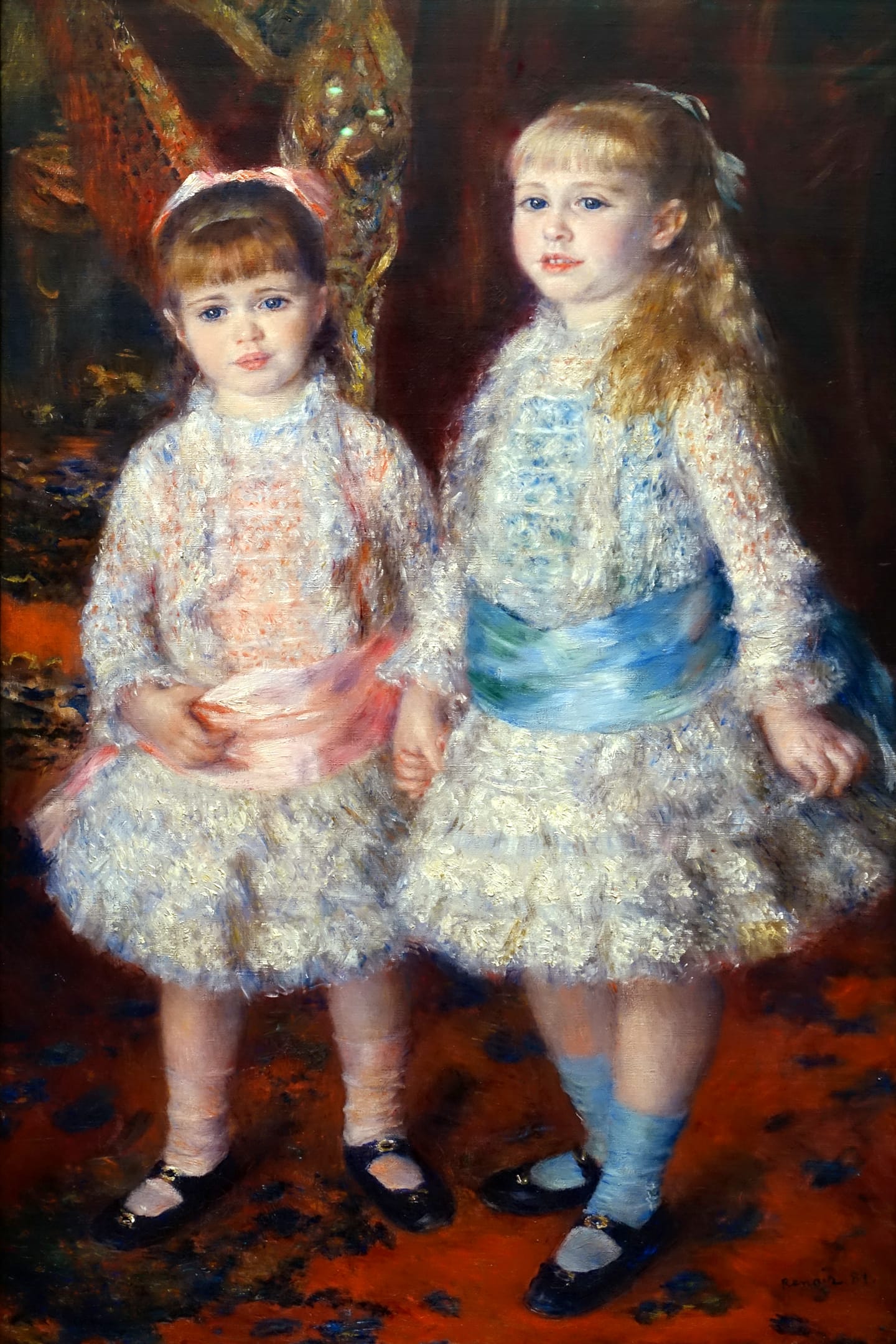
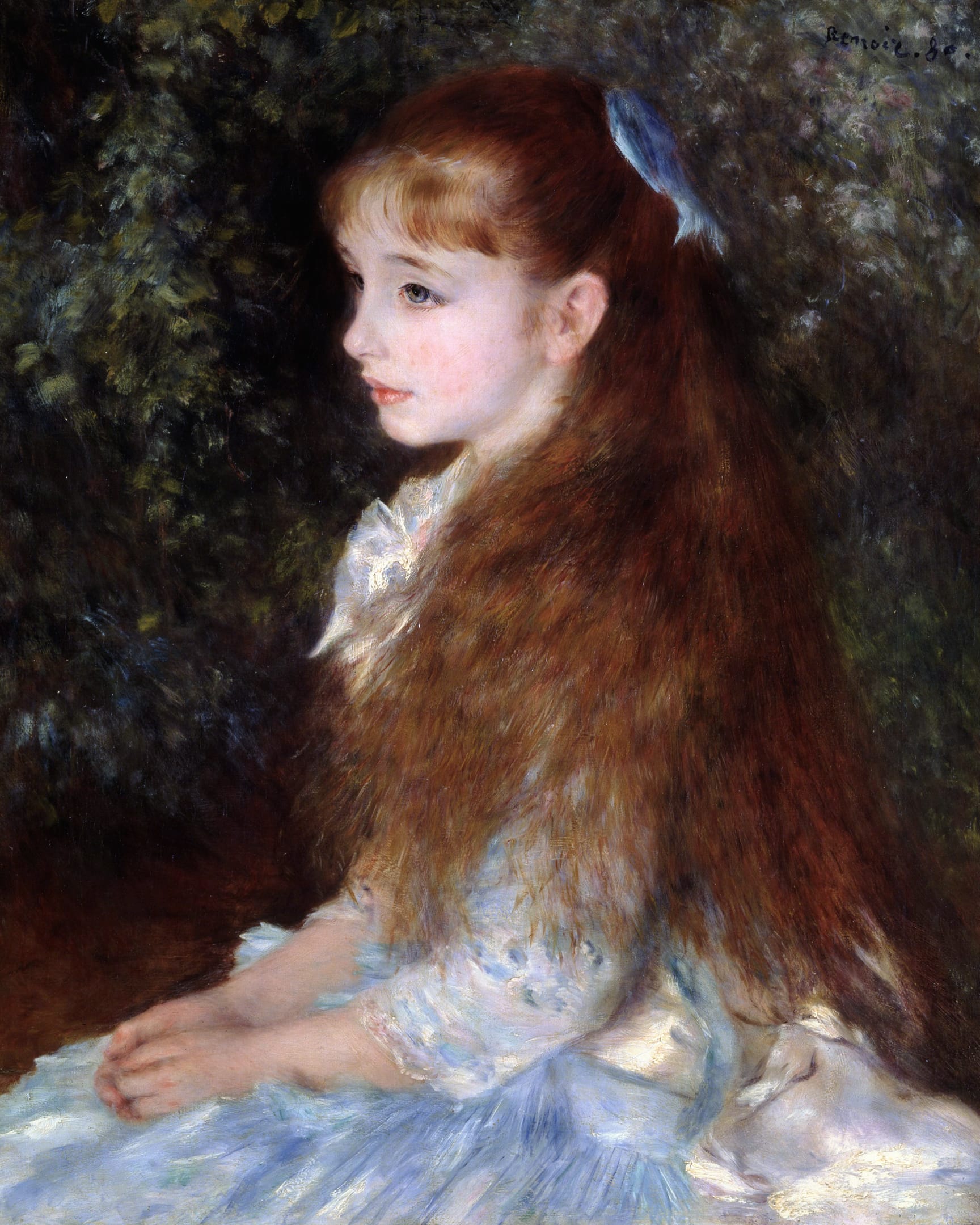
Pink and Blue. (⇲ Wiki Commons) Painting Pierre-Auguste Renoir, 1881 // Portrait of Mademoiselle Irène Cahen d'Anvers. (⇲ Wiki Commons) Painting Thomas Luny, Pierre-Auguste Renoir, 1880
The Renoir Girls
As a journalist Catherine Ostler has worked for the Tatler, the Evening Standard and The Times, Her debut history book was The Duchess Countess, the story of Elizabeth Chudleigh, Duchess of Kingston, who became embroiled in an infamous eighteenth century trial.
But, as Ostler explains on this episode of the Travels Through Time podcast, there was another story that had long gnawed away at her. She had come across it in Edmund de Waal’s Hare With the Amber Eyes, a bestselling work of family history, which included the story of Elisabeth Cahen d’Anvers – the elder of the two girls (the one to the right) in Renoir’s Pink and Blue. This young child, one filled with promise and privilege, had six decades later been murdered after her deportation to Auschwitz.
Here, then, was a painting that contained history more than Renoir had ever intended. There was glitzy ostentation of La Belle Époque and the murderous terror of the Holocaust.
Born: 25 February 1841, Limoges, France.
Died: 3 December 1919, Cagnes-sur-Mer, France.
Famous works: La Grenouillère (1869), Dance at Le Moulin de la Galette (1876), Dance at Bougival (1883)
‘Renoir was in love with painting, specifically with the Impressionist form of pervasive light and bold, indistinct strokes in place of defined lines. However disconcerting he could be in person, his pictures show only happiness. They do not contain the sufferings of the world, their creator, or their subjects.' – Catherine Ostler, The Renoir Girls, p. 20
As an artist Renoir has often been criticised for a sentimentalism that bordered on naivety. ‘A picture has to be pleasant, delightful and pretty – yes pretty’, he once wrote. ‘There are enough unpleasant things in the world without us producing more’.
And yet having started with Renoir’s frosted tones, Ostler went in search of the unpleasant. It was not too far to find. The Cahen d’Anvers were Jewish and they lived at a time when such a fact came increasingly to matter.
In 1881, however, when Renoir’s painting began the times were good. Having risen out of the Ashkenazi Jewish ghetto in Bonn they had come to Paris after a spell in Antwerp having made a fortune in business and financial speculations.
Counted among the gratin in Paris – the French equivalent of ‘the cream’ – the Cahen d’Anvers lived splendidly in the most fashionable part of Paris. At the outbreak of the French Revolution Jews had been granted equal rights in the new republic and their status had climbed ever since.
Their place among an emerging Ango-French elite was confirmed when they were star guests at the January 1881 wedding of Leopold de Rothschild and Marie Perugia in London. The journalists who covered the guests took great care to depict these wealthy Jewish visitors: their clothes, their style, their entourage.

But in retrospect this moment in early 1881 – when Renoir painted his portrait and the wedding took place in Marylebone – turned out to be a high point. In March all Europe was shocked at the news that Tsar Alexander II had been assassinated in Saint Petersburg.
A liberal ruler whose domains included the world’s highest Jewish population, the Tsar's death initiated a ferocious response. Within a month pogroms – planned assaults against Jewish businesses, homes and places of worship – were underway inside the Russian Empire. The new ruler, Tsar Alexander III, would move away from liberalism towards autocracy.
In response to this persecution, many Russian Jews fled west towards Paris. Their arrival in the 1880s and the 1890s contributed to a rise in anti-Semitism, which was inflated further still by the Dreyfus Affair. As the twentieth century began, an ominous mood had replaced the older one of acceptance. In this moment, Ostler explains, early signs of the horror to come can clearly be seen.
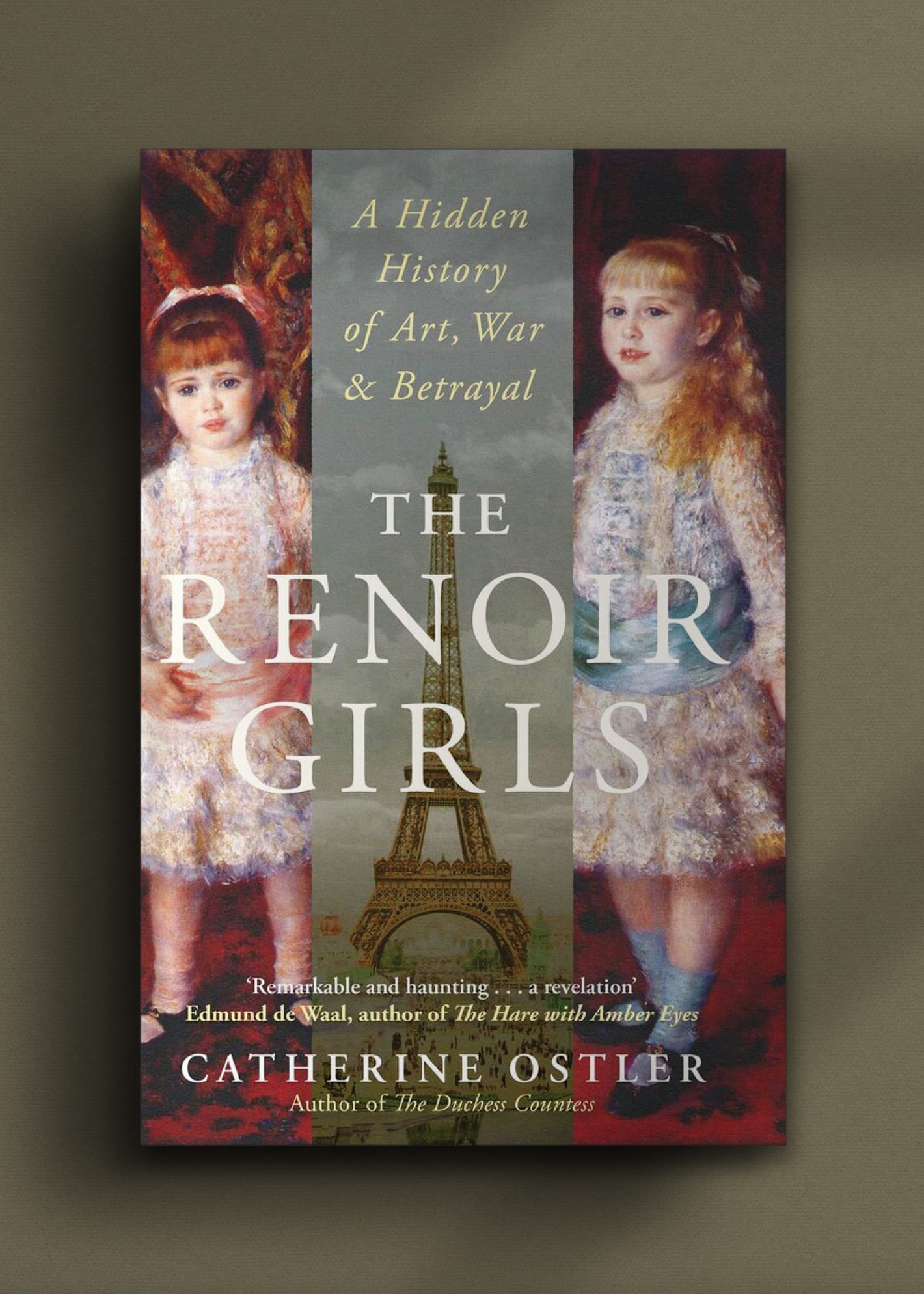
Catherine Ostler’s book, The Renoir Girls: A Hidden History of Art, War and Betrayal takes Renoir’s Pink and Blue for its starting point. Thereafter it follows the fortunes of Alice and Elisabeth Cahen d’Anvers, along with their sister Irène, through the years and decades that follow •
The Renoir Girls: A Hidden History of Art, War and Betrayal
Simon & Schuster UK, 9 April, 2026
RRP: £30 | 448 pages | ISBN: 978-1471172595
In 1881, Pierre-Auguste Renoir painted two young sisters from a Jewish banking dynasty at their home in Paris’s grand 8th arrondissement. Pink and Blue, a portrait of Elisabeth and Alice Cahen d’Anvers, captures a fleeting moment of innocence and beauty, and today it is one of Renoir’s most celebrated works. His portrait evokes the glamour of the Belle Époque: days at the races, nights at the opera, sun-soaked chateaux, brilliant salons filled with art, music and conversation. Paris at its most dazzling.
Yet beneath the glittering surface was a surging current of resentment. Renoir’s Impressionist masterpiece, radiant with light and colour, hides both a family secret and the tensions of an era poised for rupture. The same society that was illuminated by progress and culture was cast into shadow by division, prejudice and rising antisemitism. The Cahen d’Anvers, prominent patrons of this Golden Age, would come to embody both its glory and its tragedy.
In The Renoir Girls, Catherine Ostler paints a vivid and immersive portrait of intimate individual lives against the vast sweep of a changing Europe. Drawing on letters, diaries and exclusive new research, Ostler uncovers revelatory truths about a family at the heart of modern Europe’s struggles. From the aftermath of the Franco-Prussian War to the Dreyfus Affair and the devastation of two world wars, this is a powerful story of love, courage and identity in conflict with the forces of history.
Travels Through Time – Catherine Ostler: The Renoir Girls (1881)
Show Notes
Scene One: 19 January 1881
The wedding of Leopold de Rothschild and Marie Perugia in London.
Scene Two: January – March 1881
Renoir paints Alice and Elisabeth at the Cahen d'Anvers family house in Paris.
Scene Three: 13 March 1881
Tsar Alexander II is assassinated in St Petersburg.
Memento:
Pink and Blue by Pierre-Auguste Renoir.
📸 Dive into our Features
🎤 Read Interviews
🎧 Listen to Podcasts
🖼️ Buy fine art prints & more at our Store



