
Mary Anne Clarke and the Duke of York Scandal (1809)
We look back at the story of the Duke of York Scandal of 1809 when Mary Anne Clarke and Colonel Wardle upended British politics.


The disasters surrounding Andrew Mountbatten-Windsor, ex-Duke of York, today seem so deep and manifold that they must almost be without precedent. Titles gone, residences removed, a reputation in utter tatters. Last week a copy of the shameful photograph of Andrew, being driven away from a police station, was hung in the Louvre in Paris.
But in fact there is an episode in British history that bears a striking resemblance to this sordid event. It was a story of sex and power, corruption and secrets, and it involved the second son of King George III. Frederick, Duke of York.
Here Peter Moore looks back over an episode that dominated newspapers at a dramatic moment in British history. It was a moment when a lowborn woman brought down a prince.
Words by Peter Moore

Listen to the podcast here!
This audio recording is 30 minutes.
Show Notes
Scene One: 27 January 1809 (00:09:38)
Colonel Wardle stands up in the House of Commons.
Scene Two: 1 February 1809 (00:17:05)
Mary Anne Clarke gives evidence before the House of Commons.
Scene Three: 20 March 1809 (00:25:08)
Spencer Percival announces the Duke of York's resignation as Commander in Chief to the House of Commons.
Memento:
Mrs Clarke's fur coat.
The Grand Old Duke of York
Until the scandal that engulfed him in early 1809, Frederick the Duke of York, was a well-regarded member of the British royal family. The second son of King George III and third in line to the throne, he was considered a diligent public servant and somewhat gallant too.
In the 1790s the duke had gone off on campaign in Flanders against the belligerent French. Since then he had applied himself to modernising the British Army – a military force he led as its Commander-in-Chief – from the headquarters at Horse Guards on Whitehall.
But then, in January of 1809, the duke's reputation was transformed in an instant when an MP stood up in the House of Commons and accused him of corruption. The duke had, it was alleged, allowed some unknown woman called 'Mrs Clarke' to operate a clandestine market in military commissions.
Through the aegis of this Mrs Clarke – and nobody knew who she was – army places were being sold at knockdown rates. The fees were being paid personally to her and thus the flow of significant sums of money were being diverted from their rightful paths.
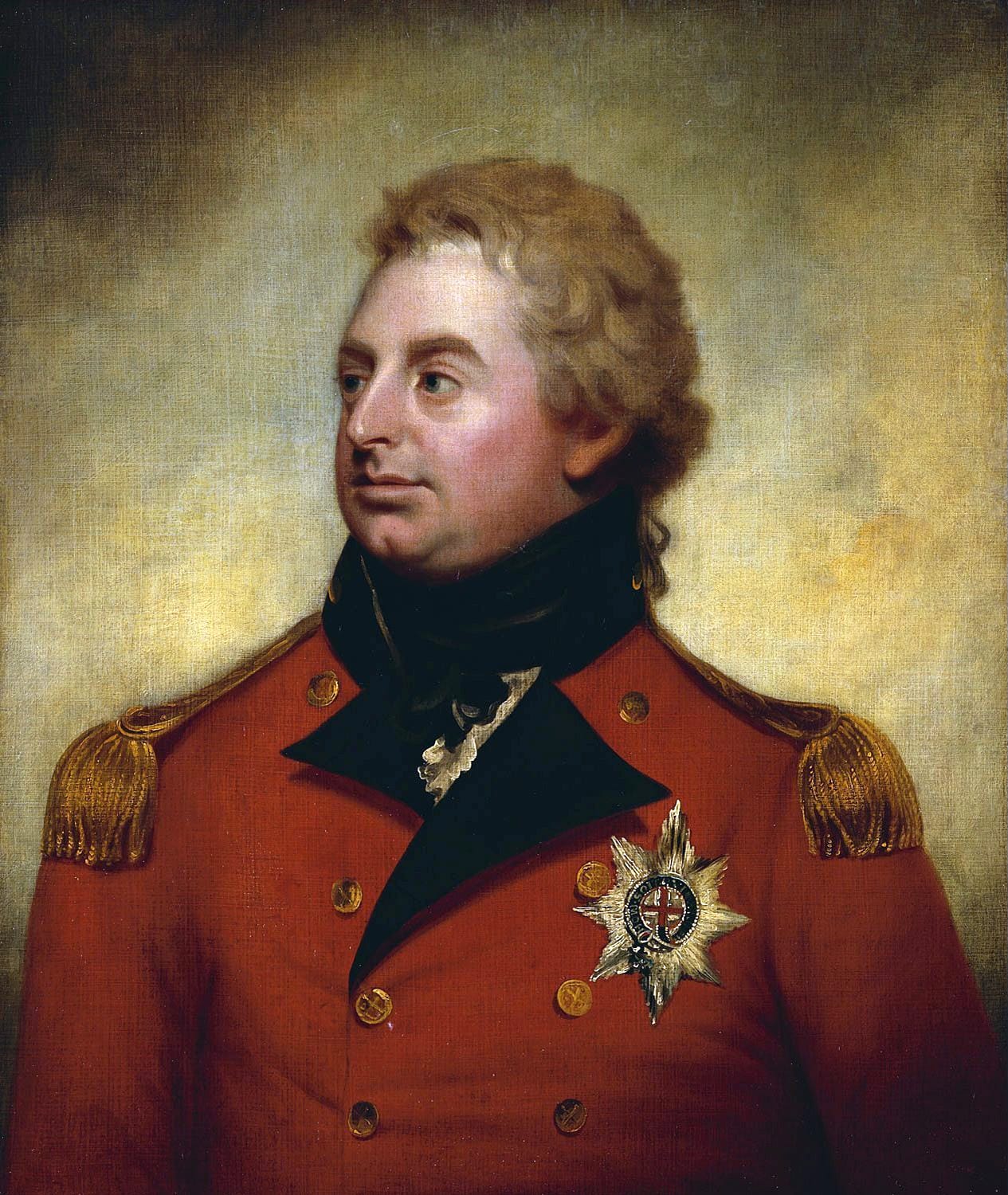
At the start of 1809 this was a particularly explosive accusation to make. The war against Napoleon's France had been dragging on for years at huge national cost. To suspect that a member of the royal family had been profiteering during this time was to confront a terrible truth.
Could it be, that while the ordinary British people – a people freighted by taxes and obliged to serve in local militias – were feeling the strain, a member of the royal family really putting his own self-interest first?
This possibility seemed all the more outrageous at the beginning of 1809. During the previous year Napoleon's troops had marched into the Iberian Peninsula. The Spanish king had abdicated, the Portuguese royal family had fled to Brazil and the British forces in the region, led by General John Moore, were faring badly.
January 1809 brought a succession of grim reports about retreats. A fortnight before the Duke of York scandal broke, Moore was knocked down by a cannonball at the Battle of Coruña. He died of his wounds not many hours later.
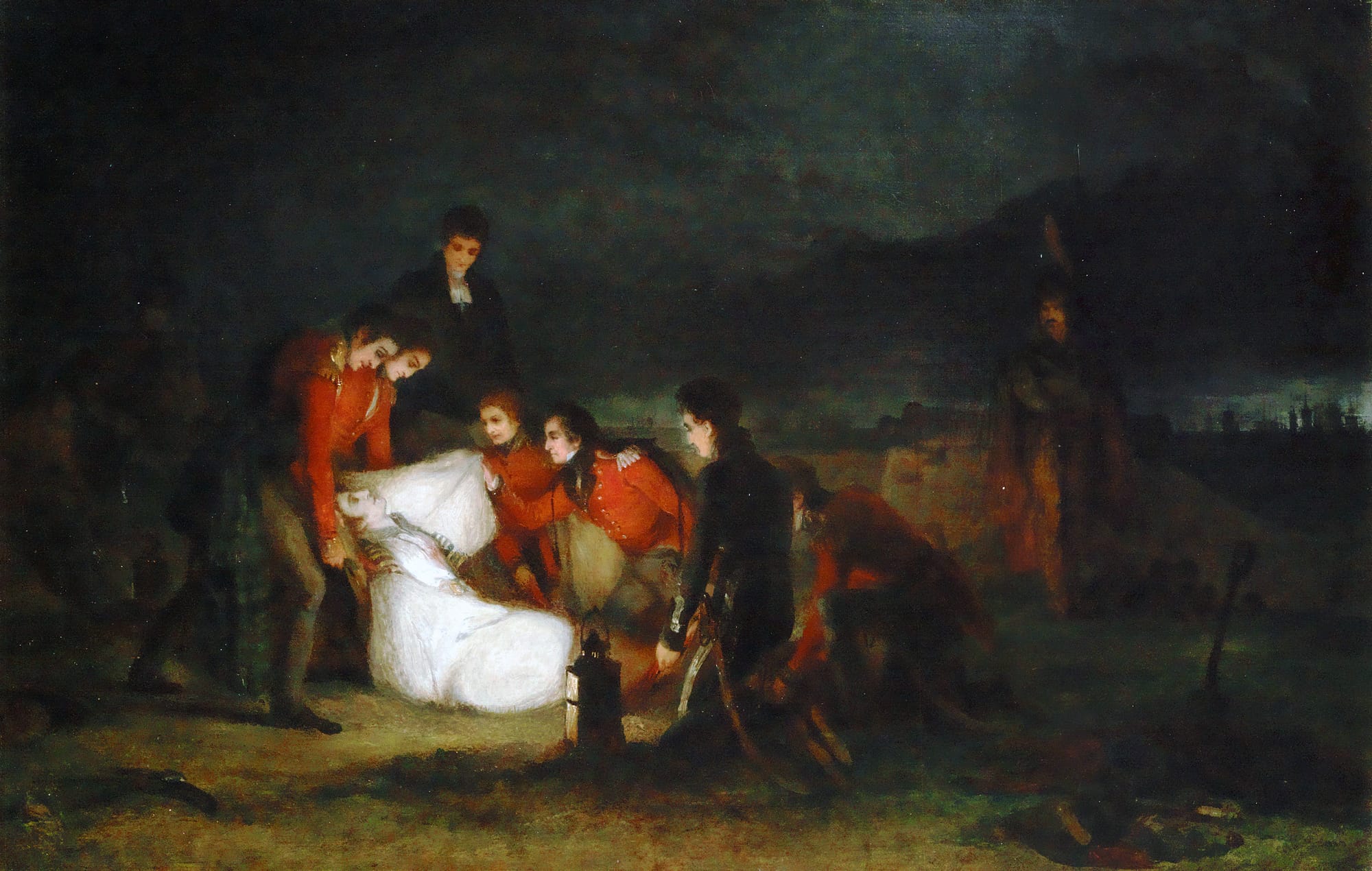
The desperate military outlook in Iberia tessellated with the raucous political atmosphere in Westminster. December 1808 had been consumed by a wretched inquiry into the behaviour of senior British generals after the Battle of Vimeiro. In what now seemed like a massive blunder, the defeated French army had been allowed to sail safely home.
While many grumbled about the foolishness of this, in Parliament a more sustained attack was being made against the British establishment. These 'radicals' were led by the charismatic MP for Westminster, Sir Francis Burdett, and they had long agitated against the corruption that riddled public life.
The House Commons may have been part of the 'Mother of All Parliaments', but the 'Burdettites' pointed out that as many as half its seats were controlled by just 150 wealthy individuals. This, the radicals argued, could not stand. They wanted an entire reformation of the political system.
It was a new face among the radicals that ignited the scandal involving the Duke of York.
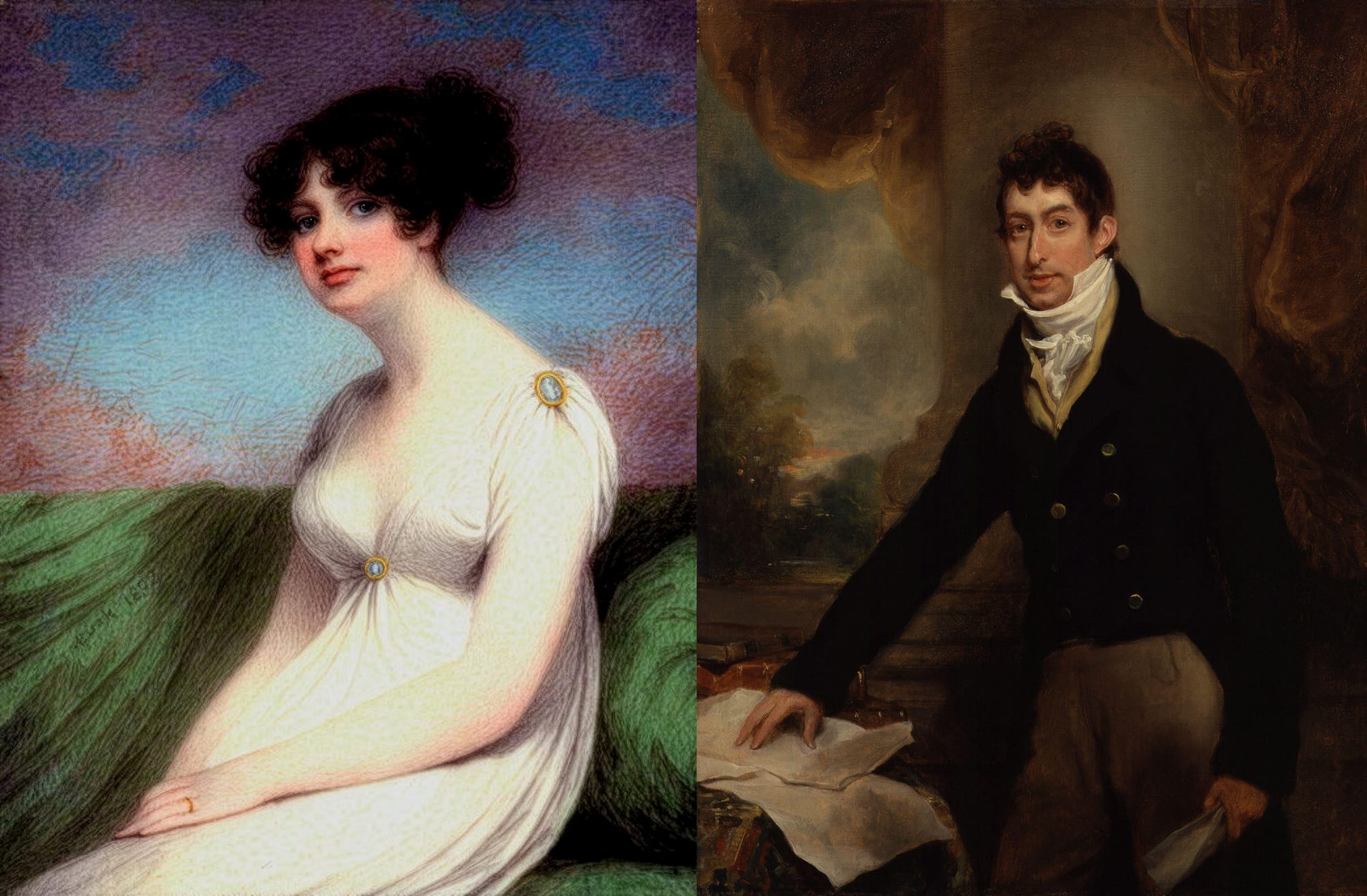
The MP's name was Gwyllym Wardle and he represented the constituency of Okehampton in Devon. On 27 January he rose in the chamber and announced that he had a grave and painful responsibility to perform. Evidence had come into his hands, Wardle explained, that suggested that the Duke of York's sizeable private fund was being augmented by the irregular sale of military commissions.
To make such a public attack on a member of the royal family was sensational. Supported in the chamber by Burdett, the member for Okehampton succeeded in forcing a public inquiry into the duke's behaviour.
Overnight Wardle's reputation was transformed. From pure anonymity he became a symbol of British courage and honesty. However much he was attacked by the Tory press, the public did not seem to care. Instead they regarded him as someone who had raised important questions about the behaviour of power figures.
February 1809 was a lively month in British politics. As some scandals do, this one, involving such a prominent figure, spoke to all sorts of different issues in the nation. How transparent were networks of 'interest'? What exactly was the private conduct of those in high office? What kind of behaviour did people expect of a member of the royal family?
It became clear very quickly that sex was an important component in what had been going on. 'Mrs Clarke', a hitherto little character at Westminster, was plainly not in the Duke of York's orbit for any other reason. But who was she? How did she gain access? What were her charms?
For a few days after Wardle's initial speech in the Commons, these questions were left unanswered. And then, on 1 February, something extraordinary happened. Appearing before Wardle's committee of enquiry before the House of Commons, as the star witness to substantiate the claims against the Duke, was none other than the mysterious woman herself.
The entry of Mrs Clarke into Parliament was detailed in the most minute detail by newspaper reporters:
Mrs Clarke, when she appeared before the House of Commons on Wednesday, was dressed as if she had been going out to an evening party, in a light blue silk gown and coat, edged with white fur, and a white muff. On her head she wore a white cap, or veil which at no time was let down over her face.
In size she is rather small, and she does not seem to be particularly well made. She has a fair, clear, smooth skin, and lively blue eyes, but her features are not handsome. Her nose is rather short and turning up, and her teeth are very indifferent; yet she has an appearance of great vivacity of manners, but is said not to be a well bred or accomplished woman.
She appears to be about thirty-five years of age, and probably has recommended herself more by her agreeable and lively spirit than by her beauty. When she first came into the House was very pale; on her second appearance the colour flushed into her face, which was like vermilion; but she seemed not at all daunted and embarrassed at any time.
The enquiry continued its work for six weeks. This was a wretched interval of time for the Duke of York and the Tory ministry led by the Duke of Portland. Spencer Perceval, Leader of the House of Commons, a barrister of tremendous eloquence, was obliged to use all his rhetorical gifts to defend the king's son.
Wardle, of course, was the hero of the day. But the most spoken about character in the story was Mary Anne Clarke herself. Day after day she turned up to the enquiry, dressed in the most luxurious style.
Clarke was seemingly willing to spill everything: names, dates, the duke's own love letters. The newspapers, meanwhile, clamoured for information. What was her background? How did she gain entry to the Duke of York's set? Was she lowborn? Did she have any fortune of her own?
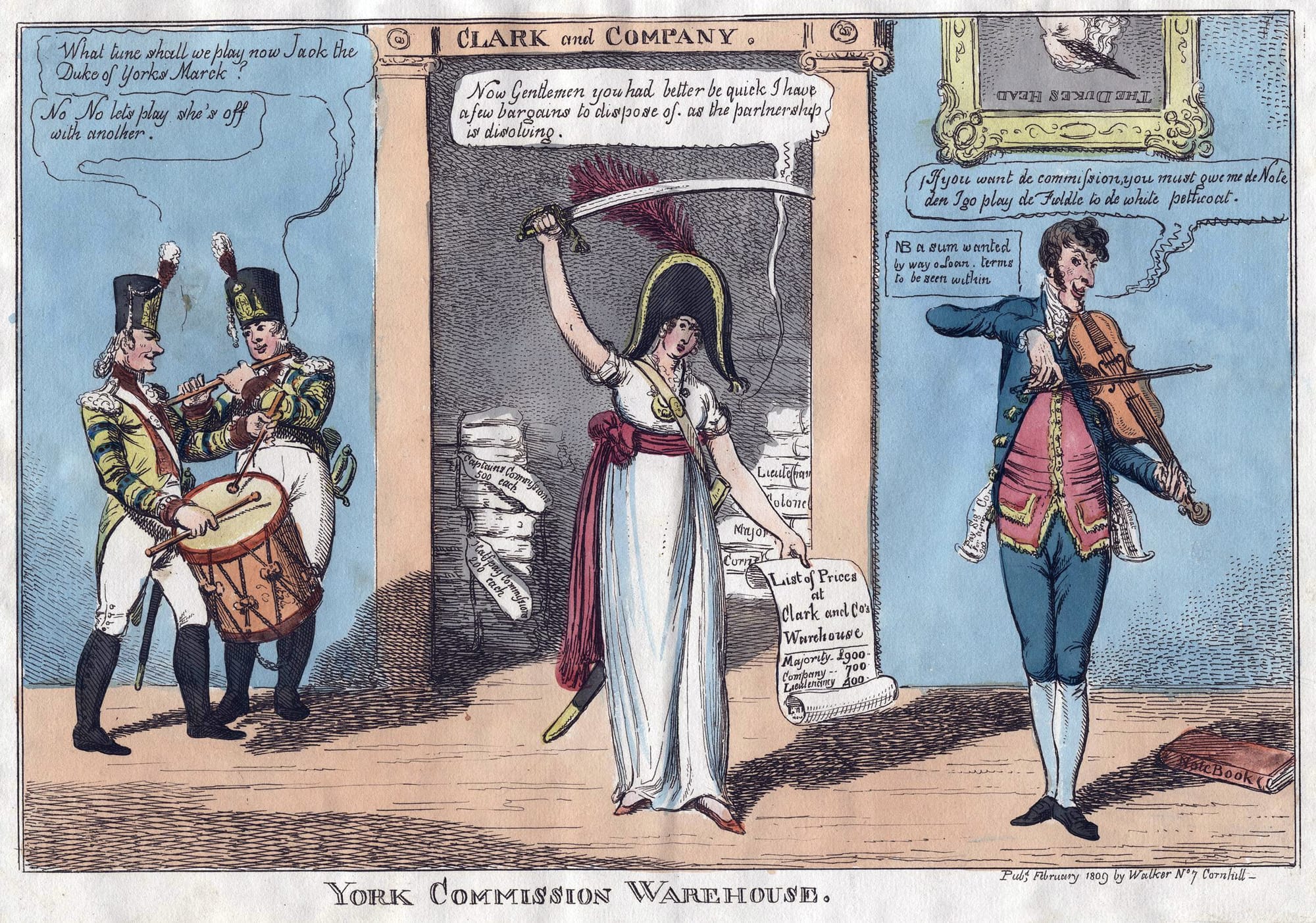
In March the story reached a climax when, having been found innocent of the main accusation against him, the Duke of York tendered his resignation as Commander-in-Chief of the British Army. By that point all London's print shops were ablaze with caricatures of the central participants in the tawdry and delicious drama.
This story – of the Duke of York, Colonel Wardle and Mary Anne Clarke – is the subject of the Travels Through Time podcast episode above. There the backdrop to the drama and the arc of the story is told, as ever, in three scenes •
📸 Dive into our Features
🎤 Read Interviews
🎧 Listen to Podcasts
🖼️ Buy fine art prints & more at our Store


;_Domenico_Corri)_by_C._Williams.jpg?ref=unseenhistories.com)