
D-Day: Nineteen Forty-Four – The Planning (Part 1 of 3)
In this special commemorative feature, nineteen historians tell the story of Operation Overlord, or D-Day, in forty-four images


Operation Overlord commenced in the early hours of 6 June 1944, a date that has forever afterwards been remembered as 'D-Day'.
Within a year of D-Day western Europe would be liberated, Nazi Germany would be defeated and Adolf Hitler would be dead.
In this three-part Viewfinder series, we asked nineteen expert historians to tell the story of Operation Overlord through forty-four specially selected images.
With contributions from Jordan Acosta, Mark Barnes, Greg Baughen, Ian Baxter, Taylor Downing, Stephen Fisher, Helen Fry, Peter Gibbs, Garrett M. Graff, Nick Hewitt, Tony Holmes, Damien Lewis, Peter Moore, Clare Mulley, John Henry Phillips, Anthony Tucker-Jones, Julie Wheelwright, Christian Wolmar and Stephen Wright
With curated and remastered images from the public archives by the Unseen Histories Studio


In the dark days of 1940, when it seemed as likely as not that Britain would succumb to the frightful power of the Nazi war machine, the prospect of a counter invasion of continental Europe was remote.
But after the opening of an eastern front in June 1941 and the entry of the United States of America into the war in December of that year, the Nazi hold on western Europe became far more precarious.
In the months and years that followed, the chances of an Allied invasion increased. A day of reckoning, it was clear to everyone, was approaching.
1/44
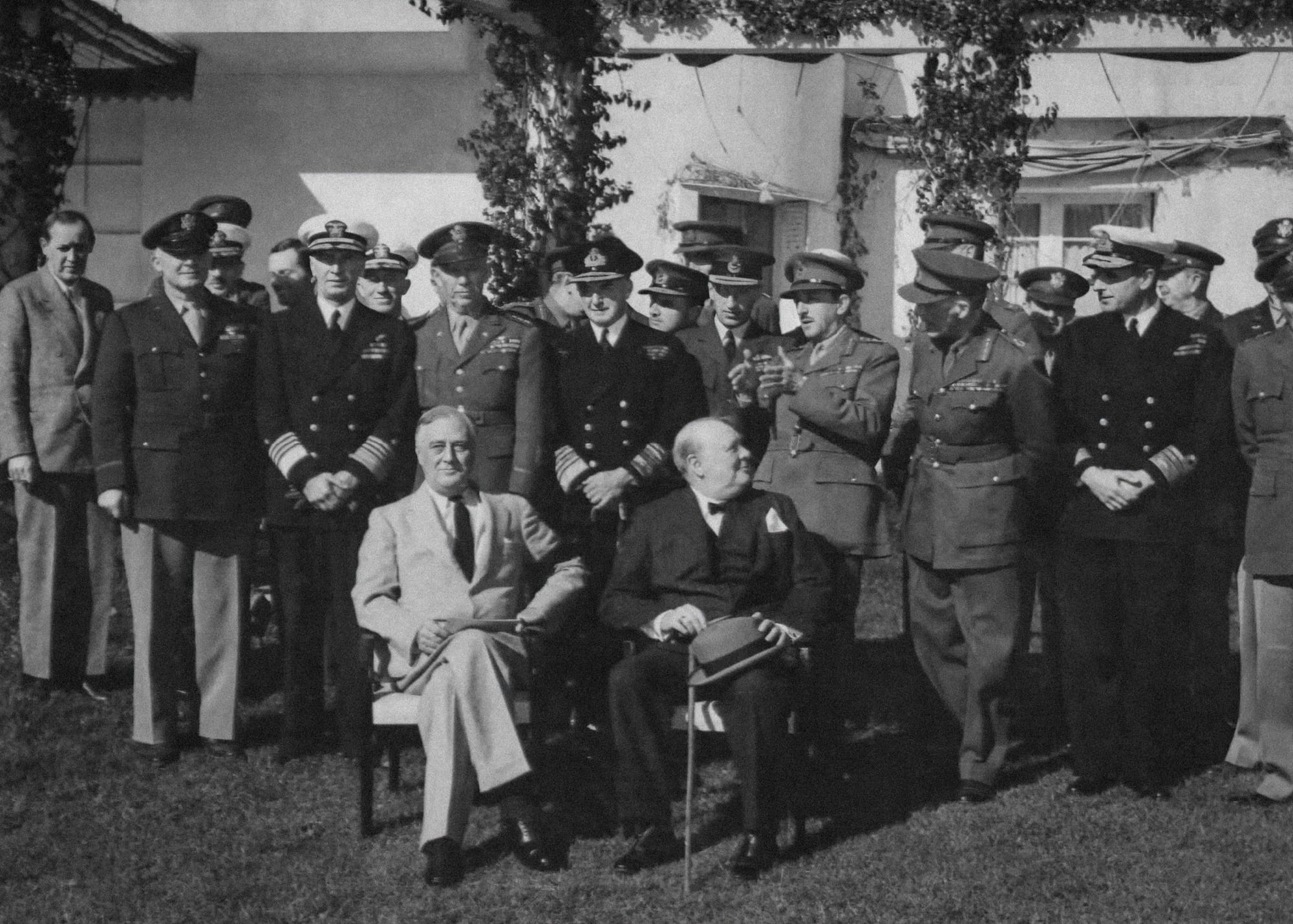
14 January 1943 – The Casablanca Conference
Taylor Downing: The British Prime Minister, Winston Churchill, and President Franklin Roosevelt got on wonderfully well in the warm sunshine of Casablanca for the famous Conference in January 1943. Of the many major decisions reached, the most momentous was the commitment to go ahead with an invasion of northern Europe sometime in spring 1944.
The photo records smiles all round but the conference revealed deep divisions between the US and British chiefs of staff. The American position was to start organising an invasion as soon as possible, preferably for 1943. The British argued that with no aerial supremacy and with the U-boats still powerful in the Atlantic, a cross-Channel invasion could be suicidal and the Allies should concentrate on the Mediterranean theatre. General Alan Brooke recorded days of bitter arguments between the two staffs in his diary. But neither side wanted to go back to their political leaders and report an impasse.
So, eventually a compromise was reached to start planning for 1944. Consequently, everyone looks happy.
2/44
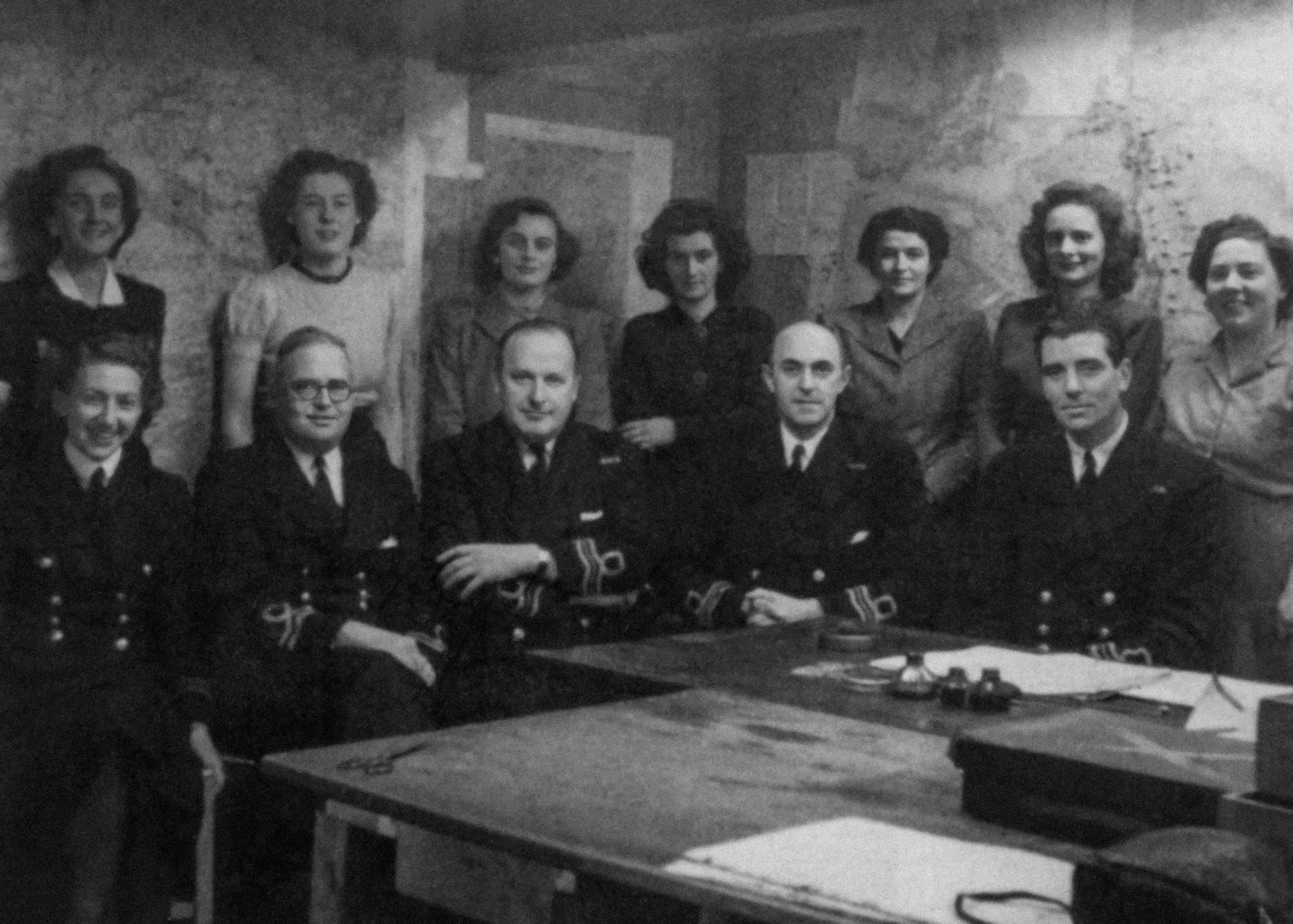
April 1943 – Operation Mincemeat
Helen Fry: In April 1943, long before the eventual invasion, British intelligence launched a major deception plan, codenamed Operation Mincemeat.
A dead body of ‘Major Martin’ in the uniform of the Royal Marines was floated off the coast of Spain, carrying fake invasion plans. It was planned by Section 17M of Naval Intelligence that had fourteen members, two-thirds of whom were women.
The Germans fell for the ruse and believed an invasion was about to happen in Greece and Sardinia, rather than Sicily. An appendix to a report on the operation ended with the words: ‘MINCEMEAT swallowed whole.’ Due to its success, it was believed possible to wrong foot the Germans again immediately ahead of D-Day in new deceptions under the umbrella of Operation Bodyguard. Deception was vital to protect D-Day and it led to German troops being held back in other areas of France; consequently, reducing the Allied losses and casualties during the landings.
3/44
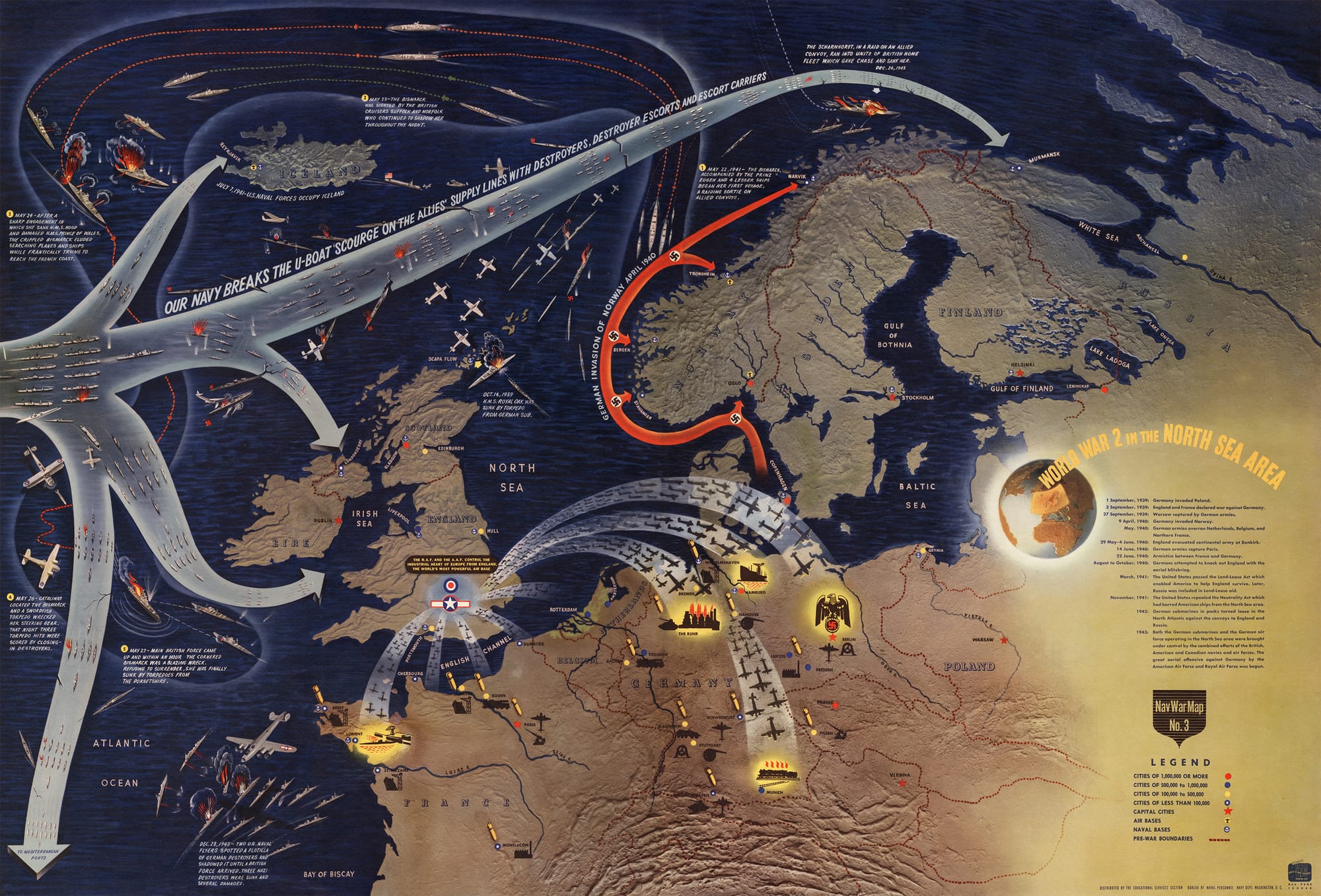
Early 1944 – World War 2 in the North Sea area
Peter Moore: This map was issued by the US Navy in the months before Operation Overlord. A stylish piece of political cartography, it related a rousing story about the Battle of the Atlantic with the tagline, ‘Our Navy Breaks The U-Boat Scourge On The Allies’ Supply Lines With Destroyers, Destroyer Escorts and Escort Carriers'.
To take a step backwards, however, is to see the broader narrative embedded within the artwork. Britain is presented as the crucible of power. Aircraft fly sorties over the Channel to France and, in greater numbers, they cross the North Sea to bomb the industrial towns of the Third Reich.
This map, which would have been displayed in soldiers’ barracks as a motivational device, engages with the idea that was gathering force in the early months of 1944. An invasion was coming. As a reporter for the New York Times described it, England had become a great warehouse full of equipment labelled “Europe.”’
4/44
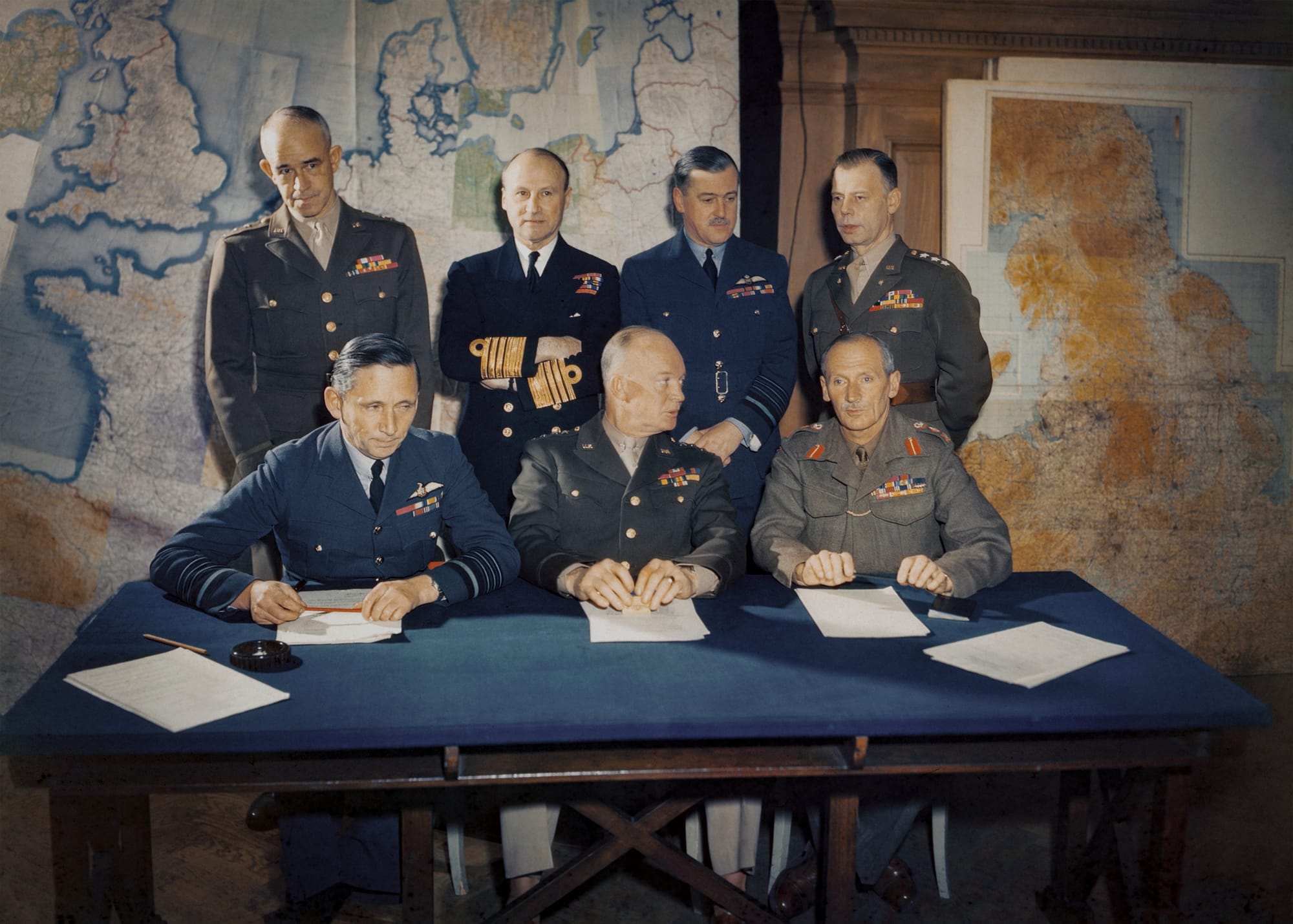
1 February 1944 – Invasion planning
Mark Barnes: This photograph shows the famous gathering of Operation Overlord top brass presented to the press at the headquarters of SHAEF (Supreme Headquarters Allied Expeditionary Force) at Norfolk House, London, on 1 February 1944.
General Dwight Eisenhower of the United States Army had arrived in London several weeks earlier to take command of what he would term the 'great crusade'. Initial planning for the invasion had begun in 1943, but the scale of intended operations had grown significantly under the auspices of British General Sir Bernard Montgomery in his role as land forces commander.
The men consented to pose sitting around a long table and as a group behind a desk. Each photographer managed to take three or four images. The expressions on the faces of some of the group betray a mixture of irritation and boredom; especially Deputy Supreme Commander Tedder, who seems to find it all a bit of a chore.
5/44
May 1944 – Addressing the Royal Ulster Rifles in Hampshire
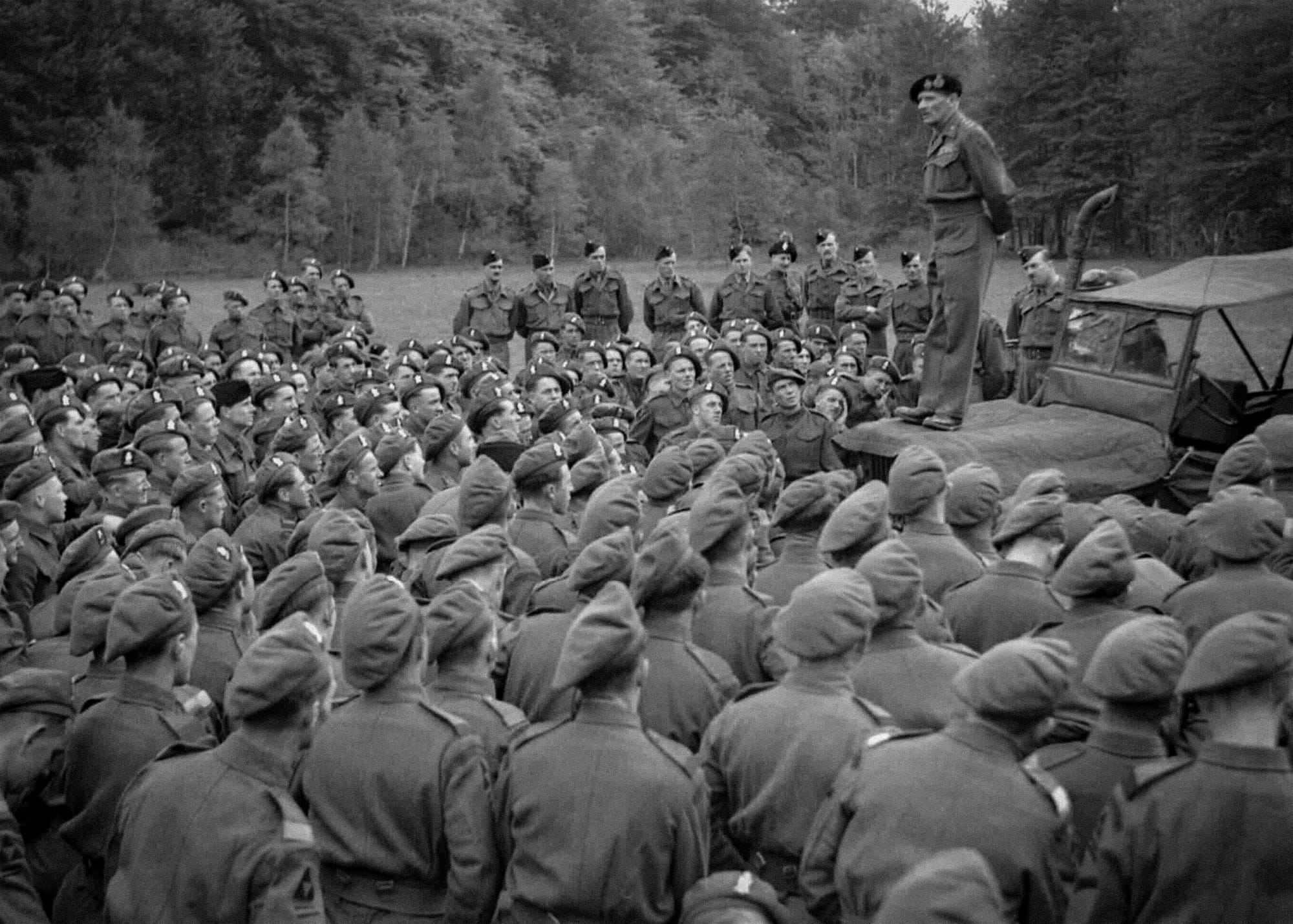
Peter Moore: Here General Sir Bernard Montgomery, who was appointed to lead all the land forces in Operation Overlord, can be seen speaking to the soldiers of the Royal Ulster Rifles from an improvised platform on the bonnet of a jeep. The force of Montgomery's personality can be gauged by total attention he commands.
Montgomery would later reflect on the importance of such informal meetings:
'When we were at home I had my British Army [and] the Canadian Army, and all the Americans, about two million, I went home, from the Eighth Army, and nobody knew me. And the soldiers said: 'Who is this guy Montgomery? We have heard of some chap in the desert who wears a beret with two badges on it, let us have a look at him'.
I knew this, so I decided, having formed the plan and got it working — got it going — I left it entirely to my staff. And I travelled England and Scotland, showing, talking to the soldiers, and I would talk to twenty thousand at one go. I would go and talk to them, from, standing on the bonnet of a jeep, with a loudspeaker, and then I would say, 'Now, come round me closer. Let's have a look at each other.'
They would all rush forward, and obviously, the general was swamped, but they liked it. And I think I can say that no man went across to Normandy who hadn't seen me and heard me speak.
I hoped, of course, I hoped that they would approve. Perhaps it was rather too much to hope. Anyhow I think they did approve really, in the end. They said, 'This guy looks alright'. They hadn't done any fighting, you see. They knew I had. They knew as far as battle was concerned, you see, I knew my stuff.' — Bernard Montgomery
6/44
15 May 1944 – The Thunderclap Conference, St Paul's School
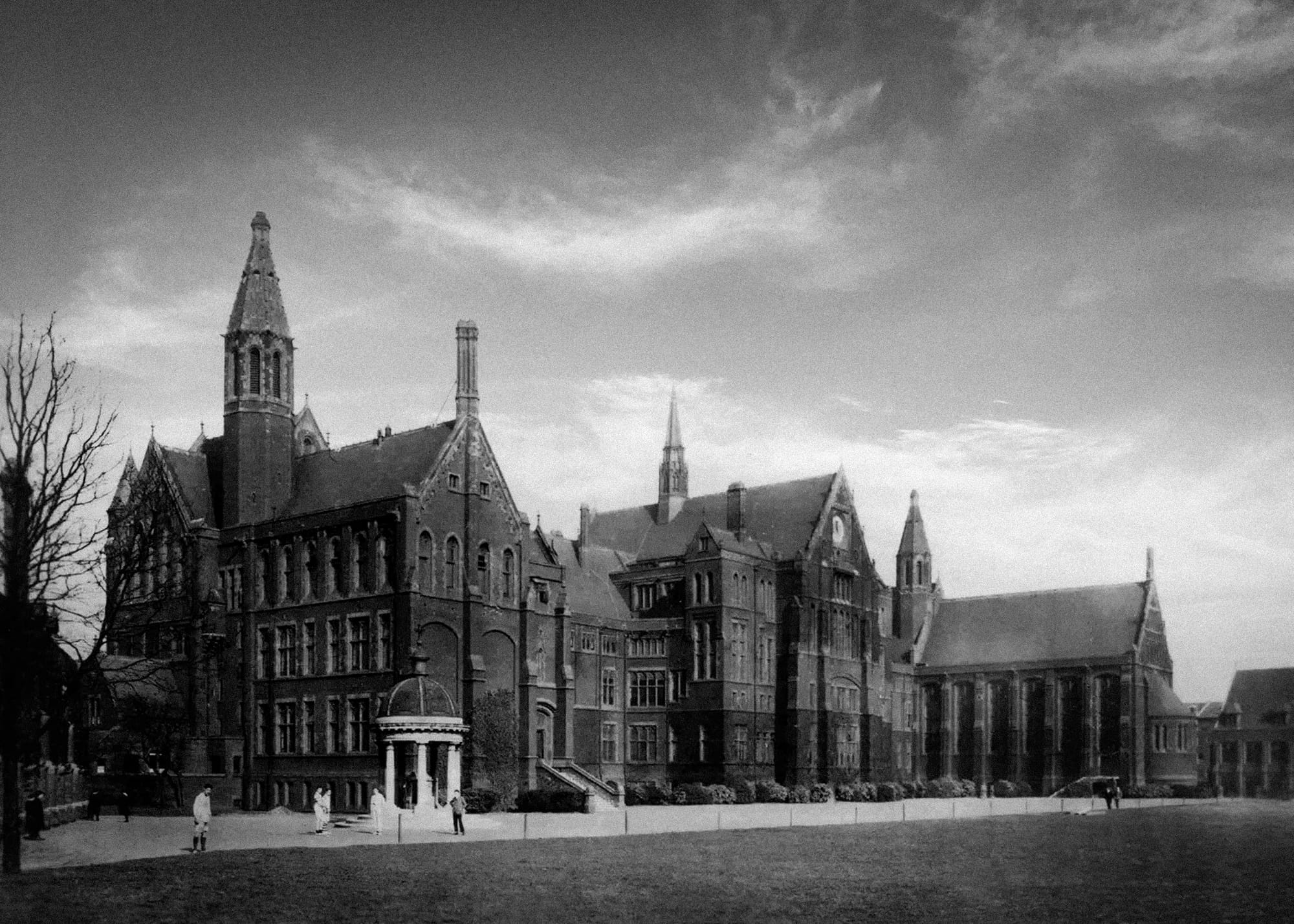
Peter Moore: As 6 June approached, the moment came for the secret military plans to be explained to the political and military establishments. In early May around 150 gilt edged invitations were sent to leading politicians and members of all the branches of the military. Each of the recipients were invited to attend a meeting at St Paul's School on Hammersmith, which is pictured in the photograph above.
15 May was a cold day for this unusual society event. In the front row sat Churchill and King George VI among a host of other dignitaries. Montgomery, who had been a pupil at the school many decades before, addressed his audience with the same blend of passion and conviction that he had perfected while speaking to the soldiers. He ran through every element of Operation Overlord as he expected it to play out.
The effect was powerful. King George — not a man given to public speaking — rose unprompted at the end and proclaimed the plans 'a wonderful undertaking'.
This meeting came to be known as the 'Thunderclap Conference'. It was significant for its subject matter, but also for the unique group of individuals it brought together. On 16 July 1944, just two months later, a German V-1 flying bomb landed just yards from St Paul's School, destroying the neighbouring St Mary's Church. Had such a strike occurred a little earlier, a dreadful calamity would have resulted.
7/44
May 1944 – German coastal defences
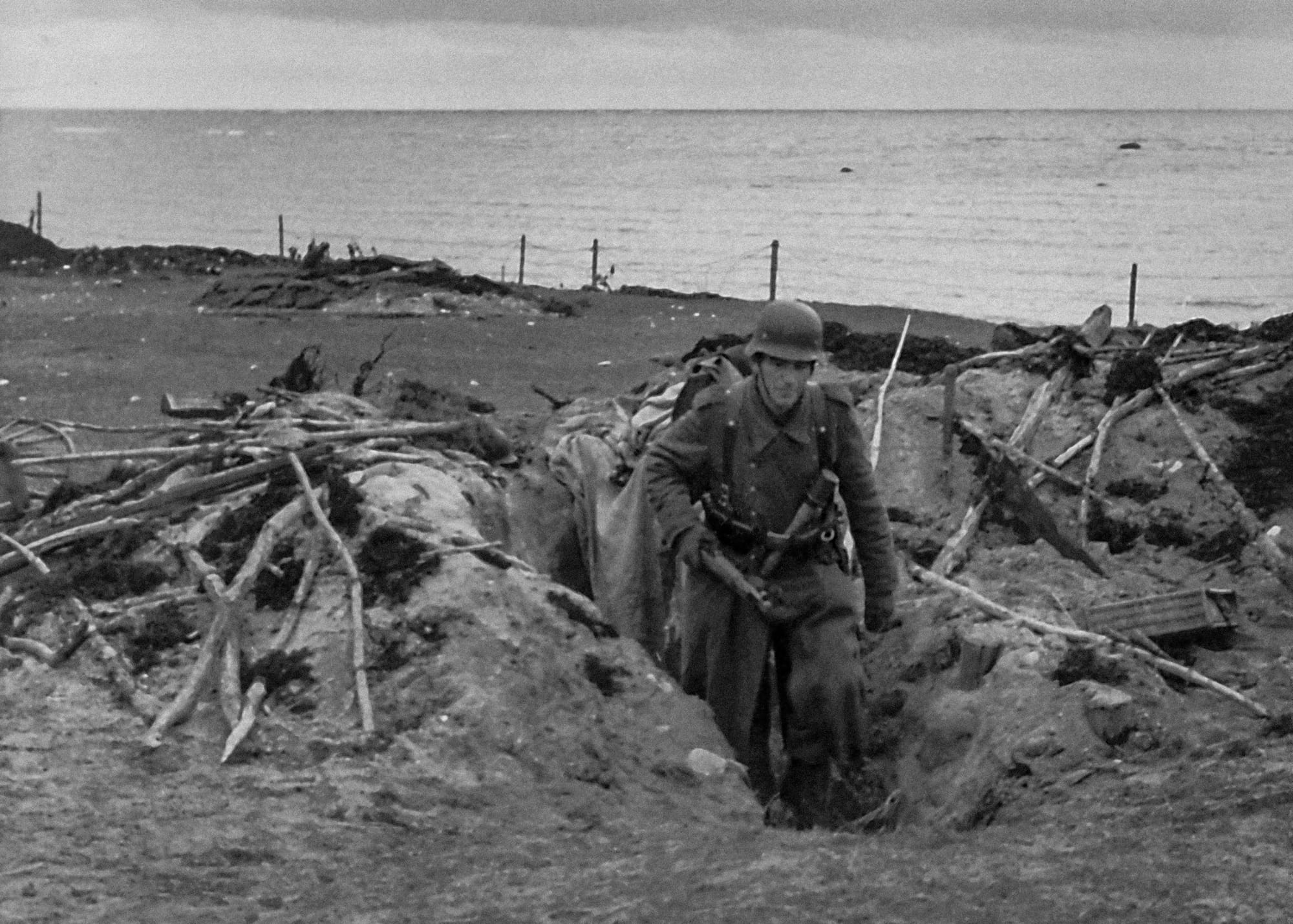
Ian Baxter: This photograph shows a German infantryman emerging from one of their fortified dugouts near positions overlooking the Channel coast between St Martin de Varreville and Azeville in Normandy.
This area would soon be known as Utah Beach by American forces belonging to the US VII Corps. Facing the invading Allied forces were two German battalions of the 919th Grenadier Regiment, which were part of the 709th Static Infantry Division. Although a high percentage of these static coastal truppen had hardly any combat experience, for a number of months prior to Operation Overlord, the soldiers were put through rigorous defence drills.
Many were trained with artillery, anti-tank, and machine gun exercises, while others remained on constant observational duties. On 6 June 1944 the 709th were heavily engaged defending the coastal area against the US 4th Infantry Division.
8/44
19 May 1944 – Pre-invasion bombing
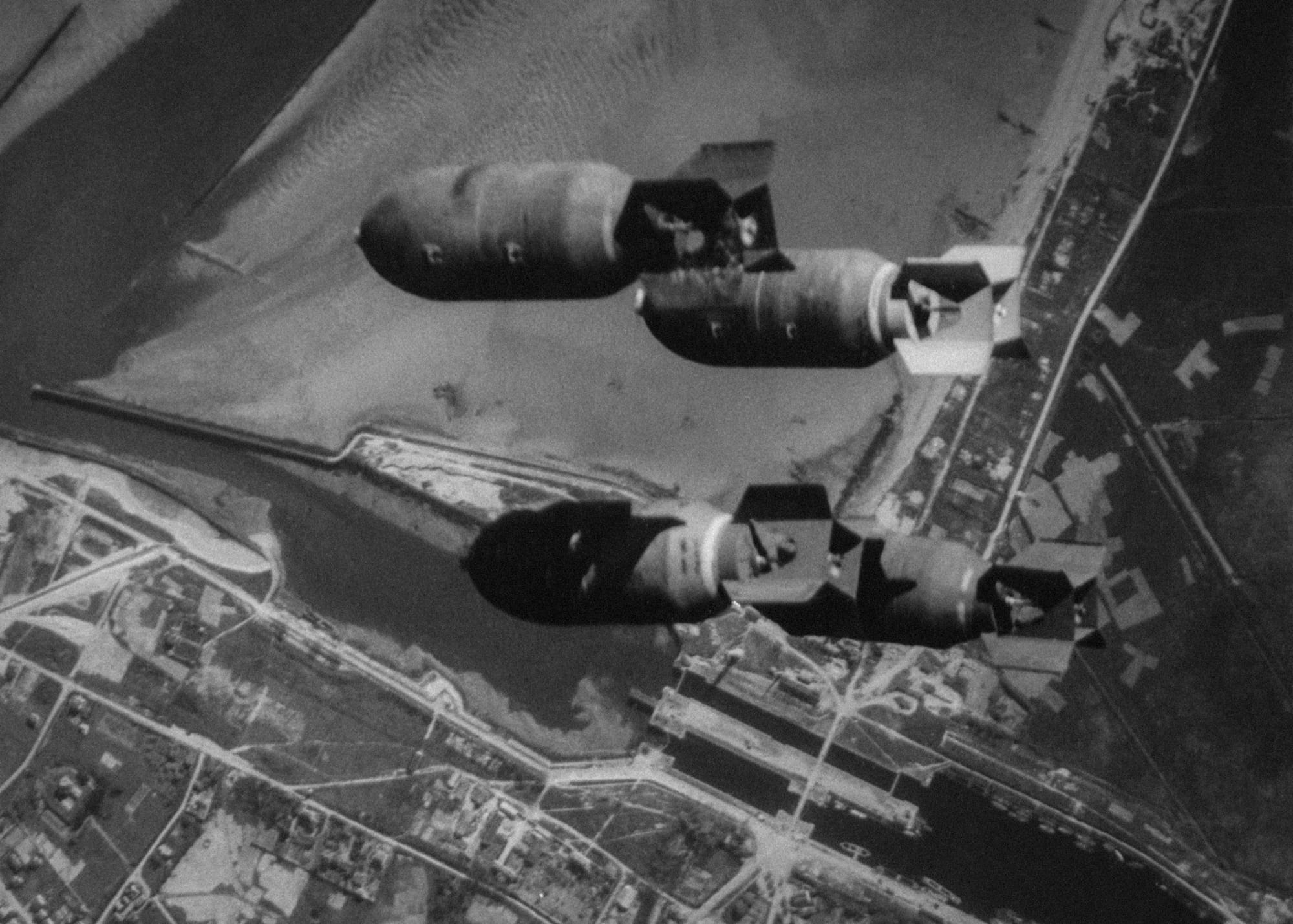
Stephen Fisher: Allied bombs fall over Ouistreham in Normandy. Although many targets on the beaches were attacked, preparatory bombing was carried out all along the French coast, so as not to make the landing area obvious to German intelligence.
Bombing Ouistreham was not without its risks. The lock gates at the mouth of the Caen Canal in Sword Area had been identified as a site of high importance. Control of the locks after D-Day would allow Allied vessels access to Ouistreham’s small port and to Caen docks, which would greatly help with the provision of supplies in the coming Normandy Campaign.
Fortunately the locks were not the target of these bombs, which instead are falling towards the neighbouring German coastal battery (codenamed 'Bass' by the Allies). The regular bombing eventually persuaded the Germans to withdraw the six 155mm guns from the battery until new enclosed casemates had been constructed to protect them. When 4 Commando attacked the site on D-Day they found that the gun pits were empty.
9/44
20 May 1944 – Dummy tank
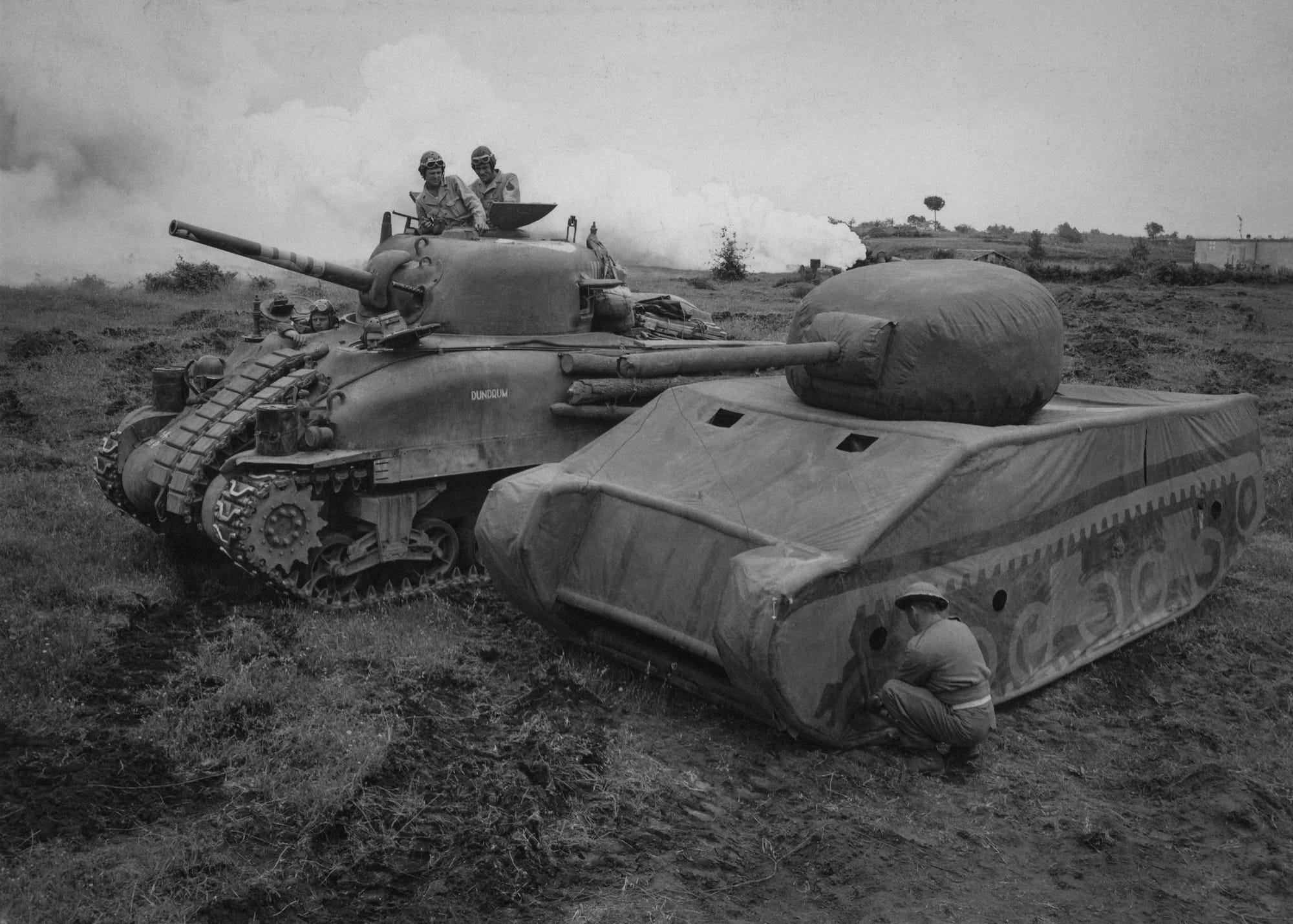
Taylor Downing: The crew of a real US Army Sherman look in amazement as they pass a dummy tank. These dummy tanks were produced in large numbers to be observed and photographed from the air by enemy reconnaissance aircraft. Often lined up in vast assembly areas, the dummies helped convince enemy intelligence that there were more armoured units available than there were in reality.
They were designed in Britain largely by film technicians who were used to creating totally artificial backdrops that looked real on camera. The designers, set builders and carpenters from Shepperton Studios to the west of London came up with many designs that were simple and cheap to produce but looked like the real thing from 20,000 feet.
The tanks were often made of rubber or canvas around a simple metal frame and could be inflated in about 20 minutes. They were light and could be carried by four men, whereas the real thing could weigh up to 30 tonnes! The dummy tanks were used extensively in Operation Fortitude, the great deception operation around D-Day.
10/44
Early June 1944 – James Stagg
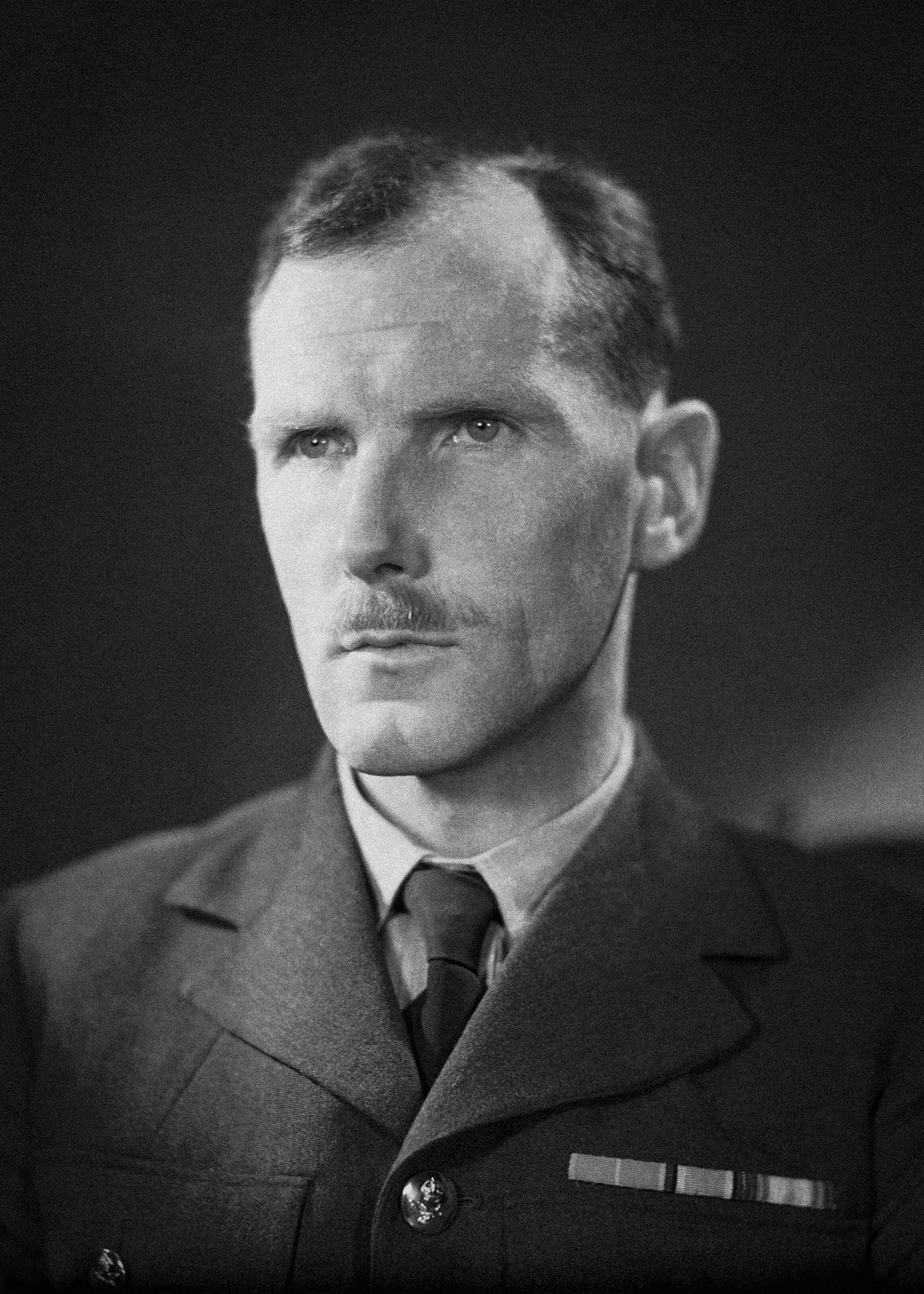
Peter Moore: The portrait above shows Group Captain James Stagg, who had been appointed chief meteorologist to SHAEF (Supreme Headquarters Allied Expeditionary Force) at the end of 1943. As D-Day approached, Stagg was to become a critical figure.
By 1944 more than eight decades had passed since the Meteorological (Met) Office had issued their very first predictions of weather for the day ahead. But no particular forecast in those years could compete in gravity with that which confronted Stagg in the first week of June.
The day for the landings had long been fixed for 5 June. That date would bring a full moon with its accompanying low tide and it was hoped that the first week of the meteorological summer would bring calm seas and settled skies. These would provide the ideal conditions for an amphibious assault.
To Stagg's consternation and general alarm of everyone involved in the planning of Operation Overlord, the weather in early June was deeply unsettled. With the huge mass of soldiers, support teams and equipment assembled on the south coast, Stagg was confronted with one of the great dilemmas in the history of science. Should he be the person to prevent the invasion from going ahead?
11/44
3-5 June 1944 – Extracts from James Stagg's diary
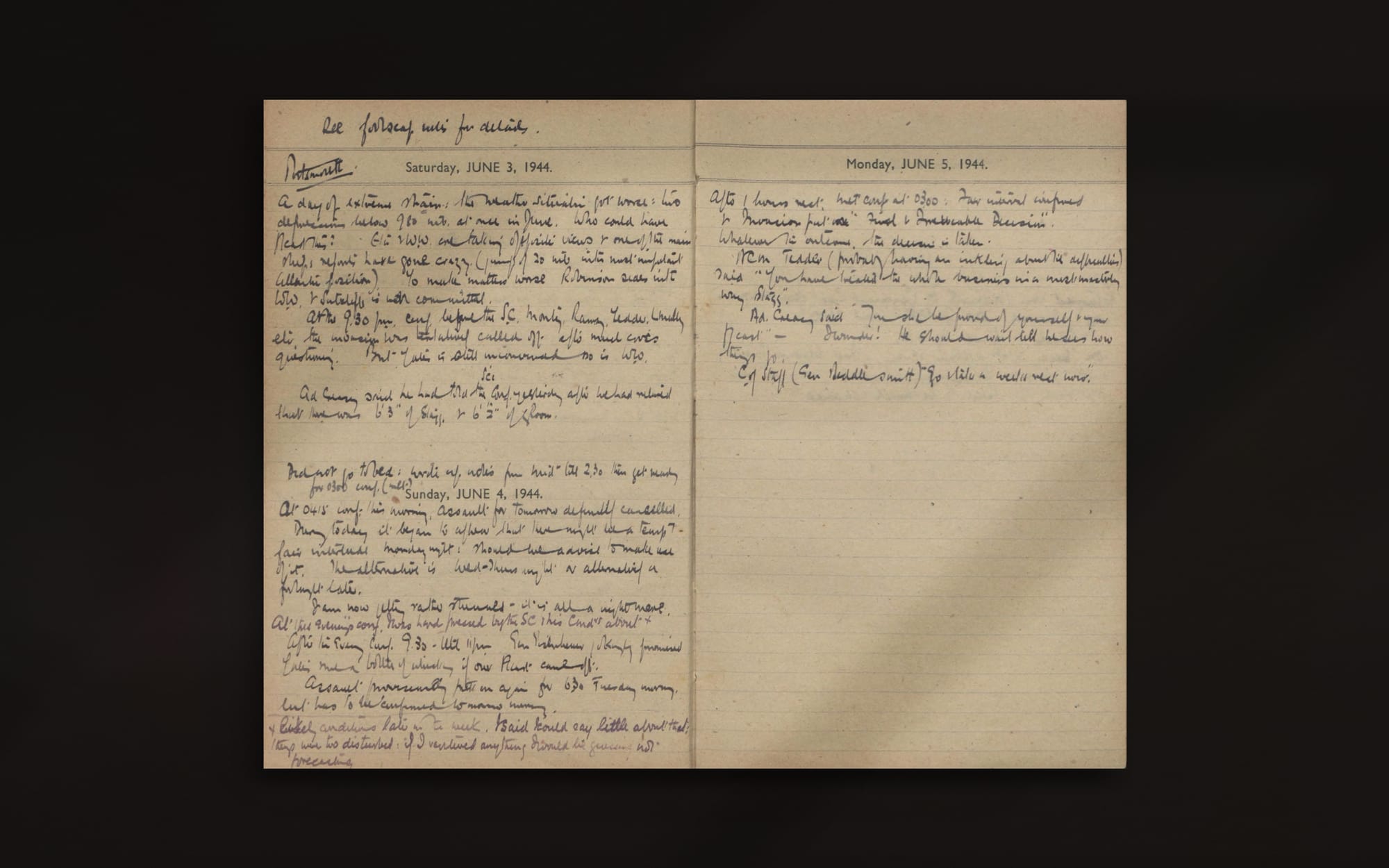
Saturday 3 June 1944
A day of extreme strain: the weather situation got worse: two depressions below 980mb at once in June. Who could have forecast this?
Eta [Air Ministry Weather Central] and W.W. [WideWing – the US Meteorological team] are taking opposite views and one of the main ships reports have gone crazy (jump of 20mb into most important Atlantic position) to make matters worse Robinson sides with W.W and Sutcliffe is non committal.
At the 9.30 p.m. conf. before the S.C. [Eisenhower , 'Supreme Commander'] Monty, Ramsey, Tedder, Leigh- Mallory etc. the invasion was tentatively called off after much cross questioning. But Yates is still unconvinced so is W.W.
Sunday 4 June 1944
At 0415 conf[erence] this morning, Assault for tomorrow definitely cancelled.
During today it began to appear that there might be a temporary fair interval Monday night: should we advise to make use of it. The alternative is Wed-Thurs night or alternatively a fortnight later.
I am now getting rather stunned – it is all a nightmare.
At this evenings conf I was hard pressed by the SC and his Commanders about * After the evening Conf 9.30 – until 11pm Gen Eisenhower jokingly promised Yates and me a bottle of whiskey if our forecast came off.
Assault provisionally put on again for 6.30 Tuesday morning but has to be confirmed tomorrow morning. likely conditions later in the week. I said I could say little about that.
Monday 5 June 1944
After 1 hours rest Met Conf at 0300: Fair interval confirmed and Invasion put on ‘Final and Irrevocable Decision’. Whatever the outcome the decision is taken.
ACM Tedder (probably having an inkling about the difficulties) said ‘You have treated the whole business in a most masterly way Stagg.'
Ad. Creasy said 'You should be proud of yourself and your forecast' – I wonder. He should wait till he sees how things go.
12/44
5 June 1944 – A BBC Weather forecaster reflects on the dilemma
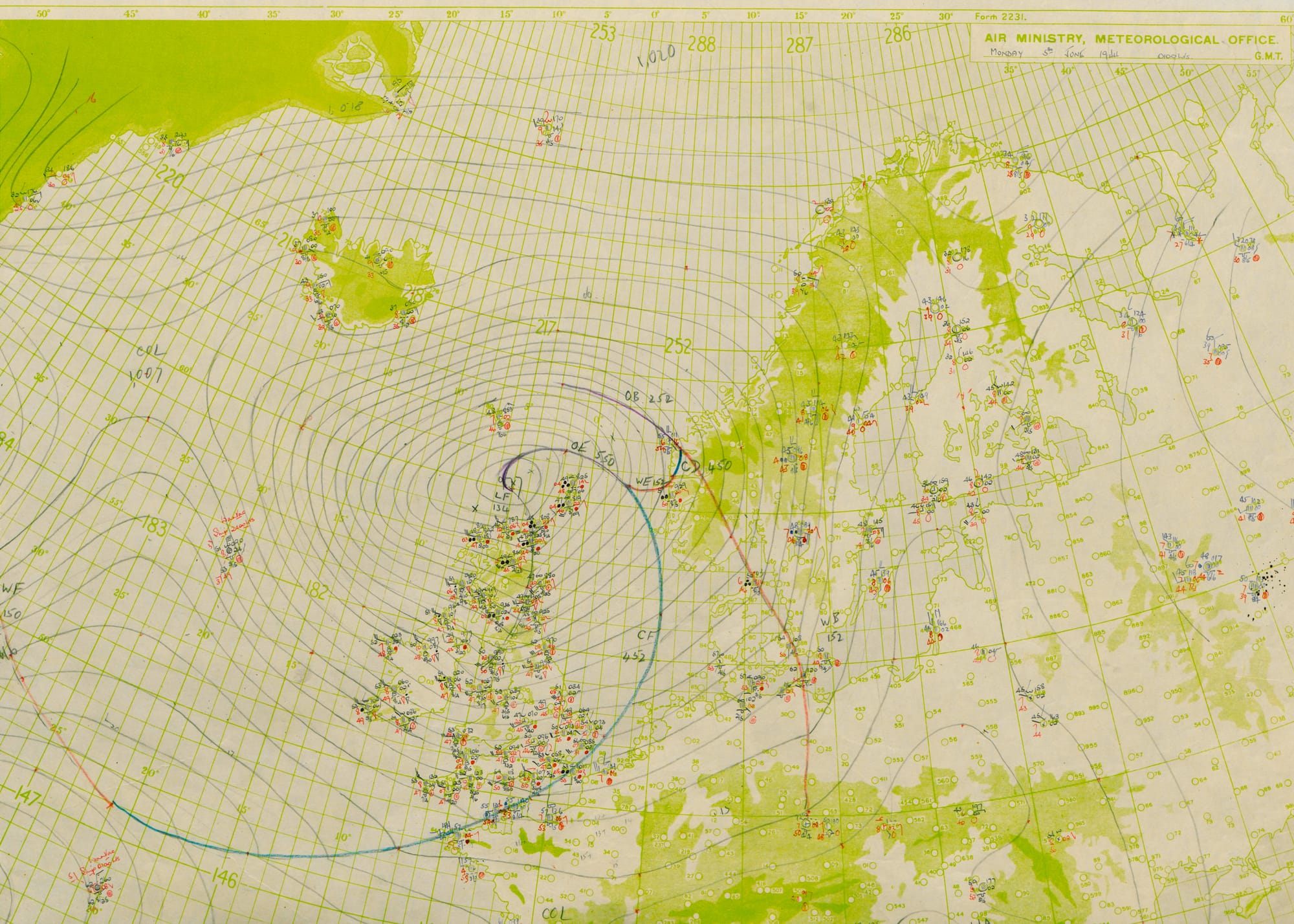
Peter Gibbs: I feel an immediate connection to the meteorologists who drew up this chart from 5 June 1944. As a forecaster starting my career 40 years after Stagg I was drawing those same pencil lines around hand-plotted inked observations decoded from a teleprinter printout.
What you need as a weather forecaster is an ability to analyse the weather upstream of your area of interest, so it's the observations in the direction the weather is coming from, in this case the west, which are the really important ones. That big hole in information over occupied Europe looks alarming at first sight, but it doesn't actually hamper the process too much. That's the weather that's already been and gone.
The thing that ramps up the stress, makes this such a tough call, is that all the predicted weather factors (wind speed, wave height, visibility, cloud cover) are right on the specified go/no go limits for the air and sea operations. It's every forecaster's nightmare. Just a small error in predicting the speed of movement, position and intensity of the area of low pressure to the north of Scotland and the transient ridge of high pressure following in from the Atlantic will tighten up or ease the isobars and tip the balance either way. It is an incredibly difficult call.
It would be so much simpler if there was a big, obvious storm barrelling in from the west — 'Sorry General, no go'. Or a big fat anticyclone sitting happily over southern England and the Channel — 'Yes General, green light'. But no, it's right on the cusp.
13/44
5 June 1944 – James Rudder's Rangers
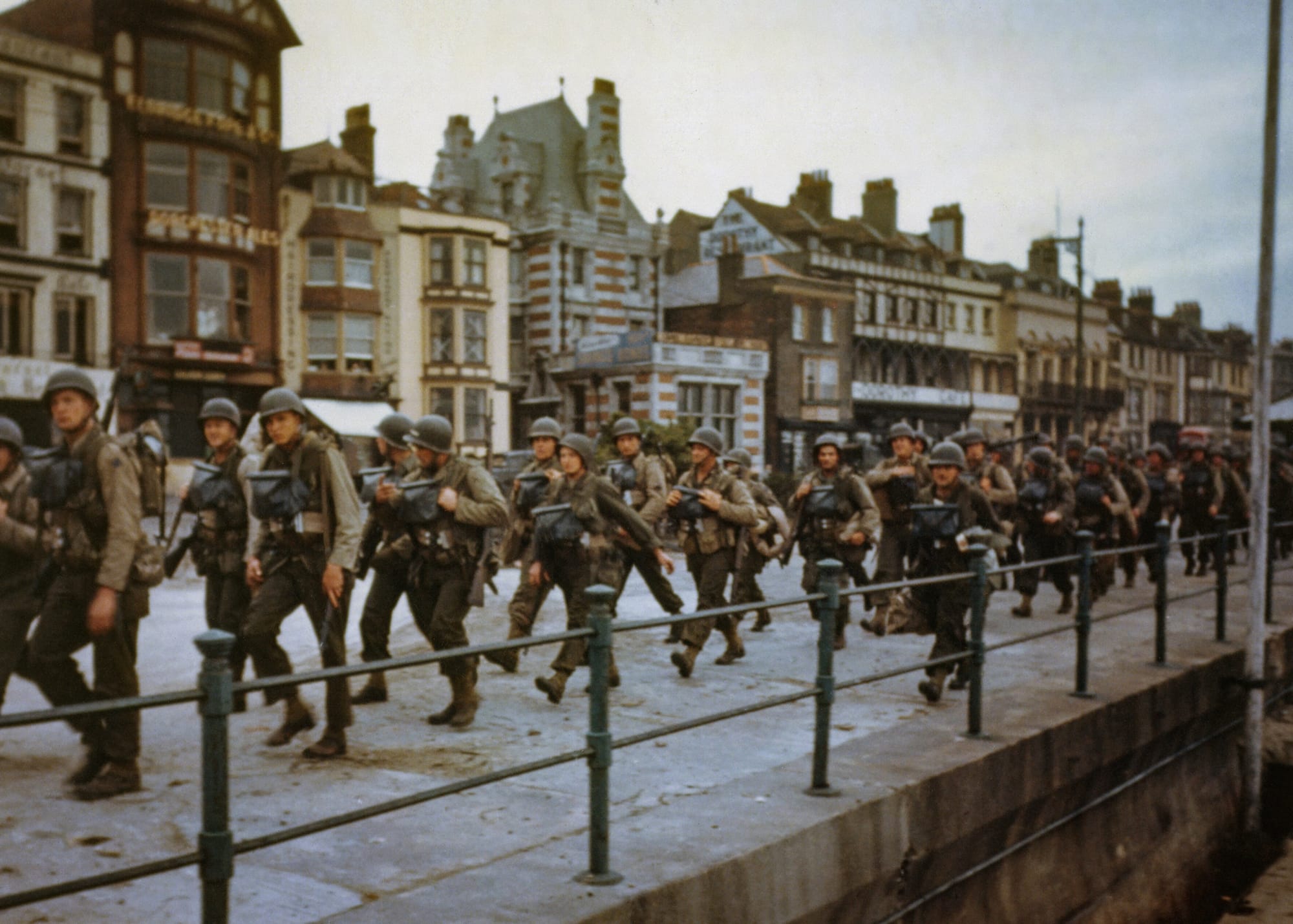
Mark Barnes: Men of Lieutenant Colonel James E Rudder's 2nd Ranger Battalion march along the seafront at Weymouth, having travelled a few miles from their staging area at Broadmayne.
These soldiers were sent to scale the cliffs at Pointe du Hoc in Normandy. The aim was to neutralise a German artillery battery that had guns ranging along Utah Beach. Rudder had convinced superiors that a direct assault by troops was the only way to ensure the guns would be destroyed. To add insult to injury, the guns had been moved some distance away but they were found and either destroyed or disabled by patrols of rangers sent out from Pointe du Hoc.
The assault would prove costly in terms of casualties. It gave Rudder and his men, however, a hallowed place in D-Day mythology. The remains of casemates and other fortifications at the site are a much visited attraction for Normandy pilgrims today.
14/44
5 June 1944 – The staging grounds
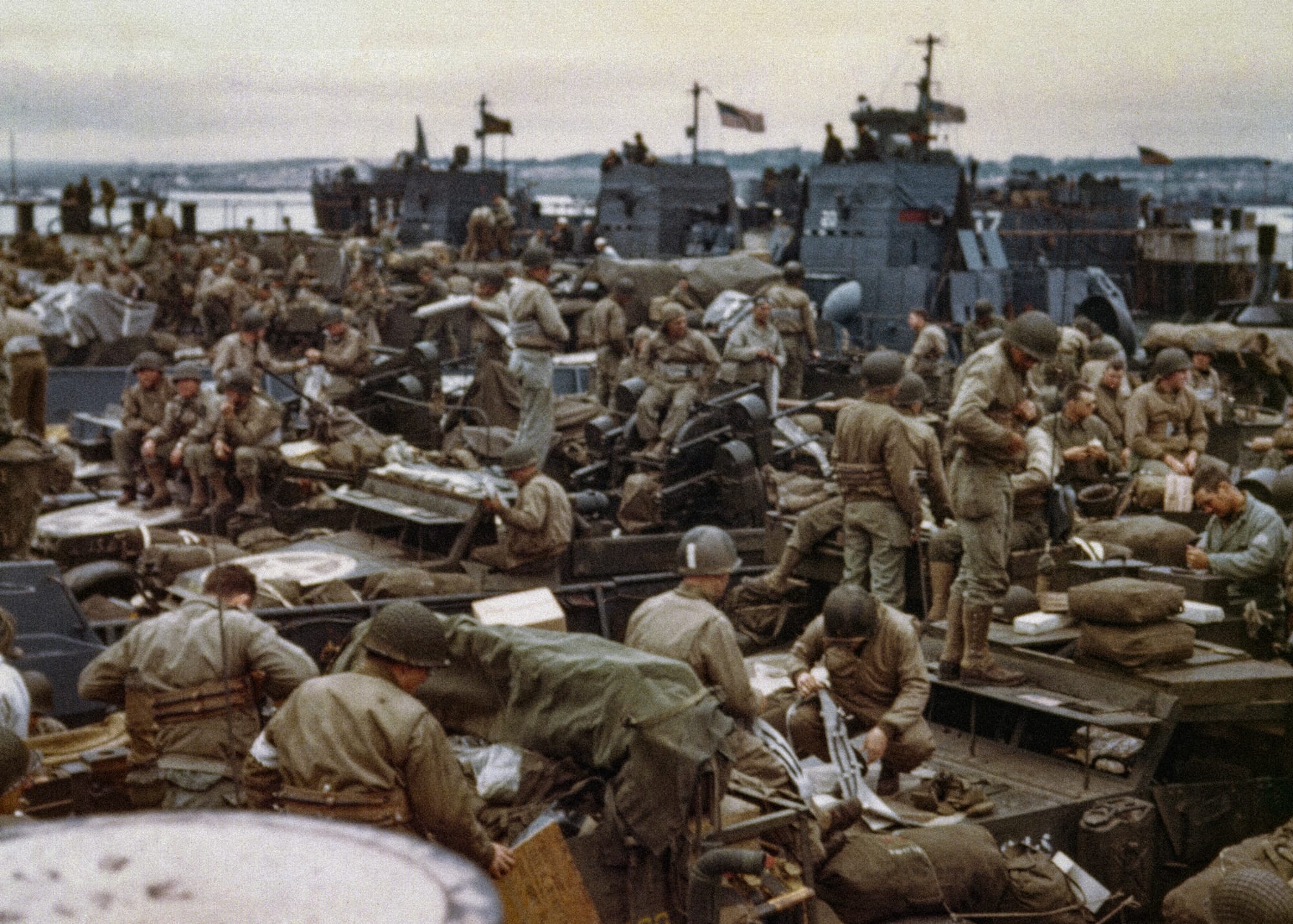
Peter Moore: The scores of soldiers in this photograph, all of them busy and filled with nervous anticipation for what lay ahead, suggest the human scale of Operation Overlord.
Never before in British history had there been such a dramatic influx of outsiders. Beginning in January 1942, American military personnel had started to arrive at ports like Portsmouth and Liverpool. As the months and years passed their numbers rose with increasing rapidity. By the eve of the invasion in May 1944, about 1.6 million GIs were stationed in Britain.
With them the soldiers brought a new level of racial (there were 130,000 black troops) and cultural diversity to Britain. The troops were very young too, with most of them aged beneath twenty-five. These youthful GIs — chewing gum, with their generous chocolate rations, 'overpaid, oversexed and over here' —would leave an enduring impression on many Britons, along with an estimated 9,000 babies.
15/44
5 June 1944 – The SAS and Operation Lost
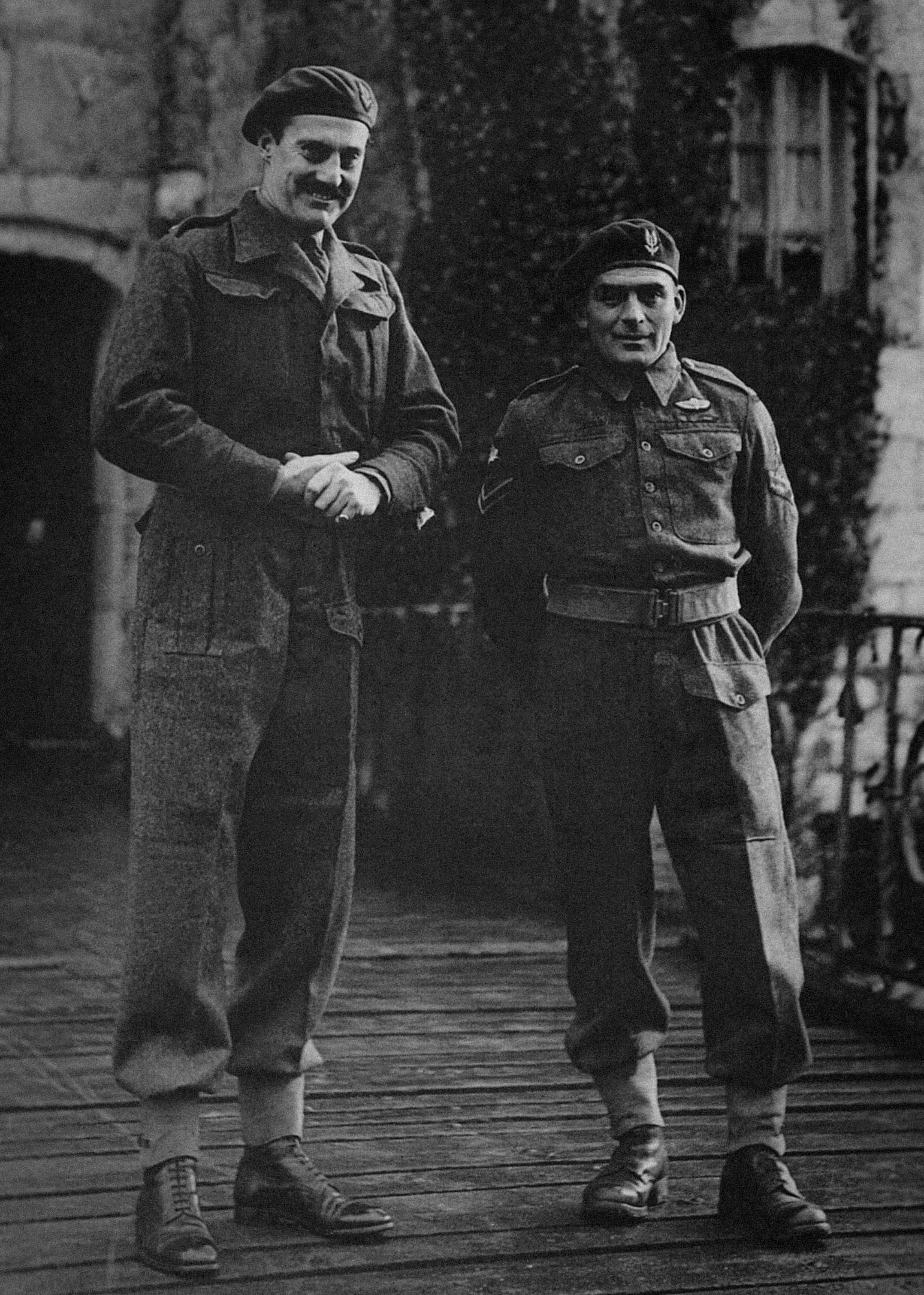
Damien Lewis: In the hours prior to D-Day, one squadron of Special Air Service warriors parachuted into Brittany, north west France, charged to spread chaos and mayhem behind enemy lines.
So successful were they, the Germans sent thousands of troops to hunt them down. After an epic battle, that entire SAS squadron went silent - reported as 'missing in action' (MIA). Hence SAS Major Oswald Cary-Elwes, who is pictured above with his ever-faithful batman, Corporal Eric Mills, were parachuted into Brittany on the aptly named Operation Lost on 22 June, to track down and discover the fate of the missing squadron.
Over the coming days they did just that and were handed maps and reports revealing the enemy strengths and defences at St Malo, the key port on the Brittany coast. As Allied commanders were planning a Second D-Day — a landing directly into a port like St Malo — Cary-Elwes and Mills were ordered to slip the enemy net, to bring that priceless intelligence back to British shores.
So began one of the most epic escape and evasions of WWII.
16/44
5 June 1944, 1800 hrs – Order of the Day
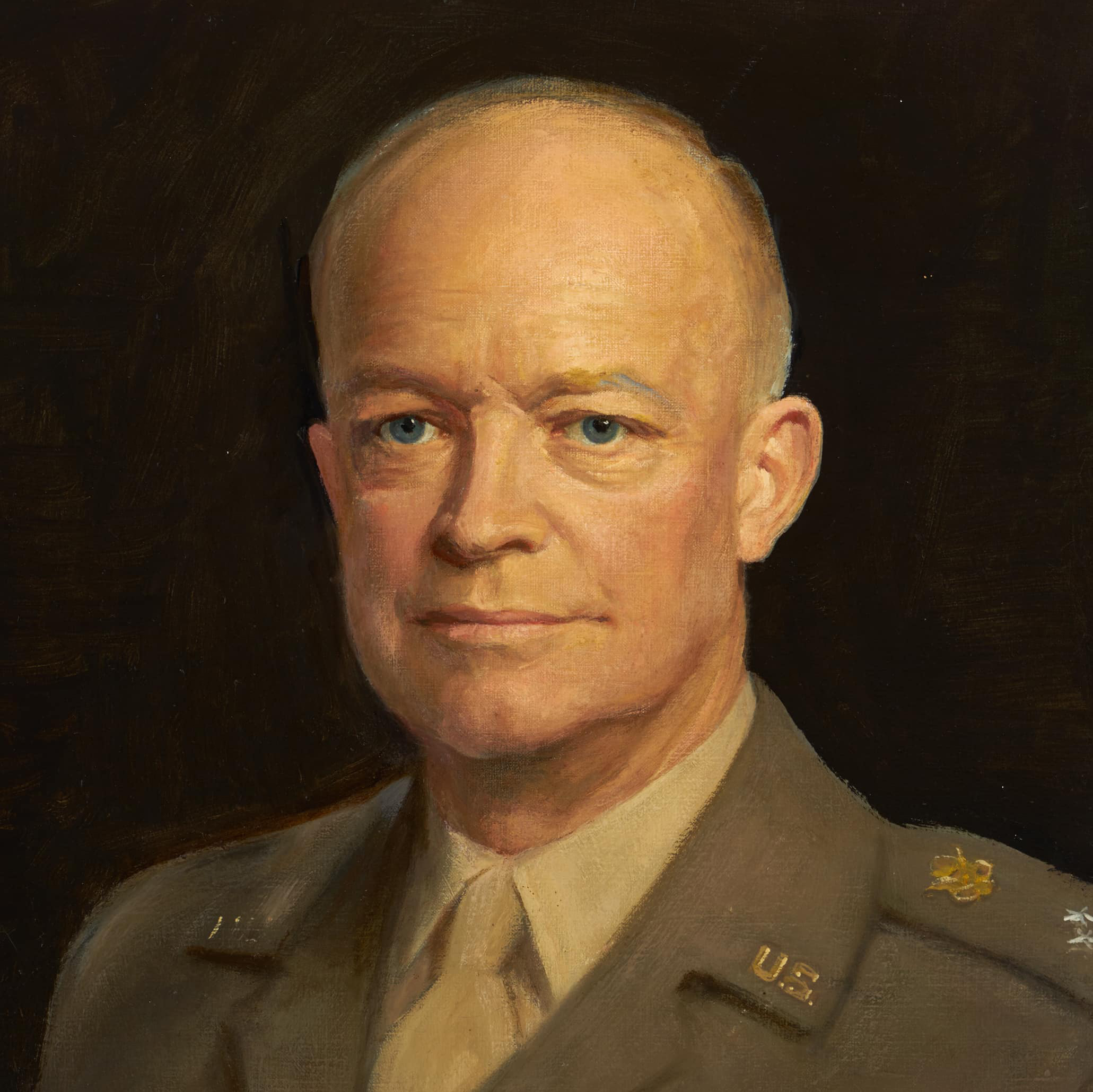
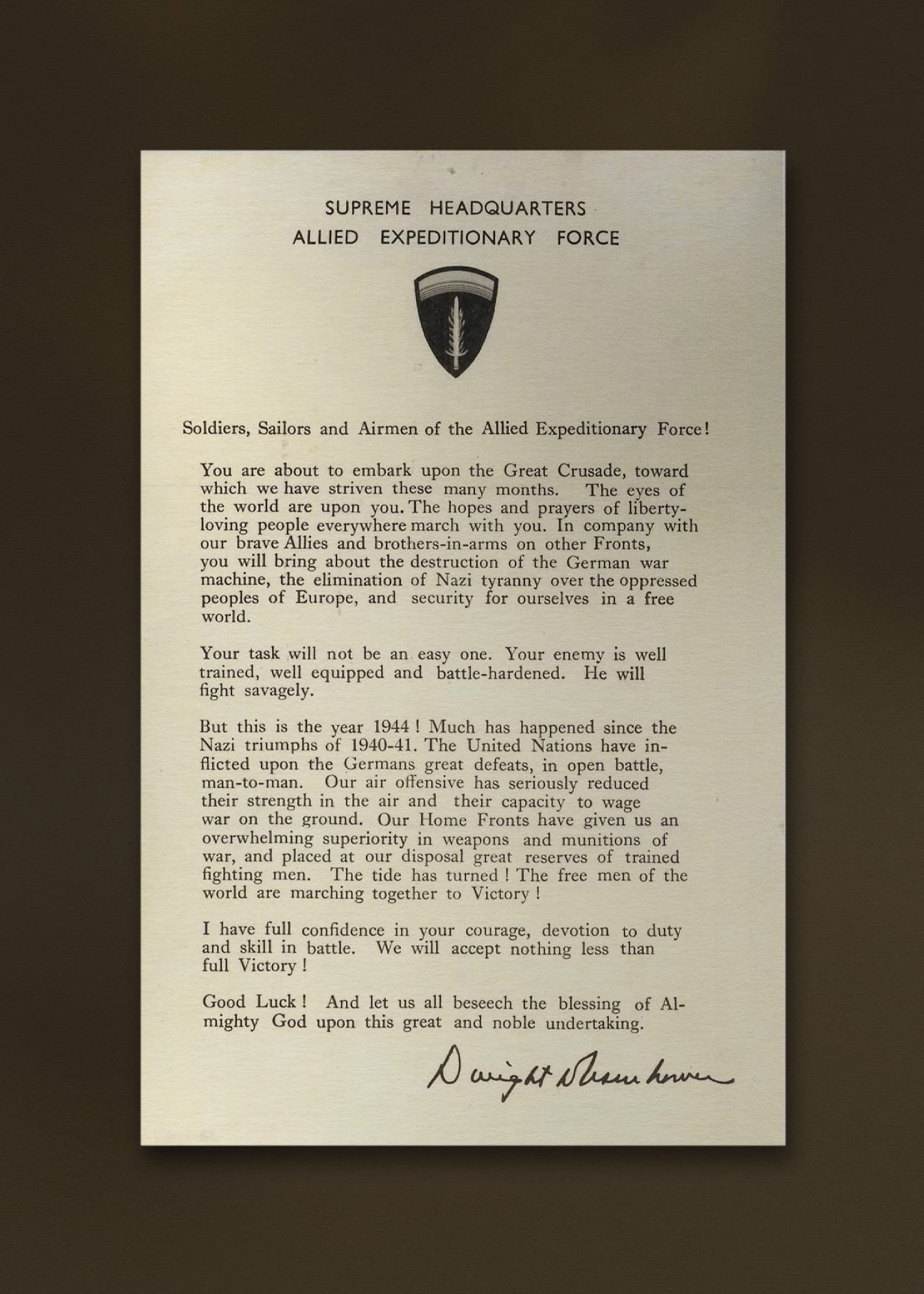
Jordan Acosta: On the eve of the fifth, General Eisenhower’s 'Order of the Day' was distributed to 175,000 members of the Allied Expeditionary Force. It emphasised the invasion’s vital importance, calling it a ‘Great Crusade ... to bring about the destruction of the German war machine.’ The Supreme Headquarters would ‘accept nothing less than full victory’, a promise Eisenhower pre-recorded for radio broadcast after the attack had begun.
What is less known is Eisenhower’s other note, which was drafted for release in the event that the invasion stalled. This ran, ‘Our landings in the Cherbourg-Havre area have failed to gain a satisfactory foothold and I have withdrawn the troops’. In this draft Eisenhower took personal responsibility for the outcome, replacing the phrase ‘This particular operation’, with the following explanation:
‘My decision to attack at this time and place was based upon the information available. The troops, the air and the Navy did all that bravery and devotion to duty could do. If any blame or fault attaches to the attempt it is mine alone.’
In his haste, Eisenhower mistakenly dated the note 5 July.
17/44
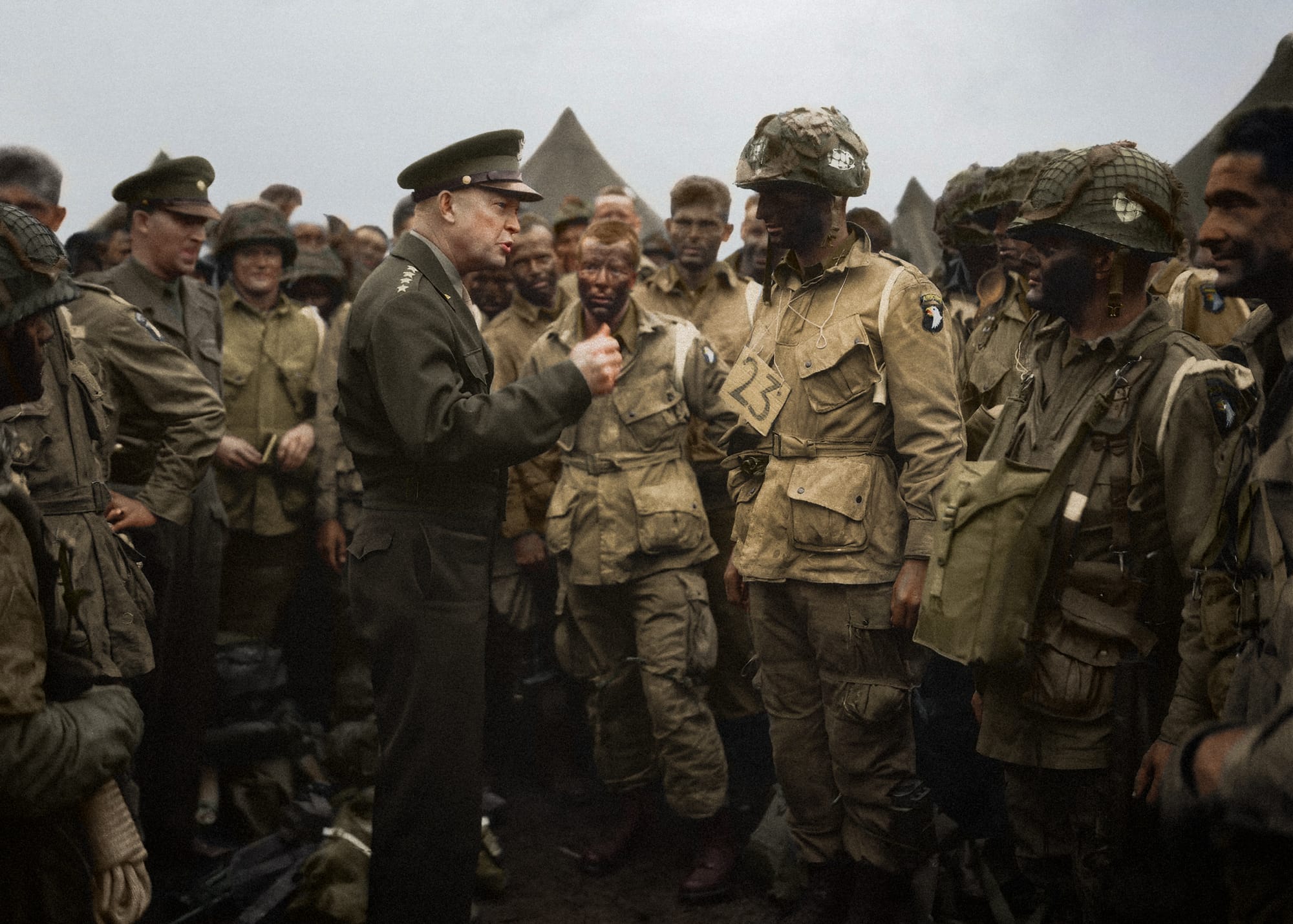
5 June 1944, 2030 hrs – The eyes of the world are upon you
Jordan Acosta: General Eisenhower meets troopers of the 502nd Parachute Infantry Regiment on the eve of the invasion. ‘Ike’, as Eisenhower was known, is captured conversing with 1st Lieutenant Wallace C. Strobel on his 22nd birthday. The 23 sign around Strobel's neck marks him out as 'jumpmaster' of plane #23.
In Strobel's own words: ‘We had darkened our faces and hands with burned cork, cocoa and cooking oil to be able to blend into the darkness and prevent reflection from the moon ... As [Eisenhower] came toward our group we straightened up and suddenly he came directly toward me ... he asked my name and which state I was from. I gave him my name and that I was from Michigan. He then said, “Oh yes, Michigan’s great fishing there. Been there several times and like it.”’
Eisenhower would later tell his chauffeur Kay Summersby, ‘It’s very hard to look a soldier in the eye, when you fear that you are sending him to his death.’ Strobel was one of nearly 800 soldiers jumping into Normandy. Only 129 survived in the hours and days which followed, though Strobel would live to the age of 77.
This photograph has been restored and colorized from an original black and white digital scan by the Unseen Histories Studio.
This Viewfinder feature was originally published June 6, 2024 on the 80th anniversary of the D-Day landings.
More

D-Day: Nineteen Forty-Four – The Invasion (Part 2 of 3)
After the twenty-four hour delay due to bad weather, acting on Group Captain Stagg's forecast, the invasion finally began at dawn on 6 June. As the sun rose on a murky June morning, the Allied forces advanced towards the concrete architecture and barbed wire of the Nazi Atlantic Wall.
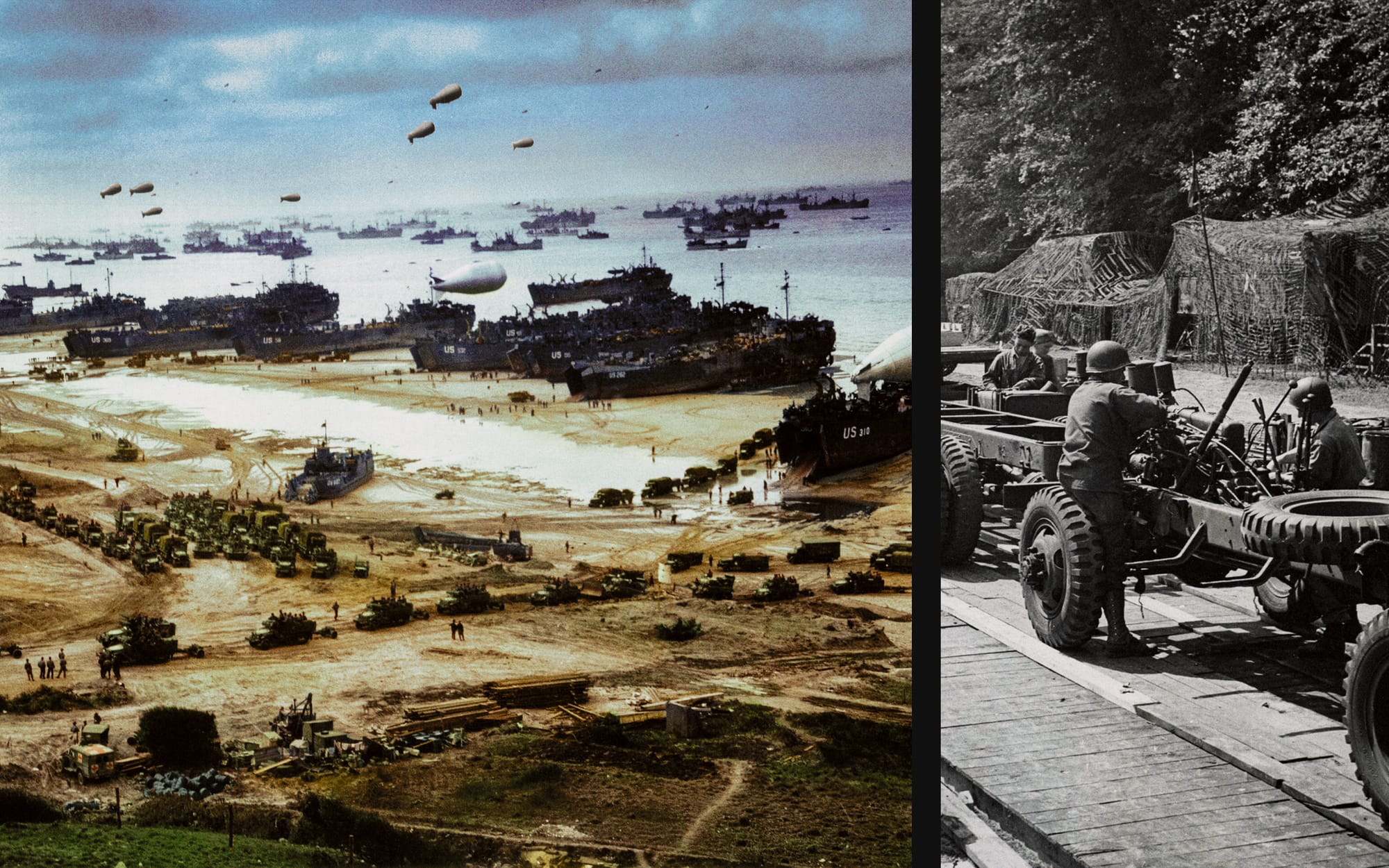
D-Day: Nineteen Forty-Four – The Aftermath (Part 3 of 3)
For all the immense challenges, D-Day had turned out to be an unquestionable success. But at sunset that evening, the Allies were left with the sobering reflection that all they had achieved so far was the merest toehold in a small part of one coastline of northern France. Another desperate phase of the war lay ahead.
About this Feature
D-Day: Nineteen Forty-Four was an ambitious endeavour to collate and publish in time for the 80th anniversary of D-Day for June 6, 2024, and would simply not have been possible without the aid and expertise of our contributors.
We have created a list of their books on Bookshop.org, so please do give them your support. You can also support Unseen Histories by their purchasing books via the links, from which we will receive a small commission; or buy a collectible WW2 fine art print from the Unseen Histories Store, hand-printed in England and individually finished with a monogram emboss.
Thank you very much for reading •
Special thanks to the many publicists and publishers who helped us contact our contributors.
📸 Dive into our Features
🎤 Read Interviews
🎧 Listen to Podcasts
🖼️ Buy fine art prints & more at our Store


-_D-day_6_June_1944-_Personalities_CH14235.jpg?ref=unseen-histories.ghost.io)